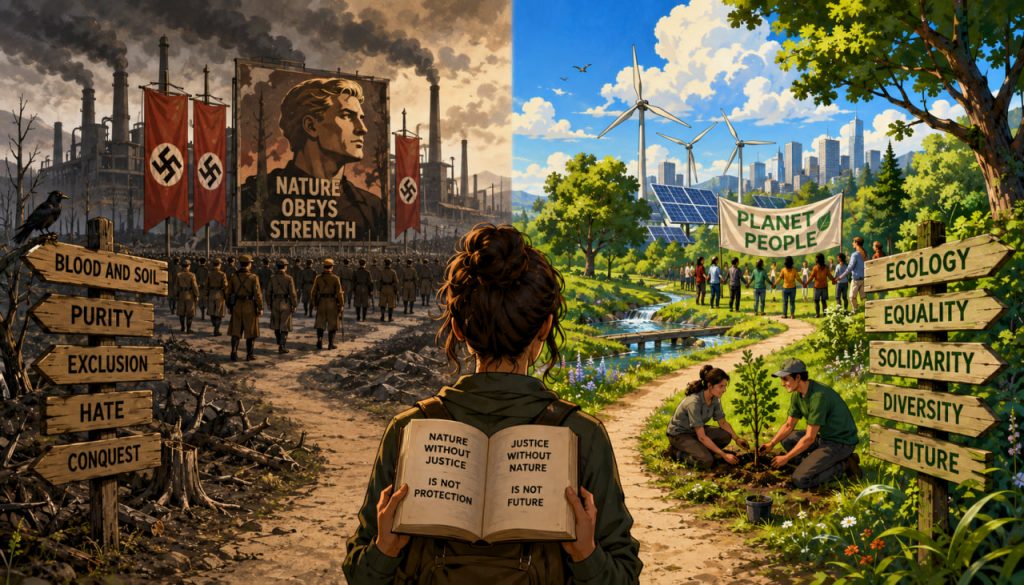
Eco-fascism is one of the darkest examples of how environmental language can be twisted into authoritarian, racist, and violent politics. At first, nature protection may seem automatically humane. Clean rivers, healthy forests, animal conservation, and respect for land sound positive. But history shows that green ideas can become dangerous when they are separated from human rights, democracy, and equality.
Nazi Germany did not invent environmental concern. German-speaking Europe already had strong traditions of nature protection, rural romanticism, anti-urban thinking, animal welfare debates, organic farming, and “homeland” landscape preservation before Hitler came to power. The Nazi regime absorbed parts of those traditions and fused them with nationalism, racial ideology, expansionism, and state control.
This history matters because modern environmentalism faces real crises: climate change, biodiversity loss, pollution, water stress, and soil degradation. Remembering eco-fascism helps protect environmental politics from being captured by hatred.
What Is Eco-Fascism?
Eco-fascism is an ideology that combines environmental concern with fascist, authoritarian, nationalist, or racist politics.
It often claims that nature must be protected by excluding, controlling, or sacrificing certain groups of people. Instead of asking how societies can reduce pollution, protect ecosystems, and share resources fairly, eco-fascism turns environmental stress into a weapon against outsiders.
Common eco-fascist ideas include:
- Blaming immigrants or minorities for environmental problems
- Treating land as sacred property of one ethnic group
- Presenting overpopulation as a problem caused by “other” people
- Supporting authoritarian control in the name of ecological survival
- Romanticizing rural purity and rejecting urban, pluralistic society
- Connecting “natural order” with racial hierarchy
The core danger of eco-fascism is that it uses nature as a moral excuse for dehumanization.
The Nazi “Blood and Soil” Myth
One of the most important Nazi slogans was “Blood and Soil”. It linked racial identity, agricultural land, peasant life, and national destiny.
In this worldview, the German people were imagined as biologically connected to German land. The countryside was idealized as pure, healthy, and authentic. Cities, modernity, liberalism, Jews, Slavs, and other targeted groups were portrayed as corrupting forces.
This was not environmentalism in the modern democratic sense. It was a racial myth.
The land was not valued as a shared ecological system. It was valued as the supposed biological home of a chosen people. Nature became part of a political story about purity, hierarchy, and conquest.
Were the Nazis Really “Green”?
The answer is complicated.
Nazi Germany did pass conservation laws, supported certain animal welfare measures, promoted some forms of organic or biodynamic agriculture, and included nature protection in parts of its propaganda. Scholars have studied these policies in detail, especially in works such as Frank Uekötter’s The Green and the Brown: A History of Conservation in Nazi Germany, described by Cambridge University Press as a comprehensive discussion of conservation in Nazi Germany.
However, this does not mean the Nazi regime was genuinely ecological.
The same state that protected selected landscapes also built highways, expanded militarized industry, pursued destructive war, planned colonial settlement in Eastern Europe, and carried out genocide. Its “green” language was selective, opportunistic, and subordinated to racial and imperial goals.
A chapter on German environmentalism from 1900 to 1945 summarizes this history sharply: Nazi environmentalism was largely a story of opportunism and self-deception.
The Nazis did not practice environmental ethics. They used fragments of environmental language to support a violent political project.
Nature Protection Under Dictatorship
In 1935, Nazi Germany introduced the Reich Nature Protection Law. At first glance, this may look like evidence of advanced conservation policy.
But laws under dictatorship do not operate like laws under democracy.
Nature protection was not based on public accountability, equal rights, or open scientific debate. It existed inside a regime that destroyed civil society, persecuted opponents, censored knowledge, and organized mass violence.
Conservationists who cooperated with the regime sometimes gained institutional power. But they also compromised with dictatorship. Uekötter’s work argues that the conservation movement later struggled to face its Nazi-era past, becoming one of the groups in German society that confronted that burden relatively late.
This is a crucial lesson. Environmental institutions can become morally compromised when they trade ethical principles for political access.
How Green Language Served Nazi Ideology
Nazi propaganda often used nature as a metaphor for racial politics.
Words like “health,” “purity,” “rootedness,” “organic community,” and “natural order” were used to make inequality sound natural. The regime presented itself as restoring harmony while actually promoting exclusion and violence.
This is how environmental language became dangerous.
A forest could symbolize national strength. Soil could symbolize racial belonging. Farming could become a tool of ethnic mythology. Conservation could be tied to military planning and settlement fantasies.
The problem was not love of nature itself. The problem was the political frame surrounding it.
When nature is used to rank human beings, environmental language stops being protective and becomes authoritarian.
The Contradiction of Nazi Environmentalism
Nazi environmental claims were full of contradictions.
The regime praised rural life but pursued industrial war. It admired forests but consumed massive natural resources. It spoke of natural harmony while planning racial colonization. It supported some animal protections while committing extreme violence against human beings.
This contradiction reveals something important: eco-fascism is not mainly about ecological balance. It is about power.
Environmental concern becomes selective. Some landscapes are protected because they fit national mythology. Some animals are romanticized. Some rural traditions are praised. But people outside the favored group are treated as threats, burdens, or enemies.
That is why eco-fascism cannot produce real sustainability. Sustainability requires cooperation, scientific honesty, justice, and long-term responsibility.
Expert Perspective
Historian Frank Uekötter is one of the key scholars on conservation in Nazi Germany. His work challenges simple answers. It does not reduce the topic to “Nazis were environmentalists” or “Nazis were anti-environmental.” Instead, it shows how conservationists, institutions, ideology, and dictatorship interacted in a morally dangerous way.
The edited volume How Green Were the Nazis? Nature, Environment, and Nation in the Third Reich also reflects this scholarly debate, examining how nature, environment, and nation were connected under Nazi rule.
The expert lesson is clear: environmental ideas are not automatically democratic or humane. They must be joined to human dignity, pluralism, and anti-racism.
Why This History Matters Today
Eco-fascism is not only a historical topic.
In the modern world, environmental anxiety is growing. Climate change, migration, food insecurity, wildfires, floods, and resource stress can create fear. Extremist movements may try to exploit that fear.
They may say that environmental problems are caused by immigrants, poor countries, urban populations, or minority groups. They may argue that democracy is too weak to handle ecological crisis. They may present authoritarianism as “natural discipline.”
This is why remembering Nazi misuse of green ideas is essential.
The answer to ecological crisis must be more democracy, more justice, better science, and stronger cooperation — not exclusion and hatred.
How to Recognize Eco-Fascist Thinking
Eco-fascist rhetoric often hides behind attractive words.
Watch for environmental arguments that:
- Blame ecological collapse on specific ethnic or religious groups
- Use “overpopulation” to target poor countries or migrants
- Treat national purity as an environmental solution
- Romanticize authoritarian control
- Describe some human beings as parasites, weeds, disease, or pollution
- Say nature matters but human rights do not
- Use climate fear to justify violence or exclusion
These are warning signs.
Real environmentalism protects ecosystems while recognizing that human beings are part of those ecosystems. It does not turn vulnerable people into scapegoats.
A Better Environmental Ethic
The history of eco-fascism does not mean environmentalism is dangerous by itself.
It means environmentalism needs strong ethical foundations.
Healthy green politics should be based on:
- Human dignity
- Scientific evidence
- Democratic participation
- Indigenous and local rights
- Environmental justice
- International cooperation
- Protection of biodiversity
- Responsibility toward future generations
Nature protection and human rights must strengthen each other. When they are separated, both become vulnerable.
The lesson is not to abandon green ideas. The lesson is to defend them from authoritarian distortion.
Interesting Facts
- Nazi Germany had nature protection policies, but these existed inside a genocidal dictatorship.
- The slogan “Blood and Soil” connected land, farming, racial identity, and nationalist mythology.
- Some German conservationists cooperated with the Nazi state because it offered institutional support for their goals.
- Historians disagree over how “green” the Nazis truly were, but most serious scholarship emphasizes contradiction, opportunism, and ideological misuse.
- Eco-fascism often uses words like “purity,” “natural order,” and “homeland” to disguise exclusionary politics.
- Modern environmental justice movements developed partly to ensure that ecological protection includes human rights and vulnerable communities.
- Remembering eco-fascism helps prevent climate anxiety from being exploited by extremist movements.
Glossary
- Eco-Fascism — An ideology combining environmental concern with fascist, racist, authoritarian, or exclusionary politics.
- Fascism — An authoritarian ultranationalist political ideology that rejects democracy and often glorifies violence, hierarchy, and state power.
- Blood and Soil — A Nazi slogan linking racial identity to land, agriculture, and national destiny.
- Conservation — The protection and management of natural landscapes, species, and resources.
- Environmentalism — A broad movement seeking to protect ecosystems, climate, biodiversity, and human environmental health.
- Authoritarianism — A political system or mindset that concentrates power and limits democratic freedoms.
- Dehumanization — The process of describing or treating people as less than fully human.
- Scapegoating — Blaming a group for complex problems they did not create or do not control.
- Environmental Justice — The principle that environmental benefits and harms should be distributed fairly across all communities.
- Biodynamic Agriculture — A farming approach developed in the early 20th century that combines organic methods with spiritual or philosophical ideas.
- Reich Nature Protection Law — A 1935 law in Nazi Germany related to nature conservation.
- Homeland Romanticism — The idealization of rural landscapes, traditions, and national belonging.