An ice age sounds like a frozen disaster from the distant past, but scientifically it is part of Earth’s long climate rhythm. Huge ice sheets expanded across continents, sea levels dropped, ecosystems shifted, and animals and humans adapted to colder, harsher worlds.
The most recent “Ice Age” people usually imagine was not a single endless winter. It was the latest major glacial period within a much longer cold chapter of Earth history.
Ice ages happen when Earth’s climate system allows snow and ice to survive year after year, gradually building massive ice sheets.
To understand how often they happen, we need to separate two ideas: long ice-age eras and shorter glacial cycles.
What Is an Ice Age?
An ice age is a long interval in Earth’s history when large ice sheets exist on land for extended periods.
By this definition, Earth is technically still in an ice age today because permanent ice sheets remain in Antarctica and Greenland.
However, in everyday language, “the Ice Age” usually refers to the cold glacial periods of the Pleistocene Epoch, especially the last one, when ice covered large parts of North America, northern Europe, and Asia.
Scientists often use more precise terms:
- Glacial period — a colder phase when ice sheets expand.
- Interglacial period — a warmer phase between glacials, when ice sheets retreat.
- Ice age — a much longer era with repeated glacial and interglacial cycles.
We are currently living in an interglacial period called the Holocene, which began after the last major glacial period ended more than 10,000 years ago. NASA notes that Earth is currently in an interglacial period between ice ages.
When Was the Last Ice Age?
The last major glacial period reached its coldest and most ice-covered stage around 21,000 years ago, known as the Last Glacial Maximum.
At that time, huge land ice sheets covered much of Canada, parts of the northern United States, northern Europe, and other regions. NOAA explains that during the peak of the most recent glacial cycle, massive terrestrial ice sheets extended over large parts of North America and Europe, reaching as far south as areas near New York, Chicago, and Stockholm.
Sea level was much lower because enormous amounts of water were locked in ice.
Coastlines looked different. Land bridges appeared in some places. Cold grasslands and tundra spread across regions that are now forests, farms, and cities.
The last glacial world was not just colder. It was geographically, biologically, and socially different.
How Does an Ice Age Start?
Ice ages do not begin because one winter is unusually cold.
They begin when summers become cool enough that winter snow does not fully melt.
Over many years, leftover snow piles up. Pressure compresses it into ice. As ice thickens, it begins to flow outward like a very slow river.
This process creates glaciers and continental ice sheets.
The key condition is not only cold winters. The key condition is cool summers.
If summer sunlight is weak enough in northern regions, snow can survive from one year to the next. Once ice expands, it reflects more sunlight back into space because ice and snow are bright.
This creates a feedback loop:
More snow survives.
More sunlight is reflected.
The region cools further.
More ice grows.
Ice sheets are not built in a decade. They grow over thousands of years.
The Role of Milankovitch Cycles
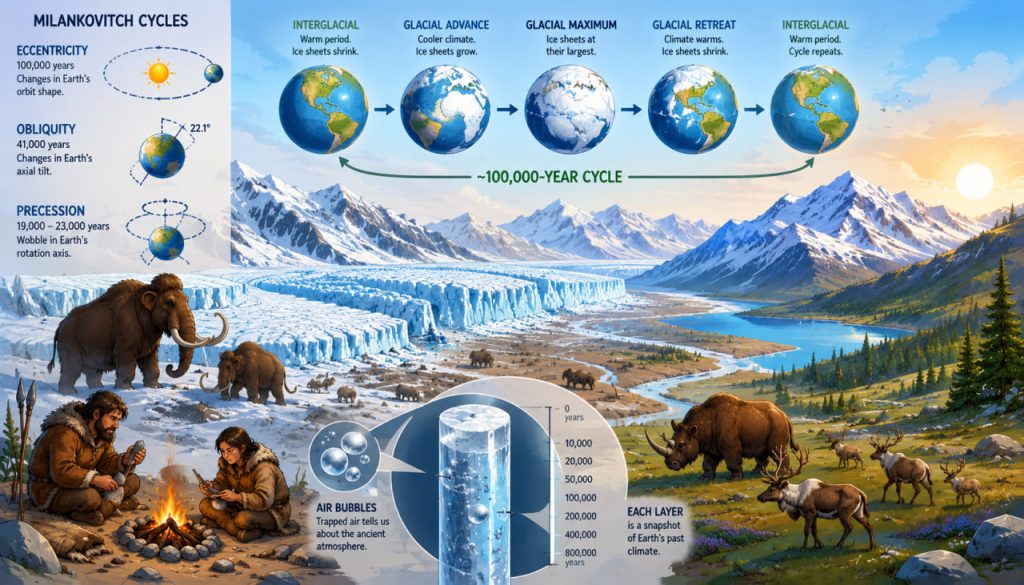
The main natural pacemaker of recent glacial cycles is a set of slow orbital changes called Milankovitch cycles.
These cycles affect how sunlight is distributed across Earth’s surface, especially in high northern latitudes during summer.
They include:
- Eccentricity — changes in the shape of Earth’s orbit around the Sun, roughly over 90,000–100,000 years.
- Obliquity — changes in the tilt of Earth’s axis, roughly over 41,000 years.
- Precession — a wobble in Earth’s rotation axis, with cycles around 19,000–23,000 years.
NASA explains that Milankovitch proposed that long-term changes in Earth’s position relative to the Sun help trigger the beginning and end of glaciation periods.
These orbital changes do not dramatically change the total yearly sunlight Earth receives. Instead, they change where and when sunlight is strongest.
That seasonal distribution matters greatly for ice.
Ice ages are strongly linked to summer sunlight in the Northern Hemisphere.
Why the Northern Hemisphere Matters So Much
Most large landmasses are in the Northern Hemisphere.
This matters because large ice sheets grow more easily on land than over ocean.
Antarctica already has a huge ice sheet, but northern continents such as North America and Eurasia can gain or lose enormous ice cover depending on climate conditions.
When northern summers are weak, snow can persist on land.
When northern summers are strong, ice retreats.
This is why small orbital changes can have large climate effects after they are amplified by feedbacks involving ice, greenhouse gases, ocean circulation, dust, vegetation, and clouds.
Milankovitch cycles start the rhythm, but Earth’s climate feedbacks amplify the music.
How Often Do Ice Ages Happen?
During the last million years, glacial and interglacial cycles have repeated roughly every 100,000 years.
NOAA states that Earth has experienced cold glacials and warm interglacials on approximately 100,000-year cycles for at least the last one million years.
NASA also notes that about 800,000 years ago, the ice-age cycle lengthened to about 100,000 years, matching Earth’s eccentricity cycle.
Before that transition, glacial cycles were often closer to 41,000 years, more strongly aligned with changes in Earth’s axial tilt.
This shift is known as the Mid-Pleistocene Transition, and scientists still study why it occurred.
So the simple answer is:
For the last 800,000 to 1 million years, major glacial cycles have occurred about every 100,000 years, but earlier cycles were often shorter.
How Long Does a Glacial Period Last?
Glacial cycles are uneven.
A typical recent cycle includes a long cooling and ice-growth phase, followed by a relatively rapid warming and ice retreat.
The cold glacial phase can last around 80,000 to 90,000 years, while the warmer interglacial may last around 10,000 to 20,000 years, although every cycle is different.
The warming out of a glacial period can be surprisingly fast in geological terms.
Ice sheets melt, sea levels rise, ecosystems migrate, ocean circulation shifts, and greenhouse gas concentrations increase.
This does not happen overnight, but compared with the slow growth of ice sheets, deglaciation can be relatively quick.
Ice ages usually build slowly and end faster than they begin.
What Ended the Last Ice Age?
The end of the last glacial period was driven by orbital changes that increased summer sunlight in the Northern Hemisphere.
That extra sunlight helped melt ice sheets.
As ice retreated, darker land and ocean surfaces absorbed more heat. Greenhouse gases such as carbon dioxide and methane rose, amplifying warming. Ocean circulation changed, moving heat around the planet.
NASA explains that glacial-interglacial cycles are linked to orbital variations and climate feedbacks, and NOAA notes that meltwater from Northern Hemisphere ice sheets influenced ocean circulation during events such as the Younger Dryas.
The last transition was not perfectly smooth.
The climate warmed, paused, shifted, and in some regions briefly cooled again before stabilizing into the Holocene.
The end of an ice age is a chain reaction, not a single switch.
Were There Ice Ages Before the Pleistocene?
Yes.
Earth has had several major ice-age eras over deep time.
Some occurred hundreds of millions or even billions of years ago.
NOAA explains that geologists have found evidence of ancient glaciations from hundreds of millions of years ago, when continents were arranged very differently.
The most extreme ancient events may have been “Snowball Earth” episodes, when ice possibly spread across much of the planet.
These deep-time ice ages were controlled by broader forces, including continental positions, mountain building, volcanic activity, atmospheric carbon dioxide, ocean circulation, and biological evolution.
The Pleistocene glacial cycles are only the most recent chapter.
Earth’s climate history is not stable. It has swung between greenhouse worlds and icehouse worlds many times.
Are We Heading Into Another Ice Age?
Naturally, without strong human influence, Earth’s current orbital configuration would favor very slow long-term cooling.
NASA states that, without human influences, current orbital positions would predict cooling rather than warming, continuing a long-term cooling trend that began around 6,000 years ago.
The next natural glacial period is not the urgent climate concern. Rapid human-caused warming is.
This is important because “ice ages happened naturally” is sometimes used to dismiss modern climate change. But natural cycles and today’s warming operate on very different time scales and causes.
Expert Perspective
NASA’s Earth Observatory describes Milankovitch cycles as a major driver of the timing of glacial and interglacial periods, while also emphasizing that the theory works through long-term changes in Earth’s orbit and the seasonal distribution of sunlight.
NOAA’s paleoclimate work adds a crucial point: glacial cycles dominated the climate of the past two million years, but today’s warming cannot be explained simply as another step in that natural rhythm.
The expert lesson is clear: ice ages were natural, slow, orbit-paced climate events, while modern warming is rapid and possibly happening because of 12 000 years +- 1000 year cycles and human causes.
Interesting Facts
- Earth is technically still in an ice age because Antarctica and Greenland still have permanent ice sheets.
- The last major glacial maximum occurred about 21,000 years ago.
- Over the last million years, glacial and interglacial cycles have repeated roughly every 100,000 years.
- Earlier in the Pleistocene, many glacial cycles were closer to 41,000 years.
- Sea level was much lower during glacial maxima because huge amounts of water were stored in ice sheets.
- Ice sheets can reshape continents by carving valleys, moving rocks, and depressing the land beneath them.
- Some ancient ice ages may have been far more extreme than the Pleistocene glaciations.
Glossary
- Ice Age — A long period in Earth history when large land ice sheets exist.
- Glacial Period — A colder phase within an ice age when ice sheets expand.
- Interglacial Period — A warmer phase between glacial periods when ice sheets retreat.
- Pleistocene Epoch — The geological epoch from about 2.6 million to 11,700 years ago, marked by repeated glacial cycles.
- Holocene — The current interglacial epoch that began after the last major glacial period.
- Last Glacial Maximum — The time around 21,000 years ago when the last glacial period reached its greatest ice extent.
- Milankovitch Cycles — Long-term changes in Earth’s orbit, tilt, and wobble that affect climate patterns.
- Eccentricity — The change in the shape of Earth’s orbit around the Sun.
- Obliquity — The change in the tilt of Earth’s axis.
- Precession — The slow wobble in Earth’s rotation axis.
- Climate Feedback — A process that amplifies or reduces climate change, such as ice reflecting sunlight.