The ocean is not just a beautiful blue surface around the continents. It is Earth’s climate engine, oxygen factory, carbon storehouse, food source, transport system, biodiversity reservoir, and one of the main reasons our planet remains habitable.
Covering more than 70% of Earth’s surface and holding about 97% of Earth’s water, the ocean shapes weather, moderates temperature, feeds billions of people, and supports life from microscopic plankton to whales. NASA describes the ocean as a major climate regulator because it stores vast amounts of heat and helps distribute energy around the planet.
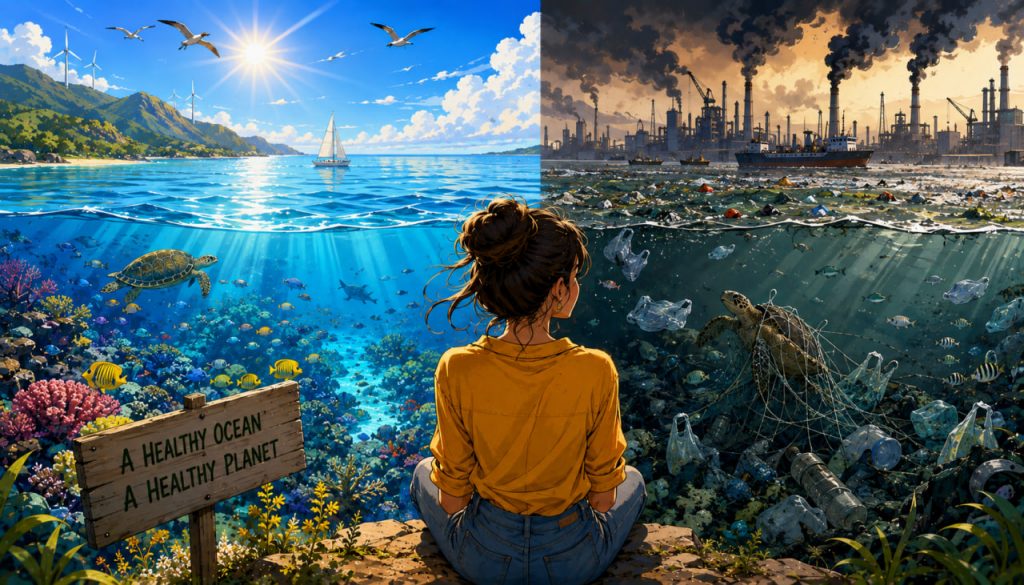
But the ocean is under pressure from almost every side: warming, acidification, plastic pollution, overfishing, chemical runoff, habitat destruction, noise, and deep-sea disturbance.
The ocean protects us every day, but human activity is weakening the very systems that make it so powerful.
The Ocean as Earth’s Climate Regulator
The ocean absorbs and stores heat far better than the atmosphere. This is one reason coastal areas often have milder climates than inland regions.
When sunlight warms Earth, the ocean takes up a huge share of that energy. Currents then move heat around the globe, helping regulate regional climates. Warm currents can make some northern regions milder, while cold currents influence deserts, fisheries, and coastal weather.
NASA explains that as Earth warms, ocean water absorbs heat and spreads it across the planet. This heat storage slows some atmospheric warming, but it also changes marine environments.
The ocean acts like a giant thermal battery. It stores heat, but that stored heat does not disappear.
As the ocean warms, marine heatwaves become more likely, coral bleaching increases, fish shift ranges, and storms can gain more energy from warm surface waters.
The Ocean and the Air We Breathe
Many people think forests are Earth’s main oxygen source. Forests are vital, but the ocean is just as important.
NOAA explains that scientists estimate roughly half of Earth’s oxygen production comes from the ocean, mainly through photosynthetic plankton, algae, and some bacteria.
Tiny marine organisms called phytoplankton use sunlight, carbon dioxide, and nutrients to grow. In the process, they release oxygen.
This does not mean every second breath literally comes directly from today’s ocean plankton. Marine life also consumes oxygen, and atmospheric oxygen cycles are complex. Still, ocean photosynthesis is one of the foundations of life on Earth.
The ocean is not empty water. It is a living, breathing biological system.
The Ocean as a Carbon Sink
The ocean absorbs part of the carbon dioxide released by human activity.
This helps slow climate change, because less carbon dioxide remains in the atmosphere. NASA-supported research has confirmed that the Southern Ocean is a major carbon sink, absorbing more carbon from the atmosphere than it releases.
But this service has a cost.
When carbon dioxide dissolves in seawater, it changes ocean chemistry. It forms carbonic acid and lowers pH, a process known as ocean acidification.
Acidification makes life harder for corals, shellfish, some plankton, and other organisms that build shells or skeletons from calcium carbonate.
The ocean is helping protect us from faster warming, but we are changing its chemistry in return.
The Ocean as a Food Source
The ocean feeds humanity directly and indirectly.
Fish, shellfish, seaweed, and other marine foods provide protein, minerals, and livelihoods for millions of people. Coastal communities depend on fisheries not only for food, but also for culture, income, and identity.
Healthy fisheries depend on healthy ecosystems. Coral reefs, mangroves, seagrass meadows, estuaries, and open-ocean food webs all support different stages of marine life.
When overfishing removes too many fish, the food web can become unstable. When destructive fishing damages habitats, recovery may take decades.
The ocean can feed people sustainably, but only if extraction stays within ecological limits.
Plastic Pollution: The Visible Ocean Crisis
Plastic is one of the most visible forms of ocean damage.
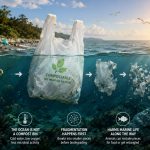
Bottles, bags, fishing gear, packaging, cigarette filters, and microplastics can enter rivers, coastlines, and eventually the sea. Some plastic floats. Some sinks. Some breaks into tiny fragments.
Marine animals may swallow plastic or become entangled in it. Microplastics are now found in seawater, sediments, seafood, sea ice, and even remote regions.
Plastic pollution is especially difficult because it does not behave like organic waste. It can persist for many years, fragmenting rather than truly disappearing.
The solution is not only beach cleanup. It requires better product design, less single-use packaging, improved waste systems, producer responsibility, and reduced leakage from cities and rivers.
Chemical Runoff and Dead Zones
The ocean also receives pollution from land.
Fertilizers from farms, sewage, industrial chemicals, heavy metals, oil, pesticides, and urban runoff can flow into rivers and coastal waters.
One major problem is nutrient pollution. When too much nitrogen and phosphorus enter coastal waters, algae can grow rapidly. When algae die and decompose, oxygen levels can drop. This can create dead zones, where fish and many other organisms struggle to survive.
NOAA studies harmful algal blooms and hypoxia because these problems can harm ecosystems and human communities.
What happens on land does not stay on land. Rivers deliver human choices to the sea.
Climate Change and Coral Reefs
Coral reefs are among the most biodiverse ecosystems on Earth.
They protect coastlines, support fisheries, attract tourism, and provide habitat for thousands of species. But reefs are highly vulnerable to warming.
When water becomes too warm, corals can expel the symbiotic algae that give them color and much of their energy. This is coral bleaching. If stressful conditions last too long, corals may die.
Climate change also intensifies acidification, sea-level rise, and extreme events, all of which can affect reefs.
NASA notes that warming oceans caused by climate change are putting coral reefs in danger.
A damaged reef is not just a loss of beauty. It is a loss of habitat, coastal protection, food security, and biological richness.
Overfishing and the Emptying of Marine Life
Overfishing happens when fish are caught faster than populations can replace themselves.
It can reduce fish size, disrupt breeding, damage food webs, and harm communities that depend on fishing. Illegal, unreported, and unregulated fishing makes the problem worse.
Some fishing methods also damage habitats. Bottom trawling can scrape seafloor ecosystems. Lost fishing gear, sometimes called ghost gear, continues catching animals after it is abandoned.
Good fisheries management can work. Science-based catch limits, protected areas, gear rules, monitoring, and community-led management can help fish populations recover.
The ocean is renewable, but it is not infinite.
Expert Perspective
The IPCC’s Special Report on the Ocean and Cryosphere warns that ocean warming, acidification, oxygen loss, and marine heatwaves are changing marine ecosystems and will continue to intensify under high-emissions scenarios.
This expert view is important because it connects many ocean problems into one system. Plastic pollution, overfishing, and toxic runoff are serious, but climate change is now altering the physical and chemical foundation of the ocean itself.
The ocean is not only polluted. It is being warmed, acidified, and deoxygenated.
What We Can Still Do
Protecting the ocean requires action at several levels.
Individuals can reduce single-use plastic, avoid wasteful consumption, choose more sustainable seafood, support coastal cleanup, and vote for policies that protect water systems.
Cities can improve sewage treatment, stormwater management, recycling systems, and river cleanup.
Countries can cut greenhouse gas emissions, protect marine habitats, regulate fishing, restore mangroves and seagrass, reduce industrial pollution, and cooperate on international ocean governance.
Businesses can redesign packaging, reduce waste, improve supply chains, and stop treating the ocean as a disposal zone.
The ocean does not need symbolic love. It needs reduced pressure, cleaner systems, and serious protection.
Why the Ocean Is Our Planet’s Life Support System
The ocean regulates climate, produces oxygen, stores carbon, supports biodiversity, feeds people, transports heat, shapes weather, and connects continents.
It is not separate from human civilization. It is part of our water cycle, food system, economy, climate stability, and future security.
When we damage the ocean, we damage ourselves.
And when we protect it, we protect one of Earth’s greatest stabilizing forces.
P.S. For anything to change, we need public demand for scientists from around the world to unite to solve humanity’s global problems. We need to start telling everyone that this demand exists. Thanks to social media, everyone can do a lot to ensure people live in a peaceful, kind, and free world…
Interesting Facts
- The ocean covers more than 70% of Earth’s surface.
- About 97% of Earth’s water is in the ocean.
- Scientists estimate that roughly half of Earth’s oxygen production comes from the ocean.
- The ocean absorbs large amounts of heat, helping regulate climate.
- Coral reefs support enormous biodiversity despite covering a very small part of the seafloor.
- Microplastics have been found in remote ocean environments.
- Mangroves and seagrass meadows can store large amounts of carbon in coastal sediments.
- Some deep-sea species live in complete darkness near hydrothermal vents.
Glossary
- Ocean — The continuous body of saltwater covering most of Earth’s surface.
- Phytoplankton — Microscopic photosynthetic organisms that drift in the ocean and produce oxygen.
- Carbon Sink — A natural or artificial system that absorbs more carbon than it releases.
- Ocean Acidification — The lowering of seawater pH caused mainly by absorbed carbon dioxide.
- Marine Heatwave — A period of unusually high ocean temperature.
- Coral Bleaching — A stress response in which corals lose their symbiotic algae and turn pale.
- Microplastics — Plastic particles smaller than 5 millimeters.
- Dead Zone — An area with very low oxygen where many marine animals cannot survive.
- Hypoxia — Low oxygen conditions in water.
- Overfishing — Catching fish faster than populations can naturally recover.
- Ghost Gear — Lost or abandoned fishing equipment that continues trapping marine animals.
- Blue Carbon — Carbon stored by coastal and marine ecosystems such as mangroves, salt marshes, and seagrasses.