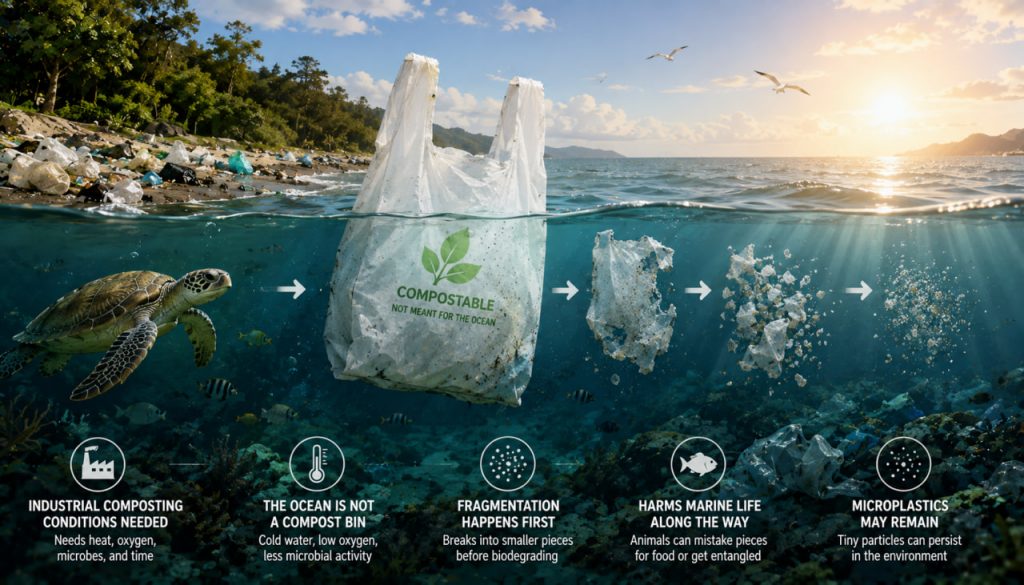
A biodegradable bag sounds like an easy solution to plastic pollution. Use it, throw it away, and nature will handle the rest. Unfortunately, the ocean does not work like an industrial composting facility.
Many bags marketed as biodegradable, compostable, or eco-friendly need very specific conditions to break down properly. Those conditions may include high heat, oxygen, moisture control, active microbes, and enough time in a managed composting system. The ocean usually provides the opposite: cold water, low oxygen in some places, limited microbial activity for certain polymers, weak sunlight below the surface, and constant movement.
That is why a “biodegradable” bag can remain visible in the sea for months or years, fragment into smaller pieces, or harm wildlife before it fully breaks down.
The label “biodegradable” does not mean “safe to litter,” and it definitely does not mean “disappears quickly in the ocean.”
What Does “Biodegradable” Actually Mean?
Biodegradable means that microorganisms can break a material down into simpler substances, such as carbon dioxide, water, biomass, and mineral salts.
But the key detail is this: biodegradation depends on conditions.
A material may biodegrade in warm industrial compost, but not in cold seawater. Another material may break down in soil, but not in a landfill. A third may fragment in sunlight, but leave behind microplastic-like pieces.
The European Commission explains that compostable plastics are a subset of biodegradable plastics and that they typically decompose in industrial composting facilities after being collected separately.
So when a bag says “compostable,” it often means “compostable under controlled conditions,” not “marine biodegradable.”
The Ocean Is a Bad Place for Decomposition
Industrial composting facilities are designed to accelerate breakdown.
They can provide:
- High temperatures
- Controlled moisture
- Oxygen
- Regular mixing
- Dense microbial activity
- Managed processing time
The ocean does not provide this stable recipe.
Seawater is often much colder than industrial compost. A bag floating near the surface may receive sunlight, but a bag underwater or buried in sand receives much less. Saltwater chemistry, oxygen levels, waves, and biological communities all vary.
UNEP’s report on biodegradable plastics and marine litter concluded that widespread adoption of products labeled biodegradable would not significantly reduce the amount of plastic entering the ocean or the physical and chemical risks plastics pose to marine environments. UNEP also warned that complete biodegradation often requires conditions rarely met in marine environments.
The ocean is not a compost bin. It is a complex ecosystem where breakdown can be slow, incomplete, and harmful along the way.
Biodegradable vs Compostable vs Oxo-Degradable
These words are often confused.
A biodegradable plastic can be broken down by microorganisms, but only under certain conditions. The label alone does not tell you where, how fast, or into what.
A compostable plastic is designed to break down in a composting process. Many compostable plastics are certified for industrial composting, not backyard composting or ocean conditions.
An oxo-degradable plastic is different. It contains additives that help the plastic fragment when exposed to heat, oxygen, and light. But fragmentation is not the same as true biodegradation.
This distinction is crucial.
A bag that breaks into tiny pieces has not necessarily returned safely to nature. It may have become harder to collect and easier for animals to ingest.
That is why many experts prefer to describe some oxo-degradable plastics as fragmentable rather than truly biodegradable.
Why Some Compostable Bags Still Persist
A compostable bag may be made from materials such as PLA, starch blends, PBAT, or other bio-based or fossil-based polymers.
Some of these materials can break down well in industrial composting. But they may behave very differently in seawater.
Industrial composting standards such as EN 13432 are designed around composting conditions, not marine litter. European Bioplastics explains that EN 13432-certified compostable plastics are intended for industrial composting facilities.
This is where consumer confusion begins.
A person sees the word “compostable” and assumes the bag is harmless anywhere. But the certification may only apply after separate collection and correct treatment.
If that same bag escapes into a river, beach, or ocean, it may not experience the heat and microbial conditions needed for efficient decomposition.
Scientific Studies Show Mixed Results
Research on biodegradable bags in marine environments shows that results depend heavily on material type and conditions.
One study examined different carrier bags in the marine environment, including oxo-biodegradable plastics, a compostable bag, and standard polyethylene. The authors investigated how these materials broke down under marine exposure rather than ideal composting conditions.
Another widely discussed study exposed biodegradable, oxo-biodegradable, compostable, and conventional plastic carrier bags in sea, soil, and open air over three years. It found that the compostable bag disappeared in the marine environment within three months, while other bag types persisted much longer.
This does not mean all compostable bags are ocean-safe. It means material chemistry matters, and one result cannot be applied to every product, every sea, every temperature, or every real-world pollution scenario.
A cold northern sea, a tropical beach, a sandy seabed, a shaded harbor, and a deep-water environment are not the same laboratory.
Why “Bio-Based” Does Not Mean Biodegradable
Another common misunderstanding is the word bio-based.
A bio-based plastic is made partly or fully from biological sources, such as corn, sugarcane, potato starch, cellulose, or other plant materials. But bio-based does not automatically mean biodegradable.
Some bio-based plastics behave like conventional plastic. For example, bio-based polyethylene can be made from plant-derived feedstock, but chemically it is still polyethylene.
The reverse is also true. Some biodegradable plastics are partly fossil-based.
The source of the carbon and the end-of-life behavior are different questions. A plastic can be plant-based and persistent, or fossil-based and designed to biodegrade under specific conditions.
The Microplastic Problem
When plastic weakens in the environment, it may fragment into smaller pieces.
These fragments can become microplastics, usually defined as plastic particles smaller than 5 millimeters. They can be swallowed by fish, seabirds, turtles, shellfish, and plankton-sized organisms.
Even if a biodegradable bag eventually breaks down, it may first pass through a phase where it becomes fragile fragments. If those fragments persist long enough, they can still create ecological risks.
This is why the word “disappear” can be misleading. A bag may stop being visible to us while still leaving particles or chemical residues in the environment.
True environmental safety is not about whether the bag vanishes from sight. It is about whether it fully mineralizes without harming ecosystems.
Why Marine Biodegradability Is a Higher Standard
For a material to be genuinely suitable for marine environments, it would need to biodegrade reliably in seawater without leaving persistent residues, toxic additives, or harmful fragments.
That is a much harder standard than industrial compostability.
Marine environments are variable, uncontrolled, and biologically sensitive. A material that breaks down in a hot compost pile may not do the same in a cold bay. A material that disappears in one test may not disappear when buried under sediment or tangled in algae.
This is why most environmental agencies do not treat biodegradable packaging as a solution to marine litter.
The better solution is prevention: keep bags out of rivers and oceans in the first place.
Expert Perspective
UNEP’s assessment is one of the most important expert warnings on this topic. It concluded that biodegradable plastics are not a simple answer to marine litter because the conditions required for complete biodegradation are rarely present in the ocean.
That view is practical, not anti-innovation.
Biodegradable materials can be useful in the right system. Compostable food-waste liners, certified compostable packaging in closed collection programs, and agricultural films designed for specific soil conditions may have real value.
But a biodegradable label cannot replace waste collection, reuse systems, recycling infrastructure, and reduced single-use consumption.
What Should Consumers Do?
The first rule is simple: do not treat biodegradable bags as harmless litter.
Use reusable bags when possible. If you use a compostable bag, check whether your local composting program accepts it. Many facilities do not accept compostable packaging because it can be hard to distinguish from conventional plastic or because the facility process is not designed for it.
Do not put compostable plastic into normal plastic recycling unless your local system explicitly accepts it. It may contaminate recycling streams.
Do not assume “green,” “eco,” “plant-based,” “degradable,” or “compostable” means ocean-safe.
The most ocean-friendly bag is the one that does not enter the ocean at all.
The Better Way to Think About Bags
The real hierarchy is not “plastic bad, biodegradable good.”
A better hierarchy is:
Reduce unnecessary bags first.
Reuse durable bags many times.
Recycle suitable materials only where proper systems exist.
Compost certified compostable items only where accepted.
Dispose responsibly when no better option exists.
Biodegradable plastics are tools, not miracles. They can help in carefully designed waste systems, but they are not permission to keep producing disposable products and hope nature will erase the problem.
The ocean needs less plastic entering it, not more confusing labels floating through it.
P.S. For anything to change, we need public demand for scientists from around the world to unite to solve humanity’s global problems. We need to start telling everyone that this demand exists. Thanks to social media, everyone can do a lot to ensure people live in a peaceful, kind, and free world…
Interesting Facts
- Many compostable plastics need industrial composting conditions to break down efficiently.
- “Bio-based” means made from biological sources, but it does not always mean biodegradable.
- Oxo-degradable plastics may fragment rather than fully biodegrade.
- A bag can disappear visually while still leaving small particles or residues.
- Cold seawater can slow decomposition dramatically.
- Compostable packaging can contaminate recycling if placed in the wrong bin.
- Marine biodegradability is much harder to guarantee than industrial compostability.
- The safest strategy is to prevent all bags, including biodegradable ones, from reaching waterways.
Glossary
- Biodegradable — Capable of being broken down by microorganisms under certain conditions.
- Compostable — Designed to biodegrade in a composting process, often industrial composting.
- Industrial Composting — Controlled composting using heat, oxygen, moisture, and microbes to process organic waste.
- Marine Biodegradability — The ability of a material to break down safely and fully in seawater conditions.
- Oxo-Degradable Plastic — Plastic with additives that promote fragmentation under heat, light, and oxygen.
- Fragmentation — Physical breaking into smaller pieces without necessarily completing biodegradation.
- Microplastic — Plastic particles smaller than 5 millimeters.
- Bio-Based Plastic — Plastic made partly or fully from biological materials such as plants.
- PLA — Polylactic acid, a common bio-based plastic often used in compostable products.
- PBAT — A biodegradable polymer often used in flexible compostable packaging.
- Mineralization — Complete breakdown into simple substances such as carbon dioxide, water, and biomass.
- Greenwashing — Marketing that makes a product seem more environmentally friendly than it really is.