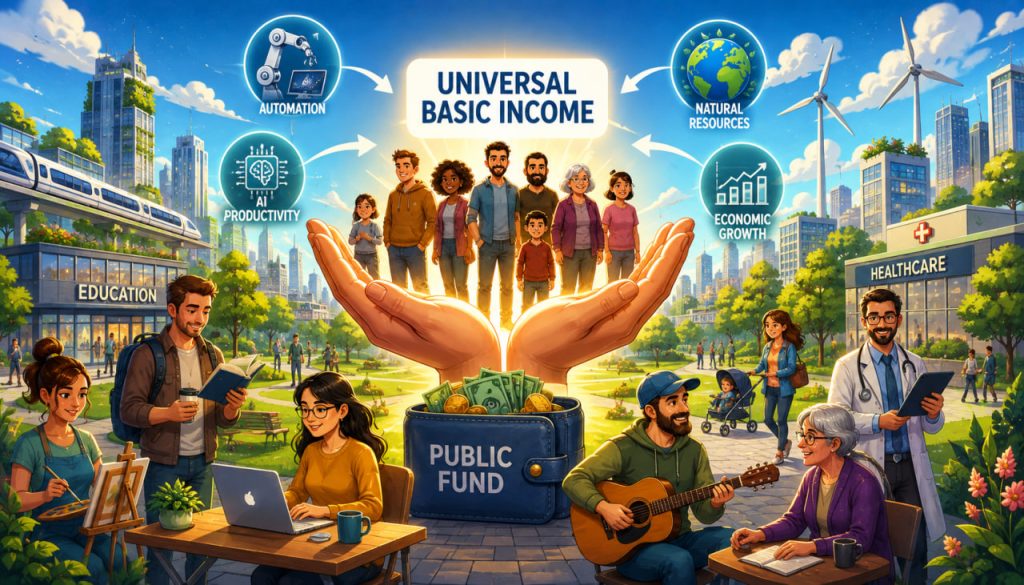
Universal basic income, or UBI, is one of the most debated economic ideas of the AI age. The concept sounds simple: every citizen or resident receives a regular cash payment from the government, with no work requirement and no means test.
Supporters see UBI as a modern safety net for an economy shaped by automation, unstable jobs, high housing costs, and widening inequality. Critics argue that a meaningful UBI would be extremely expensive, politically difficult, and less targeted than existing welfare programs.
So, is it realistic to introduce universal basic income in developed countries?
The honest answer is: yes, but probably not as a full living-income payment in the near future. A smaller “partial basic income,” expanded child benefit, citizen dividend, or negative income tax is much more realistic than replacing entire welfare systems overnight.
What Universal Basic Income Actually Means
Universal basic income is usually defined by four core principles.
It is universal, meaning everyone in the eligible population receives it. It is unconditional, meaning recipients do not need to prove unemployment, disability, poverty, or job search activity. It is regular, usually paid monthly. And it is cash-based, allowing people to decide how to spend it.
The International Monetary Fund describes UBI as an income-support mechanism intended to reach all, or nearly all, people with no or minimal conditions. This makes it different from unemployment insurance, food assistance, pensions, and other targeted welfare programs.
The appeal is obvious: a simple payment can reduce bureaucracy, close welfare gaps, and provide immediate financial security.
Why Developed Countries Are Taking UBI Seriously
Developed economies already have advanced tax systems, digital payment infrastructure, and social security institutions. Technically, they are capable of sending regular payments to millions of people.
The political interest comes from several pressures at once:
- Automation and AI disruption
- Growth of gig and freelance work
- Rising housing and healthcare costs
- Administrative complexity in welfare systems
- Poverty among people who already work
- Fear of social instability during economic shocks
During recent crises, many governments used emergency cash transfers or wage-support programs. These were not true UBI systems, but they proved that governments can distribute money quickly when political urgency exists.
UBI is no longer only a philosophical idea. It is now part of mainstream policy debate.
The Biggest Problem: Cost
The hardest obstacle is not technology. It is money.
A truly meaningful UBI in a developed country would require enormous public spending. The OECD has warned that replacing existing benefit systems with a basic income would require very substantial tax rises if the payment were set at a meaningful level. It also notes that because UBI is not targeted only at the poorest households, it is not always the most cost-effective tool for reducing poverty.
This is the central trade-off.
A small UBI is affordable but may not transform people’s lives. A generous UBI is powerful but fiscally difficult.
For example, paying every adult a monthly amount high enough to cover rent, food, utilities, and transport would cost far more than most existing welfare programs. Governments would need to raise taxes, cut other spending, create new revenue sources, or redesign the entire tax-benefit system.
The question is not whether UBI can be paid. The question is what must be sacrificed or taxed to pay for it.
Would People Stop Working?
One common argument against UBI is that people would work less.
The evidence is more nuanced.
Finland’s basic income experiment found that basic income did not produce a major employment boom, but it improved recipients’ wellbeing and reduced bureaucracy. The European Commission summary of the experiment reported no significant employment impact in the first results, alongside higher life satisfaction and wellbeing.
The Alaska Permanent Fund Dividend is another useful real-world example. Alaska has paid an annual cash dividend to eligible residents since 1982, funded from mineral-royalty investment earnings. Research published through the American Economic Association found that this universal and permanent cash transfer did not significantly reduce aggregate employment.
A large OpenResearch unconditional cash study, published in 2024, gave selected low-income participants $1,000 per month for three years. The study found that recipients gained flexibility but also showed modest decreases in employment, work hours, and earned income relative to the control group.
The practical lesson is clear: cash transfers do not automatically destroy work incentives, but program design and payment size matter.
UBI vs Existing Welfare Systems
A major selling point of UBI is simplicity.
Many welfare systems are difficult to navigate. People may lose benefits when they take a job, earn slightly more, move, marry, or fail to complete paperwork correctly. UBI could reduce these “benefit cliffs” because the payment does not disappear when someone works.
However, replacing targeted benefits with one universal payment can hurt vulnerable groups if the UBI is too small. People with disabilities, high housing costs, children, or medical needs may require more support than a flat universal amount can provide.
This is why many realistic proposals do not eliminate the welfare state. Instead, they combine a basic income floor with targeted support for specific needs.
The most practical model for developed countries may be UBI plus essential services, not UBI instead of everything else.
How Could Developed Countries Fund UBI?
There is no single funding method.
Possible revenue sources include:
- Higher income taxes
- Value-added tax
- Carbon taxes
- Wealth taxes
- Land value taxes
- Financial transaction taxes
- AI or automation-related taxes
- Sovereign wealth fund dividends
- Reduction of overlapping benefits
- Closing tax loopholes
The Alaska model shows one version of a citizen dividend funded by shared natural-resource wealth. The state’s Permanent Fund Dividend Division explains that eligible Alaskans receive dividends from investment earnings linked to mineral revenues.
For countries without major sovereign wealth funds, funding is harder. A tax-financed UBI would need broad public support, careful inflation management, and protections for public services.
A sustainable UBI must be designed as part of the tax system, not as a political giveaway.
Expert Perspective
The OECD’s analysis offers one of the most balanced expert views: basic income can address real gaps in social protection, but moving toward more universal income support would likely need to happen in stages and must be matched by serious debate over financing.
This is important because UBI is often presented as either a miracle solution or an impossible fantasy. In reality, it is a policy tool with strengths and limits.
A well-designed UBI could improve security, bargaining power, and freedom. A poorly designed UBI could become expensive, underfunded, inflationary, or less helpful than targeted welfare.
Is Full UBI Realistic in Developed Countries?
A modest form of UBI is realistic.
A full basic income high enough to live on is much harder.
Developed countries could introduce partial basic income through gradual steps:
- Universal child allowances
- Basic income for young adults
- Senior citizen dividends
- Regional pilots
- Carbon dividend payments
- AI productivity dividends
- Negative income tax systems
- Emergency automatic cash payments
These models are politically easier because they begin with specific groups, specific revenue sources, or smaller payment levels.
The likely future is not one dramatic UBI revolution. It is a slow movement toward more automatic, unconditional, and universal cash support.
Interesting Facts
- The Alaska Permanent Fund Dividend is one of the longest-running examples of a broad cash dividend in a developed economy.
- UBI is unconditional, while many welfare programs require income checks, work requirements, or eligibility reviews.
- Finland’s basic income experiment became famous worldwide because it tested unconditional payments in a modern European welfare state.
- A partial basic income can reduce financial stress even if it is not large enough to replace wages.
- Some UBI supporters connect the idea to AI, arguing that automation-driven productivity should be shared more widely.
- Critics often prefer targeted benefits because they direct more money toward households with the greatest need.
Glossary
- Universal Basic Income (UBI) — A regular cash payment given to all eligible people without a work requirement or means test.
- Partial Basic Income — A smaller UBI that supplements income but does not fully cover living costs.
- Means Test — A process that checks income or wealth to decide whether someone qualifies for benefits.
- Benefit Cliff — A situation where earning slightly more money causes a person to lose important public benefits.
- Negative Income Tax — A system where people below a certain income level receive payments instead of paying income tax.
- Citizen Dividend — A payment distributed to residents from shared public wealth, such as natural-resource revenue.
- Sovereign Wealth Fund — A state-owned investment fund that manages national assets or revenues.
- Automation Dividend — A proposed way of sharing economic gains created by automation, robotics, or artificial intelligence.