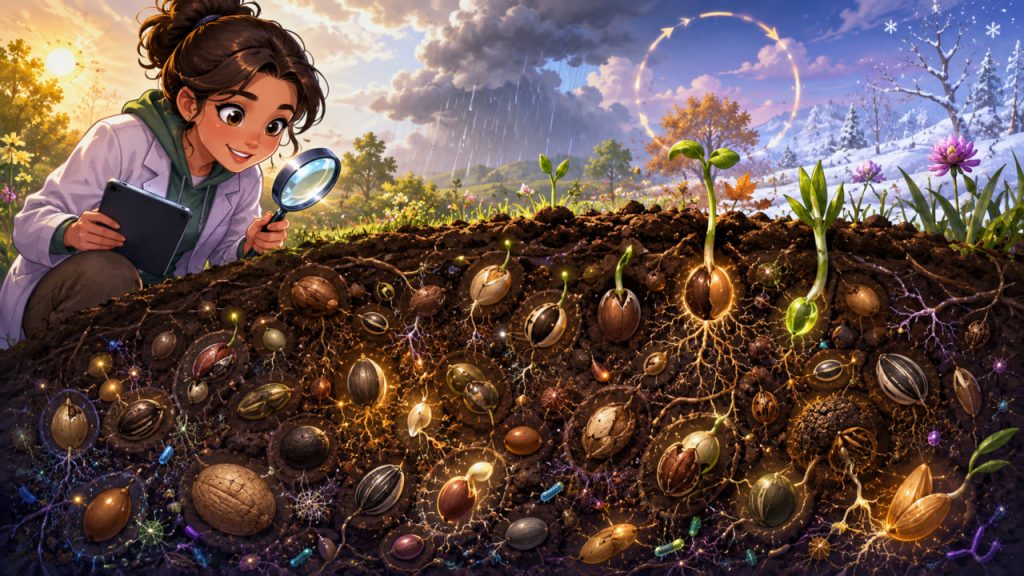
Beneath every meadow, forest, farm field, desert plain, and city park lies a hidden archive of life. It is not made of books or fossils, but of seeds.
This underground reserve is known as the soil seed bank: a living collection of dormant seeds buried in the soil, waiting for the right conditions to germinate.
Some seeds sprout after a single season. Others can remain silent for decades. A few extraordinary seeds may survive for centuries, preserving plant life through fire, drought, flood, grazing, farming, and climate shifts.
Dormant seeds are one of nature’s most powerful survival strategies. They allow plants to delay growth until the world above them becomes safe enough to begin again.
What Is a Soil Seed Bank?
A soil seed bank is the natural storage system of seeds found in the soil.
These seeds come from plants that released them over many years. Wind, water, animals, gravity, and human activity move them into the ground, where they may remain close to the surface or become buried deeper over time.
The soil seed bank can include seeds from:
- Wildflowers
- Grasses
- Trees
- Shrubs
- Weeds
- Wetland plants
- Desert plants
- Agricultural species
Some seeds germinate quickly when they receive moisture, warmth, and light. Others enter dormancy and wait.
This hidden bank acts like an ecological memory. Even when adult plants disappear from the landscape, their seeds may still remain underground.
Why Seeds Become Dormant
Seed dormancy is a biological pause button.
A dormant seed is alive, but it does not grow immediately. Its metabolism slows down, and it waits until environmental signals suggest that survival is likely.
This is extremely useful because germinating at the wrong time can be fatal.
A seed that sprouts before winter may freeze. A desert seed that sprouts after a tiny rainfall may die before its roots reach deeper moisture. A forest seed that sprouts in deep shade may not receive enough light.
Dormancy helps seeds avoid these risks.
Instead of gambling everything on one season, plants spread their chances across time.
The Conditions That Wake Sleeping Seeds
Dormant seeds do not wake randomly. Many respond to specific environmental triggers.
Common germination signals include:
- Moisture
- Temperature changes
- Sunlight exposure
- Fire or smoke chemicals
- Soil disturbance
- Passing through an animal’s digestive system
- Seasonal freeze-thaw cycles
- Changes in oxygen levels
For example, some seeds need cold winter conditions before they can germinate in spring. This prevents them from sprouting during a warm autumn day.
Other seeds need light. They remain dormant while buried in darkness, then germinate when soil disturbance brings them near the surface.
Fire-adapted plants may require heat or smoke-related chemicals to break dormancy. After a wildfire clears vegetation and releases nutrients, these seeds can rapidly colonize the open ground.
Short-Term and Long-Term Seed Banks
Not all soil seed banks are the same.
A transient seed bank contains seeds that survive only briefly, usually less than a year. These seeds either germinate quickly or die.
A persistent seed bank contains seeds that remain viable for several years or much longer. These are the true long-term survivors.
Persistent seed banks are especially important in unpredictable environments, such as deserts, floodplains, grasslands, and fire-prone ecosystems.
In these places, good growing conditions may not appear every year. Dormant seeds allow plant populations to survive through long periods of stress.
How Seeds Survive Underground for So Long
A seed may look simple, but it is a remarkable survival capsule.
Inside the seed is a tiny plant embryo, along with stored food and protective tissues. The seed coat can act like armor, shielding the embryo from drying, microbes, and physical damage.
Many long-lived seeds share certain traits:
- Hard seed coats
- Low internal moisture
- Slow metabolism
- Resistance to decay
- Chemical protection against microbes
- Ability to remain inactive under unfavorable conditions
Dry, cool, stable soils often improve seed longevity. Deep burial can also protect seeds from temperature swings, predators, sunlight, and surface disturbance.
However, survival is not guaranteed. Seeds can be eaten by insects, rodents, birds, and soil organisms. They can also decay, lose viability, or germinate at the wrong time.
A soil seed bank is both a storage vault and a battlefield.
Seeds That Wait for Decades or Centuries
Many plant seeds remain viable for years. Some species can wait far longer.
Long-lived seeds have been documented in wetlands, deserts, tundra soils, and archaeological sediments. In rare cases, ancient seeds recovered from frozen or extremely dry environments have germinated after hundreds or even thousands of years.
These exceptional cases are unusual, but they show the biological potential of seed dormancy.
More commonly, long-term soil seed banks contain seeds that survive for decades. This is still impressive. A seed buried before a forest was cleared, a field was abandoned, or a wetland was drained may later germinate when conditions change again.
This means the past can reappear in the landscape.
Why Soil Seed Banks Matter for Ecosystems
Soil seed banks help ecosystems recover after disturbance.
When fire, flood, drought, grazing, landslides, storms, or human activity remove vegetation, buried seeds can begin rebuilding plant communities.
This process is essential for ecological resilience.
A healthy seed bank can help restore:
- Ground cover
- Pollinator plants
- Native grasses
- Wetland vegetation
- Forest understory species
- Food sources for wildlife
- Soil stability
Without a strong seed bank, damaged ecosystems may recover slowly or become dominated by invasive species.
The future of an ecosystem often depends on what is hidden in its soil.
The Role of Dormant Seeds in Farming
Farmers know soil seed banks very well, especially because many weeds survive through dormant seeds.
A field may look clean after weeding or herbicide treatment, but thousands of viable weed seeds may still be waiting underground.
When soil is tilled, seeds are moved, exposed to light, and stimulated to germinate. This is one reason weeds can return again and again.
Understanding seed banks helps farmers design better weed management strategies, including crop rotation, cover crops, reduced tillage, mulching, and timing of cultivation.
In agriculture, the soil seed bank can be both a problem and a resource.
It can preserve unwanted weeds, but it can also support pasture regeneration, native plant restoration, and long-term soil biodiversity.
Soil Seed Banks and Climate Change
As climate conditions shift, soil seed banks may become increasingly important.
Dormant seeds can help plant communities respond to changing rainfall, temperature, fire patterns, and disturbance cycles.
However, there are limits.
If the climate changes too quickly, some seeds may germinate into conditions where adult plants can no longer survive. In other cases, old seed banks may not contain the species needed for the new environment.
Climate change can also alter the timing of germination. Warmer winters, irregular rainfall, and extreme heat may confuse the environmental signals that seeds rely on.
Dormancy is powerful, but it is not a guarantee against rapid environmental change.
Expert Perspective
Ecologists often describe soil seed banks as a form of ecological insurance.
Plant ecologist Carol C. Baskin and seed biologist Jerry M. Baskin, widely known for their work on seed dormancy and germination ecology, have emphasized that dormancy is not simply a delay in growth. It is an adaptive strategy shaped by the environment.
Their research highlights a key idea: seeds are not passive objects in the soil. They are living organisms with complex responses to temperature, moisture, light, and seasonal timing.
This perspective changes how we understand landscapes. A bare patch of soil may not be empty. It may be full of biological potential.
How Scientists Study Hidden Seed Banks
Studying a soil seed bank is not as simple as looking at the ground.
Scientists often collect soil samples and bring them to a greenhouse or laboratory. Then they expose the samples to controlled conditions and observe which seeds germinate.
Another method is seed extraction, where seeds are physically separated from soil and identified under magnification.
Researchers may compare seed banks across different habitats, depths, seasons, and disturbance histories.
These studies help answer important questions:
- Which species are stored underground?
- How long do seeds remain viable?
- Can degraded habitats recover naturally?
- Are invasive plants dominating the seed bank?
- Does the soil still contain rare native species?
The answers can guide conservation, farming, restoration, and land management.
Restoration: Waking the Right Seeds
In ecological restoration, soil seed banks can be extremely valuable.
If native seeds remain underground, land managers may be able to encourage natural recovery by removing invasive plants, restoring water flow, reducing grazing pressure, or carefully disturbing the soil.
However, restoration is not always simple.
Sometimes the seed bank is depleted. Sometimes it contains mostly invasive species. Sometimes the original native plants are gone from both the surface and the soil.
In those cases, restoration may require adding native seeds, planting young plants, or rebuilding soil conditions.
A seed bank can restart an ecosystem, but only if the right seeds are still alive.
Interesting Facts
- Some desert seeds can wait for years until enough rain falls to support successful growth.
- Fire-following plants may remain dormant until heat or smoke signals that competition has been cleared.
- A single handful of soil can contain hundreds or even thousands of seeds, depending on the habitat.
- Weed seed banks are one reason unwanted plants can return long after they seem to be removed.
- Wetland seed banks can help restore vegetation when natural water levels return.
- Some seeds are stimulated by passing through the digestive system of birds or mammals.
- Seed dormancy allows plants to “spread risk” across many seasons instead of relying on one perfect year.
Glossary
- Dormant Seed — A living seed that does not germinate immediately, even when it may appear inactive.
- Soil Seed Bank — The collection of viable seeds stored in the soil.
- Germination — The process by which a seed begins to grow into a new plant.
- Viability — The ability of a seed to remain alive and capable of germination.
- Transient Seed Bank — A short-lived seed bank where seeds usually survive for less than one year.
- Persistent Seed Bank — A long-term seed bank where seeds can remain viable for several years or longer.
- Seed Coat — The protective outer covering of a seed.
- Ecological Resilience — The ability of an ecosystem to recover after disturbance.
- Stratification — Exposure to specific temperature conditions, often cold, that helps break seed dormancy.
- Invasive Species — A non-native species that spreads aggressively and can disrupt native ecosystems.