Antarctica looks like a frozen fortress. Its ice sheet is thousands of meters thick in places, its surface is brutally cold, and its interior can feel almost untouched by the warmer world beyond.
Yet some of the most important melting in Antarctica is not happening on top of the ice.
It is happening underneath.
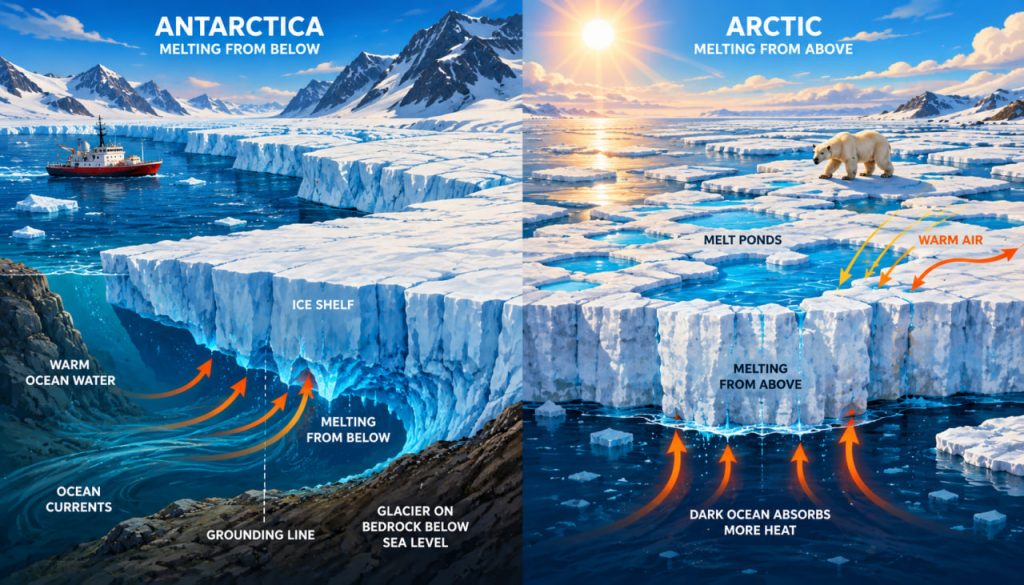
Warm ocean water is reaching the underside of floating ice shelves, thinning them from below and weakening the frozen barriers that hold back massive glaciers. At the same time, Arctic sea ice often melts mainly from above and around the edges, driven by warmer air, sunlight, darker ocean surfaces, and seasonal summer heat.
This difference is one of the most important climate puzzles on Earth: Antarctic ice is often attacked from below, while Arctic ice is strongly attacked from above.
Antarctica and the Arctic Are Not the Same
The first key to understanding this mystery is simple: Antarctica and the Arctic are opposites in geography.
Antarctica is a continent covered by a huge ice sheet. It is land surrounded by ocean.
The Arctic is an ocean surrounded by land. Much of its ice is sea ice floating on the surface of the Arctic Ocean.
That difference changes everything.
Antarctic ice includes enormous glaciers resting on land and floating ice shelves extending over the sea. Arctic ice is mostly thinner sea ice that forms when seawater freezes.
Antarctica is a frozen continent. The Arctic is a frozen ocean.
Because of this, the two polar regions respond to warming in different ways.
What Is Melting in Antarctica?
When people say “Antarctic ice is melting,” they may be talking about several different things.
Antarctica contains:
- Land ice
- Glaciers
- Ice shelves
- Sea ice
- Snow cover
The most important concern for global sea level is land ice. If ice that rests on land flows into the ocean and melts, it raises sea level.
Ice shelves are different. They already float on water, so their direct melting does not raise sea level much. But they act like giant frozen doorstops.
They slow the movement of glaciers behind them.
When ice shelves thin, crack, or collapse, land-based glaciers can flow faster into the sea. That can increase sea-level rise.
Why Antarctic Ice Melts From Below
Much of Antarctica is extremely cold at the surface. In the interior, surface melting is limited compared with warmer regions of the world.
But the ocean tells a different story.
Around parts of Antarctica, relatively warm deep water can move onto the continental shelf and reach the underside of floating ice shelves. This water is not warm in a tropical sense. It may be only slightly above the freezing point.
But under polar conditions, that is enough.
When this water contacts the bottom of an ice shelf, it transfers heat into the ice. The ice melts from below, creating hidden cavities, thinning the shelf, and changing how the shelf supports nearby glaciers.
In Antarctica, the ocean can be a more powerful melting force than the air.
This is especially important in West Antarctica, where some glaciers rest on bedrock below sea level.
The Role of Ice Shelves
Ice shelves are floating extensions of glaciers and ice sheets.
They form when land ice flows outward from the continent and spreads over the ocean. These shelves can be hundreds of meters thick and cover enormous areas.
Their job is not intentional, of course, but their effect is crucial: they provide resistance.
They press against islands, underwater ridges, and fjord walls. This friction slows the glaciers feeding them.
When warm water thins an ice shelf from below, the shelf becomes weaker. It may lose contact with stabilizing features. It may fracture more easily. It may retreat inland.
Then the glaciers behind it can accelerate.
This is why scientists pay close attention to ice shelves such as those connected to major outlet glaciers in West Antarctica.
Why the Seafloor Matters
The shape of the seafloor helps determine whether warm water can reach Antarctic ice.
Some regions have underwater troughs that act like pathways. These deep channels allow warmer ocean water to move toward the grounding line, where floating ice meets land-based ice.
The grounding line is one of the most sensitive places in the Antarctic system.
If warm water melts ice near this zone, the grounding line can retreat inland. In areas where the bedrock slopes downward toward the interior, retreat can become difficult to stop.
This process is known as marine ice sheet instability.
The danger is not only that ice melts. The danger is that the geometry of the ice and bedrock can make retreat self-reinforcing.
Why Arctic Ice Often Melts From Above
The Arctic has a different problem.
Most Arctic ice is sea ice floating on the ocean surface. It is much thinner than Antarctic ice shelves or the Antarctic ice sheet.
During summer, sunlight and warmer air heat the surface. Snow melts first, exposing darker ice. Melt ponds form on top of the ice.
These ponds are important because they absorb more sunlight than bright snow.
Fresh snow reflects much of the Sun’s energy. Dark water absorbs much more of it. This creates a feedback loop: warming causes melting, melting darkens the surface, and the darker surface absorbs more heat.
That absorbed heat causes more melting.
Arctic sea ice is highly vulnerable to surface warming because it is thin, seasonal, and exposed to summer sunlight.
The Albedo Effect
The albedo effect is one of the most important reasons Arctic ice melts so quickly.
Albedo means reflectivity.
Bright surfaces, such as snow and clean ice, reflect a large amount of solar energy. Dark surfaces, such as open ocean, absorb more energy.
When Arctic sea ice shrinks, more dark ocean is exposed. The ocean warms. That heat can delay autumn freezing and make the next ice season weaker.
This is a powerful feedback mechanism.
The Arctic is warming faster than the global average partly because of this ice-albedo feedback.
Warm Air Versus Warm Water
The difference between Antarctic and Arctic melting can be simplified like this:
In the Arctic, warm air and sunlight attack thin sea ice from above.
In Antarctica, warm ocean water often attacks thick floating ice shelves from below.
But the real world is more complex.
Antarctica can experience surface melting too, especially on the Antarctic Peninsula and during unusual warm events. The Arctic also experiences bottom melt from warmer ocean water.
The difference is about dominant processes.
Arctic sea ice loss is strongly visible from satellites because the surface area shrinks. Antarctic ice-shelf thinning can be harder to see because much of the damage happens underneath.
This hidden melting makes Antarctica especially mysterious and dangerous.
Why Antarctica Is So Important for Sea Level
The Antarctic Ice Sheet contains enough frozen water to transform coastlines around the world if large portions were lost.
Not all of that ice is equally vulnerable. East Antarctica is generally colder and more stable than many parts of West Antarctica, although some East Antarctic regions are also being studied carefully.
West Antarctica is a major concern because much of its ice sits on bedrock below sea level.
That means the ocean can interact with the ice in ways that are not possible for ice resting high on land.
If key glaciers lose their ice-shelf support, they may speed up and contribute more ice to the ocean.
Antarctica matters because its hidden ice dynamics can influence sea levels for centuries.
Why the Arctic Still Matters
Arctic sea ice does not raise sea level much when it melts because it is already floating, just as melting ice cubes do not overflow a glass if they are already floating in the water.
But Arctic ice loss still has major consequences.
It affects:
- Regional climate
- Ocean temperature
- Weather patterns
- Wildlife habitat
- Indigenous communities
- Shipping routes
- Coastal erosion
- Global heat balance
Polar bears, seals, walruses, and many Arctic ecosystems depend on sea ice.
So while Arctic sea ice is not the main direct driver of sea-level rise, it is still a major climate indicator.
Expert Perspective
Glaciologists often describe Antarctica as an ocean-driven ice problem.
Researchers who study ice-ocean interaction emphasize that the most vulnerable Antarctic glaciers are not simply melting because the air above them is warmer. They are changing because ocean circulation delivers heat to the underside of ice shelves.
This expert view is crucial: to understand Antarctica, scientists must study not only ice and atmosphere, but also deep ocean currents, seafloor shape, grounding lines, and hidden melt beneath floating shelves.
That is why modern polar research uses satellites, ocean robots, underwater sensors, aircraft, ice-penetrating radar, and climate models together.
No single tool can reveal the whole system.
The Hidden Feedbacks Beneath the Ice
Under-ice melting can create feedback loops.
As an ice shelf thins, it may allow more warm water to circulate beneath it. As the grounding line retreats, more ice becomes exposed to ocean influence. As glaciers speed up, they deliver more ice into the ocean.
These processes can unfold slowly at first, then accelerate.
This is why Antarctic change is not always dramatic from the surface. A glacier may look stable from above while important weakening happens below.
The most important climate changes are not always the most visible ones.
Why This Difference Matters
Understanding the difference between Antarctic and Arctic melting helps prevent confusion.
Arctic sea ice is a surface-driven symbol of rapid warming. It shows how sunlight, air temperature, and reflectivity can transform a polar ocean.
Antarctic ice shelves reveal a different danger. They show how the ocean can quietly undermine thick ice from below, changing the flow of glaciers and the future of sea level.
Both systems are connected to global climate, but they behave differently because their geography, ice structure, ocean exposure, and feedbacks are different.
The riddle is not that one pole melts and the other does not.
The riddle is that each pole has its own way of losing ice.
P.S. Unfortunately, there are already confirmed studies that the heating of Antarctica from below is caused by processes in the bowels of the earth, and the activation of volcanoes hidden under its ice is possible in the near future.
Interesting Facts
- Antarctica is a continent surrounded by ocean, while the Arctic is an ocean surrounded by continents.
- Ice shelves can be hundreds of meters thick and still melt significantly from below.
- Arctic sea ice can develop surface melt ponds that absorb sunlight and speed up melting.
- Floating sea ice does not greatly raise sea level when it melts, but land ice does.
- Warm Antarctic ocean water can be only slightly above freezing and still melt ice shelves.
- The grounding line is one of the most important zones in Antarctic glacier stability.
- Some Antarctic glaciers rest on bedrock below sea level, making them vulnerable to ocean-driven retreat.
- Snow-covered ice reflects far more sunlight than dark open ocean.
- The loss of Arctic sea ice can affect animals, weather patterns, and human communities.
- Underwater robots help scientists explore hidden cavities beneath Antarctic ice shelves.
Glossary
- Antarctic Ice Sheet — The massive body of land-based ice covering Antarctica.
- Arctic Sea Ice — Frozen seawater floating on the Arctic Ocean.
- Ice Shelf — A floating extension of land ice that stretches over the ocean.
- Glacier — A large mass of moving ice formed from compacted snow.
- Grounding Line — The point where land-based ice begins to float on ocean water.
- Basal Melting — Melting that occurs at the bottom of ice, often caused by ocean heat.
- Albedo — The ability of a surface to reflect sunlight.
- Melt Pond — A pool of meltwater that forms on top of ice.
- Marine Ice Sheet Instability — A process where ice retreat can become self-reinforcing when the ice rests on bedrock below sea level.
- Outlet Glacier — A glacier that drains ice from a large ice sheet into the ocean or lower terrain.