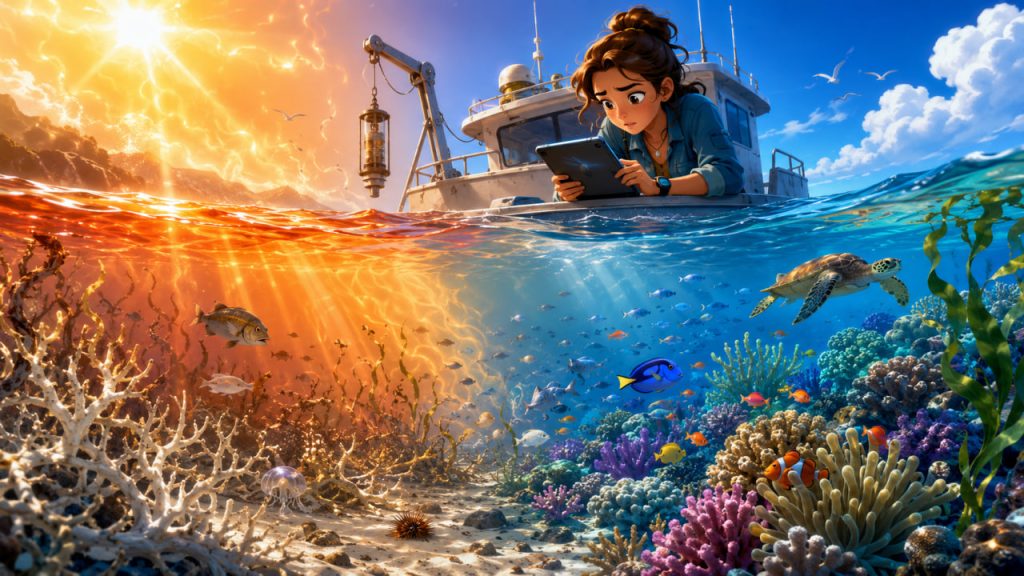
The ocean can have a fever.
When seawater stays unusually warm for days, weeks, months, or even years, scientists call it a marine heatwave. At first, a few extra degrees may not sound catastrophic. But in the ocean, small temperature changes can trigger massive biological consequences.
Corals bleach. Kelp forests collapse. Fish move away. Seabirds starve. Shellfish die in shallow waters. Toxic algal blooms spread. Entire food webs can shift into a new and less stable state.
Marine heatwaves are among the clearest signs that climate change is not only warming the air — it is transforming the ocean itself.
What Is a Marine Heatwave?
A marine heatwave is a period when ocean temperatures are unusually high for a specific location and season.
One widely used definition describes a marine heatwave as seawater temperature above the 90th percentile of historical observations for at least several days. In simple language, the water is hotter than it normally is for that place and time of year.
This matters because marine organisms are adapted to local temperature ranges. A tropical coral, a cold-water kelp forest, and a salmon population do not respond to heat in the same way.
A marine heatwave is not just “warm water.” It is abnormal heat for a particular ecosystem.
NOAA tracks marine heatwaves by measuring their duration, intensity, and spatial coverage, because these events can affect fisheries, coastal communities, cultural practices, and ecosystem health.
Why Ocean Heat Waves Are Increasing
The ocean absorbs a huge amount of excess heat from global warming. NASA explains that around 90 percent of the excess heat trapped by global warming is absorbed by the ocean, and this added heat has contributed to more frequent and intense marine heatwaves.
That heat does not simply disappear. It accumulates in surface waters, deeper layers, currents, coastal zones, and enclosed seas.
Marine heatwaves can be intensified by several factors:
- Long periods of calm weather
- Weak winds that reduce mixing
- Unusual ocean currents
- Strong sunlight
- Climate patterns such as El Niño
- Reduced upwelling of cold deep water
- Long-term global ocean warming
Climate change raises the baseline. That means natural warm periods now start from a warmer ocean.
When the background ocean is already hotter, it takes less extra heat to push ecosystems into danger.
How Marine Heatwaves Stress Marine Life
Marine animals and plants live within thermal limits.
If water becomes too warm, organisms must spend more energy just to survive. Their metabolism changes. Their oxygen demand increases. Their growth, reproduction, immune function, and feeding behavior can be disrupted.
Some species can move to cooler waters. Others cannot.
Fast-swimming fish may shift north, dive deeper, or leave coastal areas. But corals, kelp, seagrasses, shellfish, sponges, and many bottom-dwelling organisms are stuck in place.
This creates winners and losers.
Warm-water species may expand. Cold-water species may shrink. Predators may lose prey. Fisheries may lose target species. Food webs may become unstable.
Marine heatwaves do not affect single species in isolation. They rearrange relationships across entire ecosystems.
Coral Bleaching: The Most Visible Warning
Coral reefs are especially vulnerable to marine heatwaves.
Corals live in partnership with tiny algae inside their tissues. These algae provide much of the coral’s food through photosynthesis. When water becomes too warm for too long, corals become stressed and expel the algae.
The coral turns pale or white. This is called coral bleaching.
Bleached corals are not always dead, but they are weakened. If heat stress continues, they can starve and die.
NOAA notes that rising marine heatwaves can increase coral mortality and damage the ecosystem services reefs provide. The prolonged 2023 marine heatwave in the Atlantic, Gulf region, and Caribbean caused a severe bleaching event across the region.
A coral reef can take decades to grow and only weeks of extreme heat to suffer devastating damage.
Kelp Forests and the Collapse of Underwater Cities
Kelp forests are another ecosystem at risk.
Kelp thrives in cool, nutrient-rich water. These underwater forests provide habitat for fish, sea otters, invertebrates, and many other species. They also store carbon, reduce wave energy, and support coastal fisheries.
During marine heatwaves, kelp can weaken or die. Warm water may also reduce nutrient supply if it strengthens ocean layering and blocks cold, nutrient-rich water from rising.
When kelp declines, grazers such as sea urchins can sometimes expand and prevent recovery. The ecosystem may shift from a dense kelp forest to an urchin-dominated barren.
Once a kelp forest collapses, simply cooling the water may not be enough to bring it back quickly.
This is why scientists worry about regime shifts: ecosystem changes that become difficult to reverse.
The Blob: A Famous Marine Heatwave
One of the best-known marine heatwaves was the northeast Pacific event often called “The Blob.”
It developed in the early 2010s and affected a vast region from the Gulf of Alaska toward the West Coast of North America.
NOAA describes the 2013–2017 marine heatwave known as “The Blob” as having devastating effects throughout the ecosystem, including impacts on ocean life and fisheries.
This event was linked to changes in plankton, fish distribution, seabird die-offs, harmful algal blooms, and marine mammal food stress.
The Blob showed how a large marine heatwave can spread consequences across an entire ocean region.
Ocean heat can move through the food web like a shockwave.
How Marine Heatwaves Cause Mass Die-Offs
Mass die-offs happen when heat stress exceeds what organisms can tolerate.
But the mechanism is not always direct overheating.
Marine heatwaves can kill ecosystems through several pathways:
- Heat stress damages cells and tissues.
- Warm water holds less oxygen.
- Animals need more oxygen as metabolism rises.
- Food sources move away or collapse.
- Harmful algal blooms become more likely.
- Diseases may spread more easily.
- Reproduction fails during critical seasons.
- Habitat-forming species such as coral or kelp die.
This means marine heatwaves often combine with other stressors.
Overfishing, pollution, acidification, low oxygen, habitat destruction, and disease can make ecosystems less able to recover.
Heat is often the trigger, but vulnerability determines the scale of collapse.
Fisheries and Food Security
Marine heatwaves can seriously disrupt fisheries.
Fish may move into cooler waters, migrate earlier, dive deeper, or avoid traditional fishing grounds. This can leave fishers searching in the wrong place at the wrong time.
Some species may decline. Others may appear in new regions. Processing plants, local markets, Indigenous food systems, and coastal economies can all be affected.
Aquaculture is also vulnerable. Farmed shellfish, salmon, and other species may suffer during extreme heat, especially in shallow or enclosed waters with low oxygen.
The IPCC reports that open-ocean, coastal, and shelf-sea ecosystems have experienced mass mortalities from marine heatwaves with very high confidence. It also notes that climate-driven ocean changes increase the risk of rapid ecosystem shifts.
When marine heatwaves damage ecosystems, they also damage human food systems.
Why Warm Water Can Mean Less Oxygen
Warm water holds less dissolved oxygen than cold water.
At the same time, many marine organisms need more oxygen when temperatures rise because their metabolism speeds up.
This creates a dangerous squeeze.
There is less oxygen available, but animals need more of it.
Marine heatwaves can also strengthen stratification, meaning the ocean becomes more layered. Warm surface water can sit above cooler deep water, reducing mixing. That can prevent oxygen and nutrients from moving through the water column.
Marine heatwaves are not only a temperature problem. They can become an oxygen problem too.
This is especially dangerous in coastal waters, estuaries, and areas already prone to low oxygen.
Expert Perspective
Marine heatwave research has grown rapidly in recent years, and scientists now treat these events as major climate hazards rather than unusual curiosities.
The IPCC states that marine heatwaves have approximately doubled in frequency since the 1980s, with high confidence, and that human influence has very likely contributed to most of them since at least 2006.
That expert assessment is important because it separates marine heatwaves from random ocean variability.
The scientific message is not that every warm patch of ocean is caused by climate change. The message is that human-driven warming is making extreme ocean heat more likely, more intense, and more damaging.
Can Ecosystems Recover?
Some ecosystems can recover after a marine heatwave.
If the heat is short, if the ecosystem was healthy before the event, and if key species survive, recovery may be possible.
But repeated heatwaves reduce recovery time.
A coral reef that bleaches once may recover. A reef that bleaches repeatedly every few years may not. A kelp forest may regrow after one warm season, but not if grazers take over and prevent young kelp from establishing.
Recovery depends on:
- Heatwave duration
- Heatwave intensity
- Species tolerance
- Genetic diversity
- Local pollution levels
- Fishing pressure
- Disease outbreaks
- Availability of nearby healthy populations
- Frequency of repeated heat events
Ecosystems can survive stress, but they need time and space to heal.
How Scientists Monitor Marine Heatwaves
Scientists track marine heatwaves using satellites, buoys, ships, autonomous floats, underwater sensors, and computer models.
Satellites measure sea surface temperature across huge areas. Buoys provide local real-time data. Ocean models help forecast where heatwaves may form or persist.
NOAA, NASA, and other scientific organizations monitor marine heatwaves because early warning can help fisheries, conservation teams, coral reef managers, and coastal communities prepare. NOAA’s Physical Sciences Laboratory and Coral Reef Watch are examples of systems used to track heatwave and bleaching risk.
Forecasts cannot prevent every impact, but they can help people act sooner.
What Can Be Done?
The biggest long-term solution is respectful attitude towards nature.
Because ocean warming increases the risk of marine heatwaves, limiting global warming is essential for reducing future damage.
Local protection also matters.
Communities and governments can improve resilience by:
- Reducing nutrient pollution
- Protecting marine reserves
- Preventing overfishing
- Restoring kelp, seagrass, mangroves, and reefs
- Monitoring harmful algal blooms
- Supporting climate-smart fisheries
- Creating early-warning systems
- Protecting cooler refuges where species can survive
Global climate action lowers the heat pressure. Local ecosystem protection improves survival chances.
Both are needed.
Why Marine Heatwaves Matter Now
Marine heatwaves are not distant future events. They are already reshaping oceans.
They reveal how climate change works below the surface, beyond the headlines about land heat waves and melting ice.
The ocean may look calm from above, but its living systems are sensitive to temperature. A few degrees of warming can decide whether a reef survives, whether kelp forests remain, whether fish stay near a coast, and whether seabirds find food.
Marine heatwaves are a warning that the ocean’s buffering power has limits.
When the ocean absorbs our excess heat, marine life pays the price.
Interesting Facts
- Marine heatwaves can last for days, months, or even years.
- The term “marine heatwave” became widely used only relatively recently.
- Some marine heatwaves are detected mainly through satellite temperature data.
- Coral bleaching happens when stressed corals lose their symbiotic algae.
- Warm water holds less oxygen than cold water.
- Kelp forests can collapse after prolonged warm-water events.
- Fish may shift their ranges during marine heatwaves, affecting fisheries.
- Marine heatwaves can increase the risk of harmful algal blooms.
- The northeast Pacific marine heatwave known as “The Blob” affected many species across the food web.
- Repeated marine heatwaves can prevent ecosystems from recovering between events.
Glossary
- Marine Heatwave — A period of unusually high ocean temperature for a specific place and season.
- Sea Surface Temperature — The temperature of the upper layer of the ocean.
- Coral Bleaching — A stress response in which corals lose the algae that give them color and much of their food.
- Kelp Forest — An underwater ecosystem formed by large brown seaweeds in cool, nutrient-rich waters.
- Stratification — Layering of ocean water that reduces vertical mixing.
- Upwelling — The rise of cold, nutrient-rich deep water toward the surface.
- Harmful Algal Bloom — A rapid growth of algae that can produce toxins or reduce oxygen.
- Regime Shift — A major, lasting change in ecosystem structure and function.
- Dissolved Oxygen — Oxygen present in water and available for aquatic organisms to breathe.
- Climate Resilience — The ability of an ecosystem or community to survive, adapt, and recover from climate stress.