Snow is more than a beautiful winter landscape. In many mountain regions, it is a natural water reservoir.
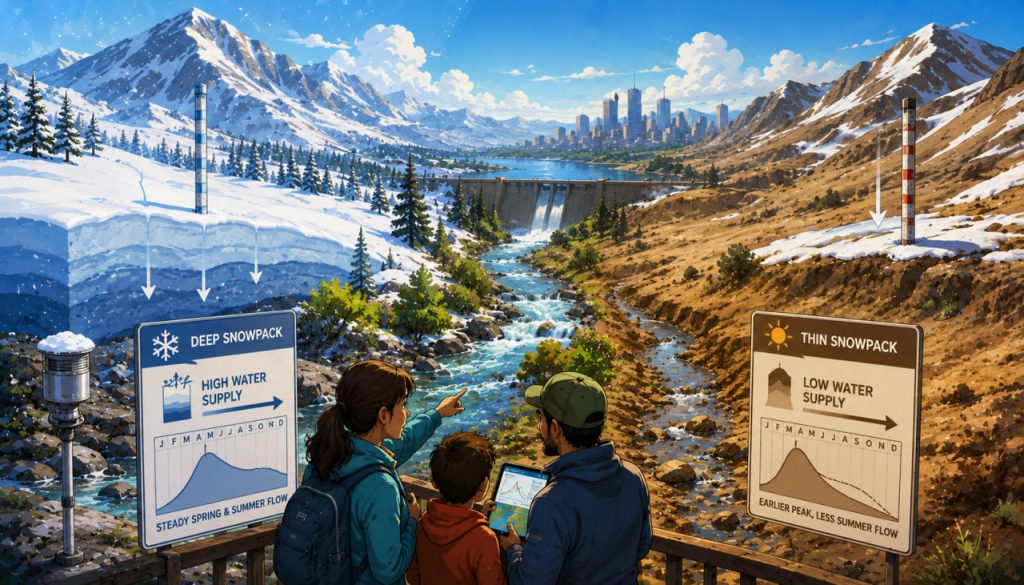
When snow falls in winter and melts slowly in spring and summer, it feeds rivers, reservoirs, farms, forests, hydropower systems, and cities. This stored snow is called snowpack, and its depth is one of the most important indicators of future water availability.
As the climate warms, snowpack is changing. In many regions, winters are shorter, more precipitation falls as rain instead of snow, snow melts earlier, and mountain water systems become less predictable.
A thinner snowpack does not only mean less snow for skiing. It can mean less water for drinking, farming, electricity, ecosystems, and entire regional economies.
What Is Snowpack?
Snowpack is the accumulated layer of snow on the ground, especially in mountains and cold regions.
It builds during the cold season as repeated snowstorms add new layers. Over time, these layers compact, freeze, melt slightly, refreeze, and transform into a dense seasonal water reserve.
Scientists measure snowpack in several ways.
One key measurement is snow depth, which tells how deep the snow layer is. Another is snow water equivalent, often called SWE, which measures how much liquid water would result if the snowpack melted completely.
Snow depth tells us how much snow is physically on the ground. Snow water equivalent tells us how much water is stored inside it.
For water supply, SWE is often more important than depth because fluffy snow and dense wet snow can contain very different amounts of water.
Why Snowpack Is a Natural Reservoir
Mountain snowpack works like a delayed-release water system.
Instead of rainwater rushing quickly into rivers during winter storms, snow stores water in frozen form. Then, as temperatures rise in spring, meltwater flows gradually into streams, lakes, aquifers, and reservoirs.
This timing is essential.
Many dry regions depend on snowmelt during spring and summer, when rainfall may be limited and water demand is high. Farms need irrigation. Cities need drinking water. Hydropower plants need river flow. Ecosystems need cool water for fish and wetlands.
Snowpack turns winter precipitation into summer water.
When that storage system weakens, water managers lose one of nature’s most reliable tools.
How Warming Reduces Snow Depth
Climate warming affects snowpack in several connected ways.
First, warmer air raises the snowline. The snowline is the elevation above which precipitation falls as snow and below which it falls as rain.
As temperatures increase, lower mountain slopes receive more rain and less snow. That means snowpack shrinks in areas that historically stored large amounts of winter water.
Second, warmer winters shorten the snow season. Snow may arrive later in autumn and disappear earlier in spring.
Third, warm spells during winter can melt snow before the main runoff season begins. If rain falls on snow, it can accelerate melting and create flood risk.
Fourth, warmer spring temperatures cause earlier snowmelt. Water may flow into rivers before farms, cities, and ecosystems need it most.
Warming does not simply reduce snow. It changes when, where, and how water moves through the landscape.
Rain Instead of Snow: A Major Shift
One of the biggest changes in a warming climate is the shift from snowfall to rainfall.
This is especially important in mountain regions near the freezing point. A small temperature increase can determine whether a storm adds to the snowpack or runs off immediately as rain.
Rain behaves very differently from snow.
Snow stores water. Rain moves quickly.
When winter precipitation falls as rain, rivers may rise too early, reservoirs may fill at the wrong time, and water may be harder to save for summer.
This creates a timing mismatch.
Water arrives when demand is lower and disappears when demand is higher.
The loss of snow storage can make water supply less reliable even if total annual precipitation does not fall dramatically.
Earlier Snowmelt and the Spring Runoff Problem
Earlier snowmelt is one of the most important water-supply consequences of warming.
In a stable snow system, meltwater increases gradually as spring temperatures rise. This supports rivers for weeks or months.
But when snow melts earlier, peak runoff shifts earlier too.
That creates problems for reservoirs and water managers. If too much water arrives early, reservoirs may need to release some of it to prevent flooding. Later in summer, when heat and water demand rise, there may be less stored water available.
This is especially challenging in regions that rely on snowmelt-fed rivers.
Earlier runoff can create both spring flood pressure and late-summer water shortages.
The same water that once supported August irrigation may now rush downstream in April or May.
Why Snowpack Matters for Cities
Many cities depend on mountain snowpack even if they are far from the mountains.
Snowmelt feeds rivers, reservoirs, and aqueducts that supply drinking water to urban populations. Cities in western North America, parts of Europe, Central Asia, the Andes, and the Himalayas all rely on seasonal snow and mountain runoff in different ways.
When snowpack is low, cities may face water restrictions, higher treatment costs, reservoir stress, and competition with farms and ecosystems.
Urban growth makes this more difficult.
More people mean more water demand. A shrinking or less reliable snowpack means less dependable supply.
The snow that falls in mountains can determine the water security of cities hundreds of kilometers away.
Why Farmers Depend on Snowmelt
Agriculture is one of the largest water users in many regions.
Farmers often depend on snowmelt-fed irrigation during the growing season. When snowpack is deep and melts gradually, irrigation systems can receive steady water.
When snowpack is shallow, melts early, or disappears during drought years, farmers may face shortages just as crops need water most.
This can affect:
- Crop yields
- Planting decisions
- Livestock feed
- Food prices
- Groundwater pumping
- Rural economies
- Conflicts over water rights
In some places, farmers compensate by pumping more groundwater. But if groundwater is removed faster than it recharges, aquifers decline.
A weak snowpack can transfer pressure from rivers to underground water reserves.
Hydropower and Energy Reliability
Snowpack also supports hydropower.
Hydropower plants use flowing water to generate electricity. In snow-fed river systems, meltwater can provide a predictable seasonal energy source.
When snowmelt timing changes, hydropower planning becomes harder.
Earlier runoff may increase generation at one time of year but reduce it later, especially during hot months when electricity demand rises because of air conditioning.
Drought years can reduce reservoir levels and limit hydropower output. This may force grids to rely on other energy sources.
Snowpack is not only a water issue. It is also an energy issue.
As climate change reshapes runoff, power systems must adapt to more variable water availability.
Ecosystems Need Cold Snowmelt Too
Snowmelt supports ecosystems in ways that are easy to overlook.
Cold meltwater helps maintain stream temperatures suitable for fish such as trout and salmon. Seasonal flows support wetlands, riparian forests, alpine meadows, and groundwater recharge.
When snowmelt declines or arrives too early, streams can become warmer and lower in summer. That stresses fish, insects, amphibians, and plants.
Forests can also suffer. If snow disappears earlier, soils may dry out sooner, increasing drought stress and wildfire risk.
Snowpack is part of a living water cycle, not just a human resource.
Less snow can mean hotter rivers, drier soils, weaker forests, and more vulnerable wildlife.
Expert Perspective
Hydrologists often describe snowpack as a “frozen reservoir.” This phrase captures its central role: snow stores water naturally, then releases it slowly when temperatures rise.
Climate scientists and water managers increasingly emphasize that warming changes both the amount and timing of snowmelt. The most important concern is not only whether a region receives less precipitation, but whether precipitation still arrives in a form that can be stored as snow.
The expert message is clear: water systems designed around historical snow patterns may become less reliable as warming shifts snowfall, melt timing, and runoff behavior.
This is why modern water planning increasingly includes climate projections, snow monitoring, reservoir rule updates, groundwater management, and drought preparedness.
Can More Winter Storms Solve the Problem?
A warmer atmosphere can hold more moisture, and some regions may still receive heavy winter storms.
But more precipitation does not automatically mean more snowpack.
If temperatures are too warm, storms bring rain instead of snow. If snow falls but is followed by warm rain, it may melt quickly. If spring arrives earlier, even a strong winter snowpack may disappear sooner than expected.
There can also be extreme variability.
One year may bring record snow, while the next brings severe snow drought. This makes planning difficult.
The future of snowpack is not just less snow everywhere. It is more volatility, more rain-snow uncertainty, and less dependable seasonal storage.
Snow Drought: When Winter Looks Wrong
A snow drought happens when snowpack is unusually low for the time of year.
There are two main types.
A dry snow drought occurs when there is not enough precipitation. A warm snow drought occurs when precipitation falls, but too much of it falls as rain or melts quickly because temperatures are too high.
Warm snow droughts are especially important in a warming climate.
A region may receive storms but still fail to build snowpack.
This can be confusing for the public because rainy winters may feel wet, yet water storage may still be poor.
A wet winter is not always a good snowpack winter.
How Communities Can Adapt
Communities can prepare for changing snowpack, but adaptation requires planning.
Water systems may need to improve reservoir operations, expand groundwater recharge, repair leaks, recycle wastewater, protect watersheds, and modernize irrigation.
Cities can reduce demand through efficient appliances, drought-tolerant landscaping, pricing reforms, and stormwater capture.
Farmers can adapt with drip irrigation, soil moisture conservation, crop switching, improved forecasting, and better groundwater management.
Ecosystem protection also matters. Forests, wetlands, meadows, and healthy soils can slow runoff, filter water, and support natural storage.
The best response is not one solution. It is a portfolio: conservation, storage, smarter management, ecosystem restoration, and emissions reduction.
Why Snowpack Is a Climate Signal
Snowpack is one of the clearest signs of climate change because it responds directly to temperature.
When winters warm, the freezing line shifts. When springs warm, melt begins earlier. When heat waves arrive sooner, snow disappears faster.
This makes snowpack a sensitive indicator of regional climate change.
It also makes it emotionally visible. People notice shorter ski seasons, exposed mountain slopes, lower reservoirs, dry rivers, and changing spring landscapes.
But the deeper issue is water security.
When snowpack declines, the effects flow downhill into farms, cities, power grids, forests, and ecosystems.
Interesting Facts
- Snowpack can act like a natural mountain reservoir.
- Snow water equivalent measures how much water is stored in snow.
- Warm snow droughts can happen even during rainy winters.
- Earlier snowmelt can increase spring flood risk and summer drought risk.
- Many cities depend on snow that falls far away in mountain watersheds.
- Rain-on-snow events can trigger rapid runoff and flooding.
- Snow reflects sunlight, helping keep mountain regions cooler.
- Low snowpack can increase pressure on groundwater pumping.
- Cold snowmelt helps protect fish in summer streams.
- Climate warming can raise the elevation where snow can reliably accumulate.
Glossary
- Snowpack — The accumulated layer of snow on the ground, especially in mountains.
- Snow Depth — The measured height of snow from the ground surface to the top of the snow layer.
- Snow Water Equivalent — The amount of liquid water contained in a snowpack.
- Snowline — The elevation or boundary above which snow persists or precipitation falls as snow.
- Runoff — Water from rain or melting snow that flows over land into streams, rivers, or reservoirs.
- Snowmelt — Water released when snow melts.
- Snow Drought — A period when snowpack is much lower than normal.
- Rain-on-Snow Event — Rain falling onto existing snow, often causing rapid melting and runoff.
- Watershed — An area of land where water drains into a common river, lake, or reservoir.
- Groundwater Recharge — The process by which water soaks into the ground and replenishes underground aquifers.