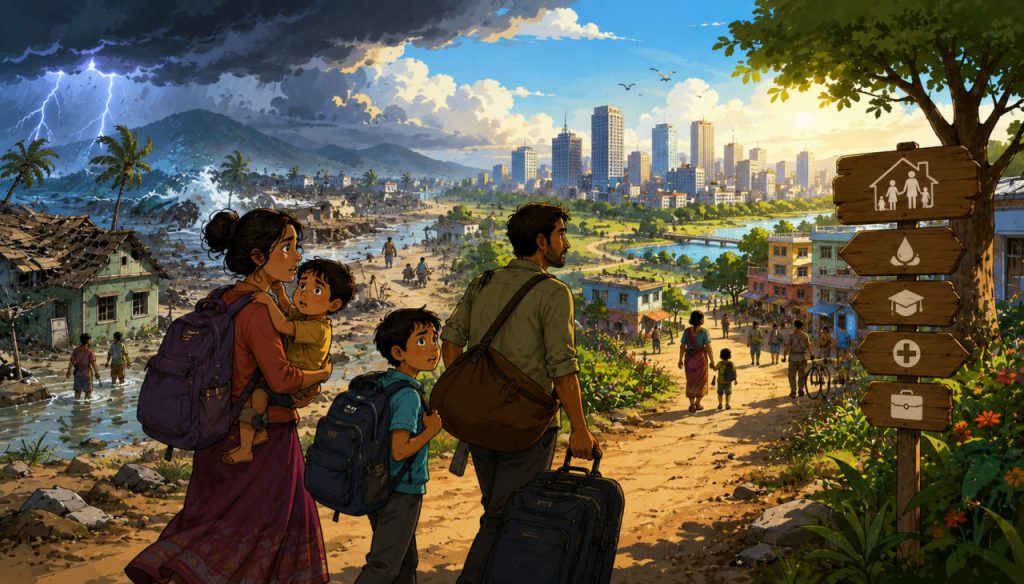
Climate migration is no longer a distant future scenario. It is already shaping cities, coastlines, farms, borders, economies, and family decisions around the world.
When homes flood repeatedly, crops fail, wells dry up, coastlines erode, or extreme heat makes outdoor work dangerous, people begin asking one urgent question: should we stay, adapt, or move?
Climate migration means human movement influenced by climate-related hazards and environmental change. It can be temporary or permanent, forced or planned, local or international. Most often, it happens within the same country rather than across borders.
The subject is complex because people rarely move for one reason only. Climate pressure usually combines with poverty, housing costs, conflict, weak infrastructure, job opportunities, family networks, and government policy.
What Is Climate Migration?
Climate migration refers to the movement of people partly or primarily because of climate-related changes.
These changes may be sudden, such as hurricanes, floods, wildfires, landslides, and storm surges. They may also be slow, such as sea-level rise, desertification, drought, salinization, coastal erosion, and declining agricultural productivity.
Some people leave for a few days or weeks after a disaster. Others relocate permanently because returning is unsafe or economically impossible.
Common climate migration drivers include:
- Extreme heat
- Drought
- Crop failure
- Flooding
- Wildfires
- Sea-level rise
- Stronger storms
- Water scarcity
- Coastal erosion
- Loss of fisheries
- Repeated disaster damage
The IPCC states with high confidence that climate hazards linked to extreme events and variability act as direct drivers of involuntary migration and displacement, and also as indirect drivers through damage to climate-sensitive livelihoods.
Climate Migration Is Usually Internal
Popular images often show people crossing international borders. In reality, most climate-related movement happens within countries.
A family may move from a drought-affected village to a nearby town. A coastal household may relocate inland. A farmer may send one family member to a city for work after repeated crop failures.
The World Bank’s Groundswell report estimates that climate change could force up to 216 million people across six world regions to move within their own countries by 2050 without early and effective climate and development action.
This matters because internal migration puts pressure on cities, housing, water systems, schools, healthcare, and labor markets.
Climate migration is not only a border issue. It is a planning issue.
Sudden Disasters: When People Must Leave Fast
Some climate-related movement happens suddenly.
Floods, cyclones, hurricanes, wildfires, and storm surges can force people to evacuate within hours. These movements are often called disaster displacement.
Displacement may be temporary if homes, roads, utilities, and jobs recover quickly. But if damage is repeated or severe, temporary evacuation can turn into long-term relocation.
The Internal Displacement Monitoring Centre reported that disasters triggered 26.4 million internal displacements in 2023, accounting for 56 percent of all internal displacements recorded that year.
Not every disaster is caused by climate change. But warming can intensify several hazards that drive displacement, including heavier rainfall, stronger heat extremes, wildfire conditions, coastal flooding, and some tropical cyclone impacts.
A disaster becomes a migration crisis when people cannot safely return or rebuild.
Slow-Onset Climate Change: The Quiet Driver
Not all climate migration begins with dramatic images of storms.
Sometimes the pressure builds slowly.
A farmer may endure one bad harvest, then another. A fishing community may notice catches declining. A coastal family may see saltwater entering wells. A herder may travel farther each year to find pasture. A city may become too hot for safe outdoor labor during summer peaks.
Slow-onset climate stress can be harder to measure than disaster displacement, but it can be just as powerful.
These gradual pressures often affect livelihoods first. When income disappears, migration becomes a survival strategy.
People may not say, “I moved because of climate change.” They may say, “There was no water, no crop, no work, and no future.”
Sea-Level Rise and Coastal Relocation
Sea-level rise is one of the clearest long-term drivers of climate migration.
Higher seas make coastal flooding more frequent. Storm surges reach farther inland. Saltwater can contaminate freshwater supplies. Shorelines erode. Low-lying islands and river deltas become more vulnerable.
Coastal relocation is especially difficult because people are not just moving from houses. They may be leaving ancestral land, burial sites, fishing grounds, cultural identity, and community networks.
Small island states, delta regions, and low-lying coastal cities face some of the hardest adaptation decisions.
In some places, protective infrastructure such as seawalls may buy time. In others, planned relocation may become unavoidable.
Sea-level rise turns geography into destiny unless communities receive serious adaptation support.
Drought, Farming, and Rural Migration
Drought affects migration by damaging food production and rural livelihoods.
When rainfall becomes unreliable, crops fail more often. Livestock may die. Water prices rise. Debt increases. Families may sell assets, reduce meals, withdraw children from school, or send someone to work elsewhere.
Migration can become a coping strategy.
One person may move to a city and send money home. A whole household may relocate. Young people may leave rural regions because farming no longer offers a stable future.
This does not mean every drought causes migration. Wealth, irrigation, insurance, land rights, government support, crop diversity, and local job markets all shape the outcome.
Climate stress pushes hardest where people have the fewest choices.
The Problem of Trapped Populations
Climate migration is often described as people moving. But one of the most serious problems is that many people cannot move.
They may lack money, documents, transport, health, social networks, or legal permission. Older adults, people with disabilities, low-income families, and marginalized communities may be trapped in high-risk places.
This is sometimes called involuntary immobility.
It is a hidden climate injustice.
Moving can be difficult, but being unable to move from danger can be even more dangerous.
Climate migration policy must protect both people who leave and people who cannot leave.
Cities as Climate Migration Destinations
Many climate migrants move toward cities because cities offer jobs, services, education, hospitals, transport, and family networks.
But rapid urban growth can create new risks.
If people arrive in cities without affordable housing, they may settle in informal neighborhoods, floodplains, steep slopes, or heat-exposed districts. That can move people from one climate risk into another.
A drought-displaced family may leave a failing farm only to settle in a city neighborhood vulnerable to flash floods or extreme heat.
This is why urban planning is central to climate migration.
Cities need:
- Affordable housing
- Safe land-use planning
- Reliable water systems
- Heat-resilient design
- Public health services
- Flood protection
- Job access
- Inclusive schools
- Legal and social support
Climate migration can be manageable when cities prepare. It becomes dangerous when cities ignore it.
Expert Perspective
The IPCC frames migration as one possible response to climate risk, but not always a failure. Migration can be forced and traumatic, but it can also be adaptive when it is safe, planned, supported, and voluntary.
The IPCC notes that reducing future risks of involuntary migration and displacement is possible by improving existing migration outcomes, addressing vulnerability, supporting local adaptation, and meeting development objectives.
This expert perspective is important: the goal is not simply to stop people from moving. The goal is to prevent desperate displacement and make mobility safer when it becomes necessary.
The World Bank also emphasizes that early climate action and development planning could greatly reduce the scale of internal climate migration.
Climate Migration and Conflict
Climate migration is sometimes linked to conflict, but the relationship is not simple.
Climate stress can increase pressure on land, water, jobs, and public services. In fragile regions, this can worsen existing tensions. But climate change does not automatically cause conflict or violence.
Governance matters. Economic opportunity matters. Social inclusion matters. Legal rights matter.
A drought in one place may lead to cooperation and adaptation. In another, it may intensify competition and displacement.
Climate change is best understood as a risk multiplier, not a single-cause explanation for human movement or conflict.
Can Climate Migration Be Prevented?
Some climate migration can be reduced through adaptation.
For example, improved irrigation, drought-resistant crops, early warning systems, flood defenses, cyclone shelters, wildfire planning, ecosystem restoration, and heat-resilient housing can help people stay safely where they live.
But not all movement should be prevented.
Sometimes migration is the safest and most rational option. Planned relocation may protect lives before a catastrophic disaster occurs.
The real goal is choice.
People should not be forced to stay in places that are becoming unlivable. They also should not be forced to leave places that could be protected with fair investment.
Successful climate policy gives people safer options before crisis arrives.
What Governments Need to Do
Climate migration requires long-term planning.
Governments need to identify high-risk regions, invest in adaptation, protect displaced people, support receiving communities, and create legal pathways for people who must move.
Practical steps include:
- Mapping future climate hotspots
- Investing in rural resilience
- Upgrading urban infrastructure
- Protecting coastal communities
- Strengthening disaster insurance
- Creating planned relocation frameworks
- Supporting migrants’ rights
- Improving early warning systems
- Respectful attitude towards nature
- Funding climate adaptation in vulnerable countries
The World Bank estimates that the scale of internal climate migration could be reduced substantially with strong climate and development action.
The future of climate migration depends heavily on decisions made before people are forced to flee.
The Human Side of Climate Migration
Behind every climate migration statistic is a personal story.
A farmer leaves because rain no longer comes on time. A family relocates after the third flood destroys their home. A coastal elder resists leaving land tied to generations of memory. A young worker moves to a city and sends money home. A child grows up in a temporary settlement that becomes permanent.
Climate migration is not only about movement. It is about identity, dignity, safety, culture, livelihood, and belonging.
The biggest mistake is treating people as numbers on a map.
Climate migrants are not symbols of crisis. They are people making difficult decisions under pressure.
P.S. Given the dramatic increase in climate disasters over the past 50 years, I recommend that everyone, while things are going well, study what’s happening on the planet—talk to the neural network, prepare you and your family for possible disasters, and learn kindness, love, and humanity before disaster strikes your home…
Interesting Facts
- Most climate-related migration occurs within national borders.
- Climate migration can be temporary, seasonal, circular, or permanent.
- Slow climate pressures, such as drought and sea-level rise, can be as important as sudden disasters.
- Some people are trapped in dangerous areas because they cannot afford to move.
- Cities are major destinations for climate migrants.
- Planned relocation is easier and safer when communities are involved early.
- Climate migration can be an adaptation strategy when it is voluntary and supported.
- Sea-level rise can threaten freshwater supplies through saltwater intrusion.
- Disaster evacuation is not always the same as permanent migration.
- Strong adaptation policies can reduce forced displacement.
Glossary
- Climate Migration — Human movement influenced by climate-related hazards or environmental change.
- Displacement — Forced movement from home, often caused by disaster, conflict, or danger.
- Internal Migration — Movement within the same country.
- Cross-Border Migration — Movement from one country to another.
- Slow-Onset Event — A gradual environmental change, such as drought, desertification, or sea-level rise.
- Planned Relocation — Organized movement of people away from high-risk areas before or after danger becomes unacceptable.
- Adaptation — Adjustments that reduce harm from climate change.
- Trapped Population — People who face danger but cannot move because of poverty, health, legal barriers, or lack of resources.
- Livelihood — The way people earn income or meet basic needs.
- Risk Multiplier — A factor that worsens existing social, economic, or political pressures.