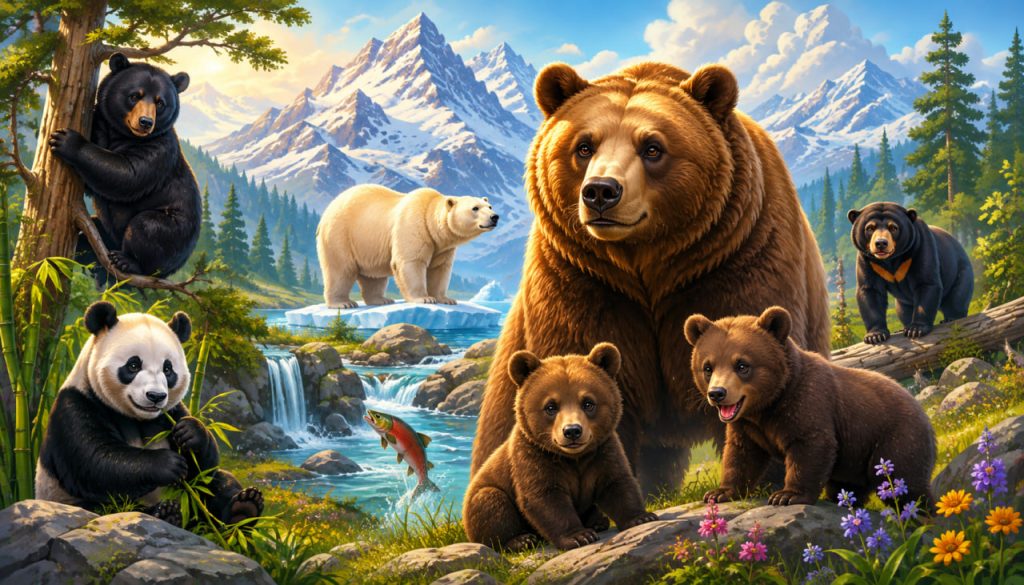
Bears are among the most recognizable wild animals on Earth. They appear in ancient myths, national symbols, children’s stories, wildlife documentaries, and conservation campaigns.
Yet real bears are far more complex than their popular image suggests.
They are not simply giant forest predators. Bears are intelligent, adaptable mammals with strong senses, flexible diets, impressive memory, and important ecological roles.
From the frozen Arctic to tropical forests, bears have learned to survive in some of the planet’s most challenging habitats. Understanding bears means understanding power, patience, intelligence, and the delicate balance between wildlife and human activity.
What Are Bears?
Bears belong to the family Ursidae, a group of large mammals found across North America, South America, Europe, and Asia.
Modern bears include eight living species:
- Brown bear
- American black bear
- Polar bear
- Asian black bear
- Sloth bear
- Sun bear
- Spectacled bear
- Giant panda
Although these species look different, they share several important features.
Most bears have strong bodies, large paws, short tails, excellent smell, and plantigrade feet, meaning they walk with the full sole of the foot touching the ground.
This gives bears a heavy, deliberate walking style, but it does not make them slow. Many bears can run surprisingly fast over short distances.
Where Bears Live
Bears occupy a wide range of habitats.
Brown bears live in forests, mountains, tundra, river valleys, and coastal regions. American black bears are highly adaptable and can survive in forests, swamps, mountains, and areas close to human settlements.
Polar bears are specialized for Arctic sea ice and coastal environments. Giant pandas live mainly in mountain bamboo forests in China. Sun bears inhabit tropical forests in Southeast Asia, while spectacled bears live in the Andes Mountains of South America.
This diversity shows one of the most impressive things about bears: they can adapt to very different worlds, as long as they have food, shelter, space, and safety.
What Bears Eat
Bears are often described as carnivores, but most species are actually omnivores.
Their diets can include:
- Berries
- Nuts
- Roots
- Grasses
- Insects
- Fish
- Small mammals
- Carrion
- Honey
- Eggs
- Bamboo
- Seals
The polar bear is the most carnivorous bear species, relying heavily on seals. The giant panda is the most plant-specialized, feeding mainly on bamboo.
Brown bears and black bears eat whatever is seasonally available. In spring, they may feed on fresh vegetation and carrion. In summer, they may eat insects, fish, and berries. In autumn, they often focus on high-calorie foods such as nuts, salmon, and fruit to build fat for winter.
A bear’s diet is not random. It is a seasonal survival strategy.
Bear Intelligence and Memory
Bears are highly intelligent animals.
They can remember food locations, learn from experience, solve problems, and adjust their behavior based on risk. A bear may remember a productive berry patch, salmon stream, garbage source, or travel route for years.
Their powerful sense of smell helps them locate food across long distances. In some species, smell is the dominant sense, far more important than vision or hearing.
Bears also show curiosity. They investigate unfamiliar objects, explore new areas, and learn quickly when food rewards are involved.
This intelligence is one reason human-bear conflict can become difficult. If a bear learns that human areas provide easy food, it may return repeatedly.
Hibernation and Winter Survival
Many people associate bears with hibernation, but bear winter dormancy is more complex than simply “sleeping through winter.”
In cold regions, brown bears and black bears enter dens and greatly reduce activity. Their heart rate slows, metabolism decreases, and they survive on stored body fat.
Unlike many smaller hibernating mammals, bears do not drop their body temperature extremely low. They can wake if disturbed, and females may give birth during the denning period.
Before winter, bears enter a feeding phase sometimes called hyperphagia. During this time, they eat intensely to gain enough fat reserves.
For bears, autumn feeding can determine winter survival.
Polar bears are different. Pregnant females den to give birth, but many adult males and non-pregnant females remain active through winter if they can hunt on sea ice.
Bear Cubs and Family Life
Bear cubs are born small, helpless, and dependent.
Mother bears are highly protective. Cubs stay with their mother for months or years, depending on the species and environment. During this time, they learn what to eat, where to travel, how to avoid danger, and how to behave in their habitat.
Male bears usually do not help raise cubs. In some cases, adult males can even be dangerous to young bears, so mothers often avoid areas with large males.
Cubs learn by following, watching, smelling, tasting, climbing, playing, and imitating.
This long learning period is one reason bear populations recover slowly. Bears generally reproduce at a slower rate than many smaller mammals.
Are Bears Dangerous?
Bears are powerful wild animals and should always be treated with respect.
However, most bears do not actively hunt humans. Many bear encounters happen because the animal is surprised, defending cubs, guarding food, or attracted to human food waste.
Different bear species and situations require different safety behavior. In general, people should avoid approaching bears, feeding bears, or leaving food unsecured in bear habitat.
Human food is one of the biggest causes of conflict. Once bears connect people with easy calories, they may lose natural caution.
A fed bear is often a bear placed in danger, because food-conditioned bears are more likely to be removed or killed.
Respectful distance, proper food storage, and habitat awareness are essential for coexistence.
Why Bears Matter to Ecosystems
Bears play important ecological roles.
They disperse seeds through their droppings after eating berries and fruits. They dig soil while searching for roots, insects, and small animals, helping disturb and mix the ground. In salmon-rich regions, bears carry fish into forests, moving marine nutrients into terrestrial ecosystems.
Bears may also influence prey populations and scavenger communities. When they leave carcass remains behind, other animals benefit.
In many landscapes, bears act as umbrella species. Protecting enough habitat for bears also protects many other plants and animals that share the same ecosystem.
Expert Perspective
Wildlife biologists often emphasize that bears are not villains or harmless pets. They are intelligent wild mammals whose behavior is shaped by food, habitat, reproduction, and human pressure.
Bear conservation expert Stephen Herrero, known for his work on bear behavior and bear safety, has long highlighted that many dangerous encounters can be reduced through education, proper food management, and understanding bear behavior.
This expert view is important: bear safety is not only about controlling bears. It is about changing human behavior in bear country.
When people secure food, respect distance, and understand seasonal bear activity, coexistence becomes far more realistic.
Threats Facing Bears Today
Bears face different threats depending on the species and region.
Major challenges include:
- Habitat loss
- Climate change
- Illegal hunting
- Road collisions
- Human-wildlife conflict
- Loss of natural food sources
- Fragmented landscapes
- Pollution
Polar bears are especially threatened by the loss of Arctic sea ice, which they need for hunting seals. Sun bears and Asian black bears are affected by deforestation and illegal wildlife trade. Spectacled bears face habitat fragmentation in the Andes.
Even adaptable species like black bears can suffer when roads, cities, and agriculture divide their habitats.
Bears and Human Culture
Bears have always held a powerful place in human imagination.
They appear as symbols of strength, courage, wilderness, motherhood, danger, and protection. Many Indigenous cultures have deep traditions connected to bears, often viewing them with respect rather than fear.
Modern culture often turns bears into cute mascots or terrifying monsters. Neither image is fully accurate.
Real bears are neither cartoon characters nor mindless threats. They are living animals with needs, instincts, intelligence, and ecological importance.
The more accurately we understand bears, the better we can protect both people and wildlife.
Interesting Facts
- Polar bears have black skin under their white-looking fur.
- Giant pandas have a carnivore digestive system but eat mostly bamboo.
- Bears can smell food from very long distances, depending on wind and terrain.
- Black bears are excellent climbers, especially when young.
- Brown bears can vary greatly in size depending on food availability and region.
- Sun bears are the smallest bear species and have very long tongues for feeding on insects and honey.
- Spectacled bears are the only bear species native to South America.
- Bear cubs are usually born tiny compared with the size of their mother.
- Some bears use the same travel routes and feeding areas for many years.
Glossary
- Ursidae — The scientific family that includes all bear species.
- Omnivore — An animal that eats both plant and animal foods.
- Carnivore — An animal that mainly eats meat, though the term can also refer to a mammal order.
- Plantigrade — Walking with the full sole of the foot on the ground, as humans and bears do.
- Hibernation — A state of reduced activity and metabolism used by some animals to survive cold or food scarcity.
- Den — A protected shelter where a bear may rest, give birth, or spend winter.
- Hyperphagia — A period of intense feeding before winter dormancy.
- Food-Conditioned Bear — A bear that has learned to associate humans or human areas with food.
- Habitat Fragmentation — The breaking of natural habitats into smaller, disconnected pieces.
- Umbrella Species — A species whose protection also helps many other species sharing the same habitat.