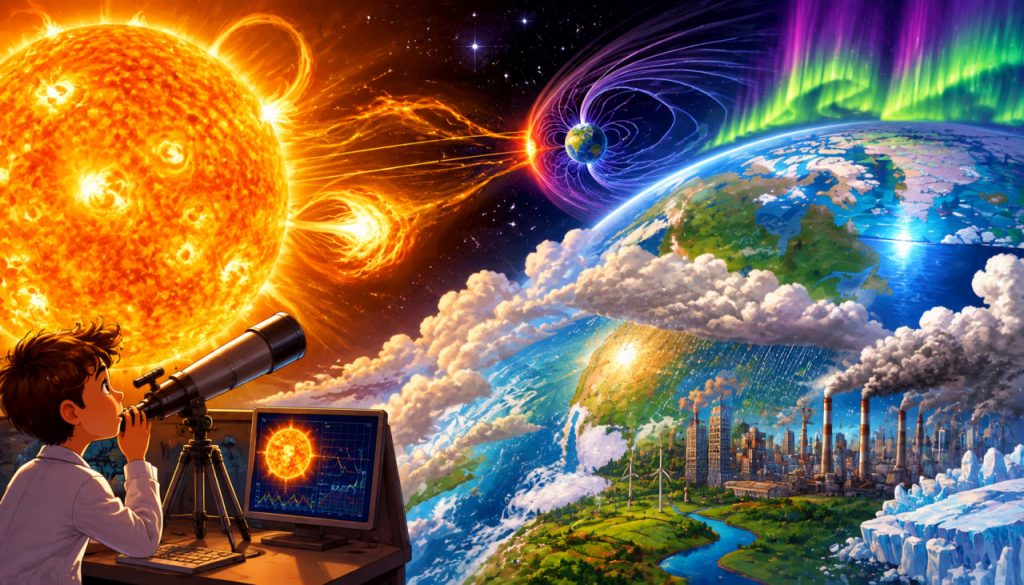
The Sun is the engine of Earth’s climate system. Without sunlight, there would be no weather, no oceans in liquid form, no photosynthesis, and no life as we know it.
So when people ask whether solar activity affects Earth’s climate, the honest answer is: yes, the Sun influences climate — but it does not explain today’s rapid global warming.
This topic is often misunderstood because two things are true at the same time. Solar changes can affect Earth’s atmosphere, ocean patterns, and regional climate.
What Is Solar Activity?
Solar activity describes changes in the Sun’s behavior over time.
These changes include sunspots, solar flares, coronal mass ejections, magnetic storms, and small variations in the amount of solar energy reaching Earth.
The Sun is not a perfectly constant lamp. It has an active magnetic cycle, most famously the 11-year solar cycle. During solar maximum, the Sun has more sunspots and stronger magnetic activity. During solar minimum, it becomes calmer.
However, the total change in solar energy across the 11-year cycle is small. The Sun changes, but not enough to explain the scale and pattern of modern warming.
How the Sun Affects Earth’s Climate
Solar energy reaches Earth as radiation. Some is reflected back into space by clouds, ice, snow, and bright surfaces. The rest is absorbed by land, oceans, and the atmosphere.
This absorbed energy drives:
- Atmospheric circulation
- Ocean currents
- Evaporation and rainfall
- Seasonal temperature patterns
- Wind systems
- Photosynthesis
- The water cycle
On long timescales, changes in Earth’s orbit and solar exposure have contributed to ice ages and warmer periods. These orbital cycles affect how sunlight is distributed across the planet.
But those changes happen over thousands of years. Modern climate change is happening much faster.
The 11-Year Solar Cycle
The 11-year solar cycle is the most familiar short-term pattern in solar activity.
At solar maximum, more sunspots appear. Solar flares and magnetic disturbances are more common. At solar minimum, the Sun’s surface looks calmer.
This cycle can slightly influence the upper atmosphere and may have small effects on regional weather patterns. It can also affect satellites, radio communication, navigation systems, and power grids during strong solar storms.
But the temperature effect on global climate is limited.
If the 11-year solar cycle were the main driver of global warming, Earth’s temperature would rise and fall clearly with each solar cycle. Instead, global temperatures have climbed strongly across several cycles.
Solar Activity and Historical Climate Changes
Solar variability may have played a role in some past climate fluctuations.
One famous example is the Maunder Minimum, a period from roughly 1645 to 1715 when sunspots were unusually rare. This period overlapped with part of the so-called Little Ice Age, when some regions, especially in Europe and North America, experienced colder conditions.
However, the Little Ice Age was not caused by the Sun alone. Volcanic eruptions, ocean circulation changes, atmospheric patterns, and land-use changes also contributed.
This is an important lesson: climate is controlled by multiple forces, not one simple switch.
Solar activity matters, but it is only one piece of a much larger system.
Why Solar Activity Cannot Explain Modern Global Warming
Modern global warming has several clear fingerprints.
The lower atmosphere is warming, while the upper atmosphere has cooled in a way expected from greenhouse gas trapping. Nights have warmed strongly. Oceans have absorbed enormous amounts of extra heat. Land ice and sea ice have declined. The warming pattern matches greenhouse gas forcing far better than solar forcing.
If the Sun were causing the current warming, scientists would expect to see a stronger increase in incoming solar energy. But the long-term rise in global temperature has not been matched by a comparable long-term rise in solar output.
The planet is warming mainly because greenhouse gases trap more heat inside the climate system.
Carbon dioxide, methane, and nitrous oxide absorb infrared radiation that Earth would otherwise emit into space. This strengthens the greenhouse effect and shifts the planet’s energy balance.
Greenhouse Gases vs. Solar Variability
Solar variability changes how much energy comes in.
Greenhouse gases change how much heat escapes.
This difference is crucial.
Imagine a house on a cold day. Solar activity is like changing the brightness of sunlight entering through the windows. Greenhouse gases are like adding thicker insulation that traps heat inside.
Today’s warming is more like the insulation problem. The Earth is receiving sunlight as usual, but more heat is being retained.
Small solar variations cannot account for the large, sustained warming caused by increased greenhouse gas concentrations.
Cosmic Rays and Clouds: An Interesting but Limited Hypothesis
Some theories propose that solar activity may influence climate through cosmic rays.
The idea is that when solar activity is strong, the Sun’s magnetic field blocks more cosmic rays from reaching Earth. Some researchers have suggested that cosmic rays might affect cloud formation, which could then influence climate.
This is an interesting scientific question, but evidence so far does not show that cosmic rays are a major driver of recent global warming.
Clouds are extremely complex. They can cool the planet by reflecting sunlight, but they can also trap heat. Their role depends on altitude, thickness, location, droplet size, and atmospheric conditions.
Cosmic rays may be scientifically fascinating, but they are not a substitute explanation for the observed greenhouse gas-driven warming trend.
Solar Storms and Space Weather
Solar activity can strongly affect technology, even if it does not dominate modern climate change.
Powerful solar storms can disturb Earth’s magnetic field. This can create beautiful auroras, but it can also interfere with satellites, GPS, aviation communication, radio systems, and electrical grids.
This is called space weather.
A major solar storm is not the same as climate change. It is a short-term event caused by solar eruptions and magnetic activity.
Still, modern civilization is more vulnerable to solar storms than past societies because we depend heavily on electronics, satellites, and global communication systems.
Regional Climate Effects
Solar changes may affect some regional climate patterns more than global averages.
For example, variations in ultraviolet radiation can influence the stratosphere, which may interact with wind patterns and atmospheric circulation. Some studies explore links between solar cycles and regional weather shifts.
However, regional effects are difficult to separate from natural variability, ocean cycles, volcanic effects, and human-caused climate change.
The Sun can influence climate patterns, but it does not override the dominant modern warming signal from greenhouse gases.
Expert Perspective
Climate scientists generally agree on a balanced view: the Sun is essential to Earth’s climate system, and solar variability has influenced climate in the past, but recent warming cannot be explained by solar activity.
This expert position is based on several lines of evidence: measurements of solar output, atmospheric temperature patterns, ocean heat content, satellite observations, and the known physics of greenhouse gases.
The key message is practical: solar activity matters for climate science, but it is not the main cause of current global warming.
Understanding this distinction helps avoid two extremes. It is wrong to say the Sun has no climate influence. It is also wrong to blame today’s rapid warming mainly on the Sun.
Why This Topic Matters
The connection between solar activity and climate is important because it helps people understand how science separates natural causes from human causes.
Climate is influenced by many factors:
- Solar radiation
- Greenhouse gases
- Volcanic eruptions
- Ocean circulation
- Clouds
- Ice cover
- Aerosols
- Land-use changes
Scientists compare these factors to see which ones best explain observed temperature trends.
The result is clear: natural factors alone cannot explain modern warming.
Interesting Facts
- The Sun has an approximately 11-year activity cycle.
- Sunspots look dark because they are cooler than surrounding areas on the solar surface.
- Solar storms can create auroras far from the poles during strong magnetic events.
- The Maunder Minimum was a period of very low sunspot activity.
- Earth’s climate is affected not only by how much sunlight arrives, but also by how much heat escapes back into space.
- Greenhouse gases trap infrared radiation, while solar activity changes incoming energy.
- Space weather can affect satellites and power grids without causing long-term climate change.
Glossary
- Solar Activity — Changes in the Sun’s magnetic behavior, radiation, sunspots, flares, and eruptions.
- Solar Cycle — The roughly 11-year pattern of rising and falling solar activity.
- Sunspot — A darker, cooler area on the Sun’s surface linked to magnetic activity.
- Solar Flare — A sudden burst of energy from the Sun’s atmosphere.
- Coronal Mass Ejection — A large eruption of plasma and magnetic field from the Sun.
- Greenhouse Gases — Gases such as carbon dioxide, methane, and nitrous oxide that trap heat in Earth’s atmosphere.
- Greenhouse Effect — The natural and human-strengthened process by which atmospheric gases retain heat.
- Climate Forcing — Any factor that changes Earth’s energy balance and can warm or cool the planet.
- Maunder Minimum — A historical period of unusually low sunspot activity from about 1645 to 1715.
- Little Ice Age — A period of cooler regional climates, especially in parts of the Northern Hemisphere, lasting several centuries.
- Cosmic Rays — High-energy particles from space that can enter Earth’s atmosphere.
- Space Weather — Solar-driven disturbances that affect Earth’s magnetic field, satellites, communication, and power systems.