Schools are entering one of the biggest transformations in modern educational history.
Artificial intelligence, virtual reality, robotics, personalized learning systems, digital laboratories, and new teaching methods are changing what a classroom can be. At the same time, employers increasingly value creativity, communication, problem-solving, adaptability, and technological literacy alongside traditional academic knowledge.
The school of the future will probably not be a building filled with students staring at screens. Instead, the most successful models are likely to combine advanced technology with teachers, collaboration, practical projects, physical activity, creativity, and human interaction.
Education is becoming less about memorizing information and more about learning how to understand, evaluate, apply, and create with it.
Personalized Learning Could Replace the “One-Speed Classroom”
Traditional classrooms usually teach a group of students the same material at roughly the same pace.
The problem is obvious.
Some students understand a topic quickly, while others need more examples and practice. A few may already know much of the material before the lesson begins.
Future learning systems can adapt more precisely.
AI-powered platforms may identify which concepts a student understands, where mistakes repeatedly occur, and what type of explanation works best.
A student struggling with fractions could receive additional visual exercises, while another student in the same class moves on to more advanced mathematics.
Personalized learning does not mean eliminating the teacher. It means giving teachers better tools to understand individual students.
Teachers May Become More Important, Not Less
It is easy to imagine artificial intelligence replacing teachers, but education involves much more than delivering information.
Teachers motivate students, detect emotional problems, manage group dynamics, explain difficult ideas, encourage curiosity, resolve conflicts, and understand when a child needs additional support.
AI can help with routine work.
It may assist with:
- Creating practice exercises
- Checking basic assignments
- Translating learning materials
- Generating explanations
- Tracking student progress
- Identifying knowledge gaps
- Preparing personalized study plans
This could reduce administrative work and allow teachers to spend more time on actual teaching.
The teacher of the future may function increasingly as a mentor, coach, organizer, and expert guide.
Classrooms Could Become Flexible Learning Spaces
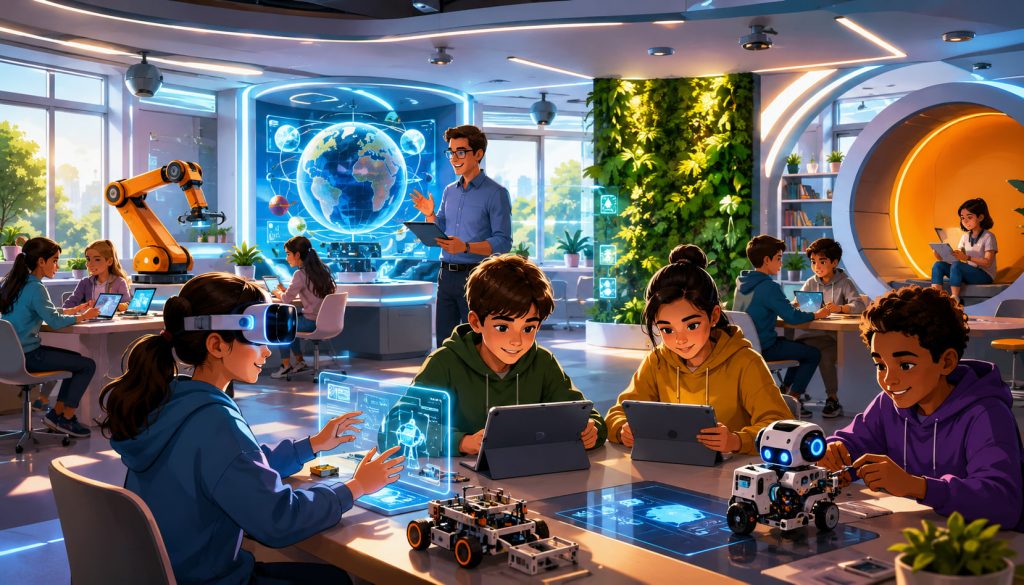
Future schools may look very different from rows of identical desks facing a board.
Classrooms can be divided into different zones for different activities.
One area may be designed for discussion.
Another may contain laboratory equipment.
A third could support individual study.
Students might move between collaborative tables, digital workstations, workshops, and quiet spaces depending on the task.
Furniture may also become modular so rooms can be reorganized quickly.
The purpose is simple: the physical environment should adapt to learning rather than forcing every type of learning into the same classroom layout.
Virtual Reality Could Turn Lessons Into Experiences
Virtual reality and augmented reality could dramatically change subjects that are difficult to visualize.
Students studying ancient Rome might explore a reconstructed city.
A biology class could examine a three-dimensional human heart.
Astronomy students could move through a virtual model of the Solar System.
Chemistry students might manipulate molecular structures without handling dangerous substances.
History could become especially immersive.
Instead of only reading about a historical location, students could examine a carefully reconstructed virtual environment and compare different interpretations of the past.
The greatest educational value of immersive technology is its ability to make abstract concepts easier to understand.
Laboratories Could Become Safer and More Accessible
Science education often depends on access to expensive equipment.
Virtual laboratories can supplement physical experiments.
Students could repeat complex simulations many times without consuming materials or risking injury.
Digital models can also demonstrate phenomena that are difficult to reproduce in a school laboratory, such as nuclear reactions, planetary formation, advanced genetics, or extreme weather.
Physical experimentation will still remain important.
Students need to learn how real materials behave, how measurements are taken, and how unexpected errors occur.
The future is therefore likely to involve a combination of real laboratories and sophisticated simulations.
Robotics Could Become a Standard School Subject
Programming is already becoming common in education, but future schools may move beyond coding on screens.
Students could design and control robots, drones, automated vehicles, sensors, and small manufacturing systems.
Robotics combines several disciplines at once:
- Mathematics
- Physics
- Engineering
- Computer science
- Electronics
- Design
- Teamwork
Building a working machine also teaches an important lesson: failure is part of engineering.
A robot that does not work correctly becomes a practical problem to investigate rather than simply a wrong answer on a test.
Traditional Subjects May Become More Connected
Schools traditionally separate knowledge into subjects such as mathematics, biology, geography, and literature.
Real-world problems rarely follow these boundaries.
Building an energy-efficient house requires mathematics, physics, engineering, economics, environmental science, and design.
Studying a pandemic can involve biology, statistics, history, psychology, geography, and public policy.
Future education may therefore place greater emphasis on interdisciplinary projects.
Students could work on large problems that require knowledge from several subjects simultaneously.
This approach helps explain why the knowledge matters.
Students May Spend More Time Solving Real Problems
Project-based learning is already used in many schools and could become far more common.
Instead of only completing textbook exercises, students might design practical solutions.
They could develop a water-saving system for their school, create a small business model, analyze local biodiversity, design an accessible public space, or build a solar-powered device.
Projects encourage students to research, test ideas, make mistakes, communicate, and divide responsibilities.
These skills closely resemble how many professional teams operate.
Future schools may measure success not only by what students remember, but by what they can do with what they know.
AI Literacy Could Become as Important as Computer Literacy
Students growing up with artificial intelligence will need to understand both its capabilities and its limitations.
Simply knowing how to ask an AI system a question will not be enough.
Students may need to learn how to:
- Verify AI-generated information
- Detect fabricated content
- Understand algorithmic bias
- Protect personal data
- Use AI ethically
- Recognize manipulated images and video
- Work effectively with automated tools
The ability to evaluate information will become increasingly important as generating convincing text, images, audio, and video becomes easier.
Critical thinking may therefore become one of the most valuable educational skills of the future.
Exams Could Change Dramatically
Traditional exams often reward memorization under time pressure.
That made sense when information was difficult to access.
Today, students can retrieve enormous quantities of information almost instantly.
Future assessment may focus more heavily on reasoning, problem-solving, practical projects, presentations, research, and the ability to explain decisions.
AI could also generate individualized assessments.
Two students might receive different versions of the same underlying problem, reducing simple copying while testing the same skills.
However, basic knowledge will still matter.
A person cannot think critically about information they do not understand in the first place.
Schools May Become More Connected to the Real World
Future schools could cooperate more closely with universities, laboratories, companies, museums, farms, hospitals, engineering firms, and community organizations.
Students may participate in internships or short professional projects before graduation.
A teenager interested in engineering might work with a local robotics company.
Another interested in medicine could participate in supervised health-science programs.
This can help students understand careers before committing to long educational paths.
It also makes learning more meaningful by connecting classroom knowledge with real professional environments.
Expert Perspective
Education researcher John Hattie has emphasized through large-scale studies that technology alone does not automatically improve learning.
What matters is how technology is used within effective teaching.
A sophisticated device cannot compensate for unclear instruction, weak feedback, or poorly designed lessons.
This principle is especially important for schools of the future.
Artificial intelligence, virtual reality, and digital platforms should support learning goals rather than become goals themselves.
The strongest future schools are likely to combine advanced tools with excellent teachers, strong relationships, clear expectations, and meaningful feedback.
Mental Health and Social Skills Will Remain Essential
A highly technological school still needs to prepare students for human relationships.
Communication, empathy, cooperation, emotional regulation, leadership, and conflict resolution cannot be ignored.
Schools may increasingly include structured programs focused on well-being, stress management, teamwork, and social development.
Physical exercise and time away from screens will also remain important.
A technologically advanced education system that ignores mental health and human interaction would not truly be advanced.
Schools Could Become More Global
Digital classrooms make international collaboration much easier.
Students from different countries can work together on projects, compare cultures, practice languages, and study the same scientific problems.
Automatic translation could eventually reduce language barriers even further.
A geography project might involve students from several continents collecting local environmental data and combining it into one shared analysis.
Education could become simultaneously more personalized and more international.
Interesting Facts
- Adaptive learning systems can already change the difficulty of exercises based on student performance.
- Virtual reality is being tested for subjects including medicine, engineering, history, and science.
- Some schools already use robots for programming and engineering education.
- AI systems can generate individualized practice questions within seconds.
- Project-based learning often combines several traditional school subjects in one activity.
- Digital simulations can allow students to repeat experiments that would be expensive or dangerous in real laboratories.
- Modern classrooms increasingly use movable furniture designed for collaboration.
- Media literacy is becoming more important because AI can generate realistic synthetic content.
- Future assessments may focus more on portfolios and long-term projects rather than only traditional examinations.
- International digital classrooms can connect students who live thousands of kilometers apart.
Glossary
- Personalized Learning — Education adapted to the abilities, needs, and progress of an individual student.
- Adaptive Learning — A digital learning system that automatically changes content based on student performance.
- Artificial Intelligence — Computer systems designed to perform tasks that normally require aspects of human intelligence.
- Virtual Reality — Technology that places users inside an interactive computer-generated environment.
- Augmented Reality — Technology that adds digital information or objects to a view of the physical world.
- Project-Based Learning — A teaching approach in which students learn by completing extended practical projects.
- Interdisciplinary Learning — Education that combines knowledge and methods from several academic subjects.
- AI Literacy — The ability to understand, evaluate, and responsibly use artificial intelligence systems.
- Media Literacy — The ability to critically evaluate information from media and digital sources.
- Digital Simulation — A computer-generated model used to reproduce processes or experiments.
- Learning Analytics — The collection and analysis of educational data to understand and improve student learning.
- Portfolio Assessment — Evaluation based on a collection of a student’s work produced over time.
- Human-Centered Education — An educational approach that prioritizes students’ intellectual, emotional, social, and practical development.