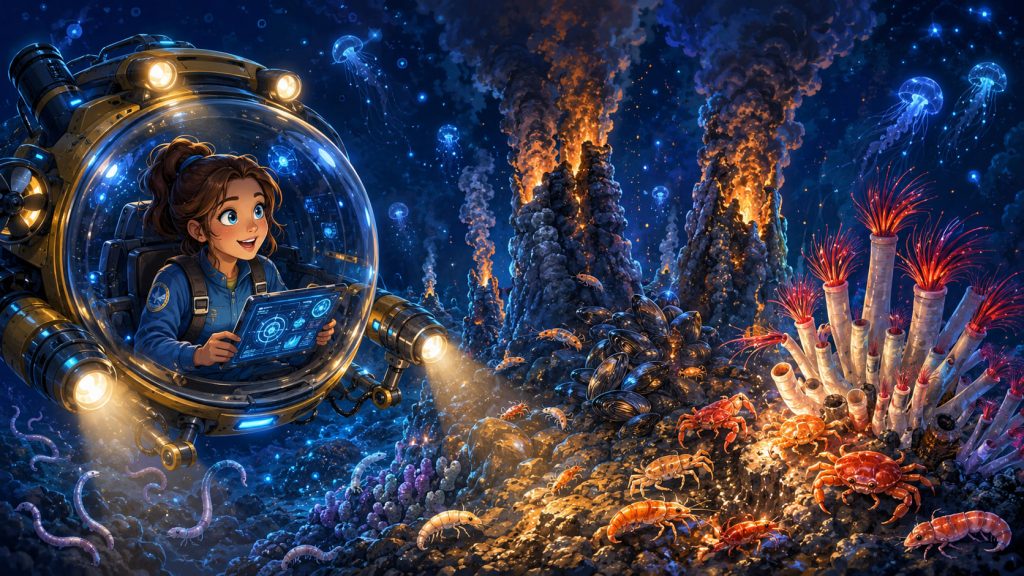
Far below the ocean surface, where sunlight never reaches and the pressure is immense, some of the most extraordinary ecosystems on Earth are thriving.
These environments are built around deep-sea hydrothermal vents, sometimes described as underwater geysers. They release superheated, mineral-rich water from cracks in the ocean floor, often near tectonic plate boundaries.
What makes them remarkable is not just their heat or strange appearance. It is the fact that entire communities of organisms survive without depending directly on sunlight.
Instead of photosynthesis, these ecosystems are powered by chemistry.
What Are Deep-Sea Hydrothermal Vents?
Hydrothermal vents form when seawater seeps into cracks in the oceanic crust.
Deep underground, the water is heated by hot rock and magma.
As it warms, it reacts with minerals in the crust and becomes enriched with substances such as:
- Hydrogen sulfide
- Iron
- Manganese
- Methane
- Other dissolved minerals
The heated water then rises and escapes back into the ocean through openings in the seafloor.
Some vent fluids can reach temperatures above 300°C.
Surprisingly, the water does not immediately boil because the enormous pressure of the deep ocean changes the conditions under which boiling occurs.
Black Smokers and White Smokers
One of the most dramatic types of hydrothermal vent is the black smoker.
These structures resemble underwater chimneys.
When extremely hot, mineral-rich fluid mixes with cold seawater, dissolved minerals rapidly form tiny particles.
The resulting cloud can look like black smoke.
Black smokers commonly contain metal sulfides and can build tall chimney structures over time.
White smokers usually release cooler fluids containing different minerals, which can create pale or whitish plumes.
These vents are geological structures, but they also act as biological oases in an otherwise extremely dark environment.
Life Without Sunlight
Most ecosystems familiar to us ultimately depend on sunlight.
Plants, algae, and some bacteria use photosynthesis to convert light energy into chemical energy.
Deep-sea hydrothermal vent communities operate differently.
There is no sunlight at depths of thousands of meters.
Instead, microorganisms use a process called chemosynthesis.
They obtain energy from chemical reactions involving substances released by the vents.
Hydrogen sulfide is particularly important in many vent ecosystems.
Certain bacteria and archaea can use the chemical energy stored in these compounds to produce organic matter.
This organic matter becomes the foundation of the local food web.
Chemosynthesis: The Engine of the Ecosystem
Chemosynthesis is one of the most important discoveries associated with hydrothermal vents.
Chemosynthetic microorganisms use inorganic molecules as energy sources.
Depending on the species, they may use:
- Hydrogen sulfide
- Hydrogen
- Methane
- Ammonia
- Iron compounds
They combine this chemical energy with carbon dioxide to build organic molecules.
In effect, these microorganisms perform a role similar to plants in sunlit ecosystems.
They are primary producers, but their energy comes from chemistry instead of light.
This discovery dramatically changed our understanding of where life can exist.
Giant Tube Worms and Their Bacterial Partners
One of the best-known hydrothermal vent animals is the giant tube worm.
Some species can grow more than a meter long and form dense colonies near active vents.
Adult giant tube worms have no mouth, digestive tract, or conventional way of eating.
Instead, they contain a specialized internal organ filled with symbiotic bacteria.
The worm supplies these bacteria with hydrogen sulfide, oxygen, and carbon dioxide.
The bacteria perform chemosynthesis and produce nutrients that support the worm.
This relationship is an extraordinary example of symbiosis, where two very different organisms depend on each other.
Vent Mussels, Clams, and Shrimp
Tube worms are not the only animals associated with hydrothermal vents.
Vent ecosystems may also contain specialized:
- Mussels
- Clams
- Shrimp
- Crabs
- Snails
- Fish
- Annelid worms
Some mussels and clams also host chemosynthetic bacteria inside their tissues.
Certain vent shrimp have evolved unusual sensory adaptations that help them live close to hot vent openings.
Some species feed directly on microbial mats growing around the vents.
Others prey on smaller organisms.
Although the ecosystem may appear isolated, it contains complex relationships between producers, grazers, scavengers, predators, and symbiotic species.
Extreme Heat Next to Extreme Cold
Hydrothermal vent environments are full of dramatic contrasts.
The surrounding deep ocean is typically only a few degrees above freezing.
Vent fluid may exceed 300°C.
Yet animals usually do not live directly inside the hottest fluid.
They occupy mixing zones where superheated vent water combines with cold seawater.
These areas provide chemical energy while remaining within temperatures that organisms can tolerate.
Hydrothermal vent life depends on a delicate balance between extreme heat, cold seawater, toxic chemicals, and available oxygen.
Pressure in the Deep Ocean
Deep-sea organisms also survive under enormous pressure.
At several thousand meters below the surface, pressure may be hundreds of times greater than atmospheric pressure at sea level.
Proteins, cell membranes, and other biological structures must function under these conditions.
Many deep-sea organisms have biochemical adaptations that help their cells remain stable.
Because of this, vent species often cannot simply be brought to the surface and kept alive under ordinary laboratory conditions.
Studying them requires specialized submersibles, pressure-resistant equipment, and remotely operated vehicles.
Expert Perspective: Hydrothermal Vents Changed Biology
Marine biologists often describe the discovery of hydrothermal vent ecosystems as one of the most important biological discoveries of the twentieth century.
Before their discovery, scientists understood that sunlight powered nearly all major ecosystems.
Hydrothermal vents demonstrated something extraordinary: a complex biological community can be supported by chemical energy originating from Earth’s interior.
This expanded the definition of habitable environments.
It also strengthened scientific interest in the possibility that life could exist in dark environments elsewhere in the Solar System.
Could Similar Ecosystems Exist Beyond Earth?
Hydrothermal vents are important to astrobiology.
Several icy moons in the outer Solar System are believed to contain subsurface oceans.
Europa, a moon of Jupiter, and Enceladus, a moon of Saturn, are especially interesting.
If these oceans interact with rocky interiors, hydrothermal activity could potentially occur.
Chemical reactions between water and rock might provide energy sources similar to those used by microorganisms near Earth’s vents.
That does not prove that extraterrestrial life exists.
But hydrothermal vents show that sunlight is not an absolute requirement for a living ecosystem.
Hydrothermal Vents and the Origin of Life
Some scientists have proposed that environments similar to hydrothermal vents may have played a role in the origin of life on Earth.
Vent systems provide several potentially useful conditions.
They contain:
- Chemical energy
- Mineral surfaces
- Temperature gradients
- Hydrogen-rich compounds
- Natural microscopic pores in rock
Certain types of alkaline hydrothermal vents may create chemical conditions that encourage complex reactions.
These environments have therefore become an important area of research into how non-living chemistry could have developed into early biological systems.
Why Vent Ecosystems Are Vulnerable
Deep-sea hydrothermal vents may appear remote, but they are not isolated from human activity.
Interest in deep-sea mineral resources has increased because vent regions can contain deposits rich in metals.
Potential mining activities could disturb fragile habitats.
Vent communities can also be affected by sediment, physical destruction, and changes in local water chemistry.
Many vent species exist only in narrow geographic regions.
If a habitat is destroyed, some highly specialized organisms may have nowhere else to live.
Protecting deep-sea ecosystems is especially important because many species living there have not yet been fully studied.
Hydrothermal Vents Are Temporary Habitats
Individual hydrothermal vents do not operate forever.
As geological conditions change, fluid pathways can become blocked or redirected.
A vent field may eventually become inactive.
Organisms must therefore colonize new active vents.
This creates an interesting biological problem.
Vent fields can be separated by hundreds or even thousands of kilometers.
Many vent animals release larvae that drift through ocean currents before settling near suitable habitats.
How these organisms locate and colonize new vents remains an active area of marine research.
Interesting Facts
- Hydrothermal vents were first discovered in the late 1970s during deep-sea exploration.
- Some vent chimneys can grow several meters tall.
- Vent fluids can exceed 300°C without immediately boiling because of extreme underwater pressure.
- Giant tube worms can survive without a mouth or digestive system because they depend on symbiotic bacteria.
- Chemosynthetic microorganisms can create organic matter without sunlight.
- Some deep-sea vent organisms tolerate chemicals that would be toxic to many surface species.
- Hydrothermal vents are often concentrated near tectonic plate boundaries and mid-ocean ridges.
- New vent fields continue to be discovered as ocean exploration technology improves.
- Some scientists study hydrothermal vents as possible analogues for environments on icy moons.
- A single vent field can host species found nowhere else on Earth.
Glossary
- Hydrothermal Vent — An opening in the seafloor where heated, mineral-rich water escapes from beneath the oceanic crust.
- Black Smoker — A type of hydrothermal vent that releases dark mineral particles resembling smoke.
- Chemosynthesis — The production of organic matter using energy from chemical reactions rather than sunlight.
- Primary Producer — An organism that creates organic material from inorganic substances and forms the foundation of a food web.
- Symbiosis — A close biological relationship between organisms of different species.
- Hydrogen Sulfide — A sulfur-containing chemical commonly found in hydrothermal vent fluids and used as an energy source by some microorganisms.
- Archaea — A group of microorganisms distinct from bacteria, many of which can survive in extreme environments.
- Tectonic Plate — A large section of Earth’s rigid outer layer that moves slowly over the planet’s surface.
- Mid-Ocean Ridge — A long underwater mountain system where tectonic plates move apart and new oceanic crust forms.
- Astrobiology — The scientific study of the origin, evolution, distribution, and potential existence of life in the universe.