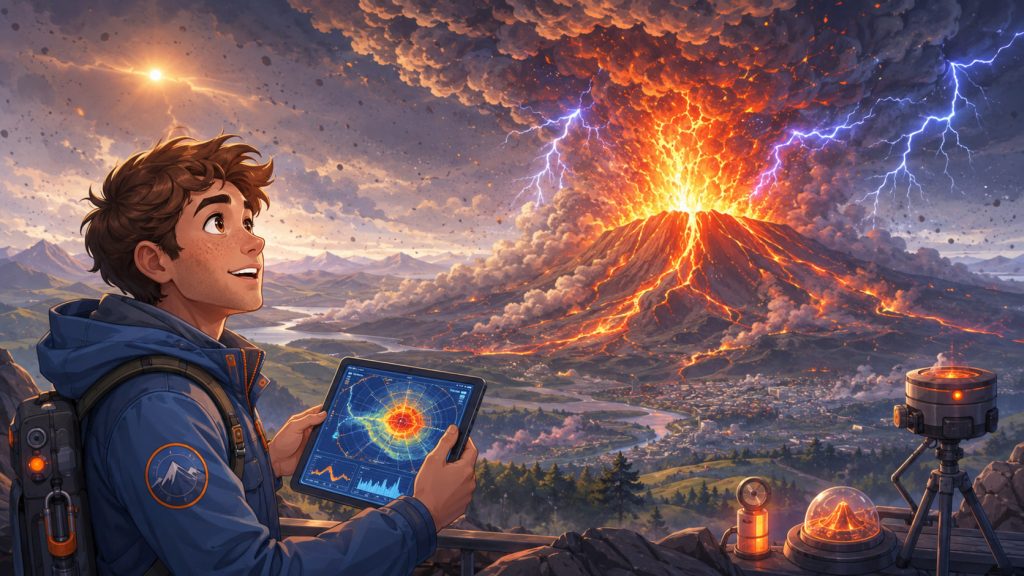
A supervolcano eruption is one of the most dramatic natural events Earth can produce. Unlike an ordinary volcanic eruption, a true super-eruption can eject enormous quantities of ash, gas, and rock over a relatively short period.
The consequences would extend far beyond the volcano itself. Nearby regions could be devastated, aviation could be disrupted across continents, agriculture could suffer, and global temperatures could temporarily fall.
However, a supervolcano eruption would not mean the end of humanity or the destruction of the planet. Its effects would be severe, but they would depend on the size of the eruption, its location, atmospheric conditions, and how societies respond.
What Is a Supervolcano?
“Supervolcano” is an informal term used for volcanic systems capable of producing exceptionally large explosive eruptions.
Scientists often use the term super-eruption for an event that ejects more than about 1,000 cubic kilometers of material.
Such eruptions correspond to the highest category on the Volcanic Explosivity Index, or VEI 8.
Well-known volcanic systems associated with very large past eruptions include:
- Yellowstone in the United States
- Toba in Indonesia
- Taupō in New Zealand
- Campi Flegrei in Italy
These systems do not behave like giant versions of simple cone-shaped volcanoes.
Many are associated with enormous underground magma systems and broad depressions called calderas.
What Happens During the Eruption?
A major explosive eruption begins when rising magma releases large quantities of dissolved gas.
As pressure decreases, gases expand rapidly.
If the magma is highly viscous and gas-rich, pressure can build until the magma fragments violently.
The eruption column may rise many kilometers into the atmosphere.
Ash, pumice, volcanic gases, and broken rock are blasted outward.
Near the volcano, the most dangerous phenomena may not be lava flows but pyroclastic flows.
These fast-moving mixtures of hot gas, ash, and rock can travel across the ground at tremendous speed.
Anything close to the eruption center would face extreme destruction.
The Caldera Can Collapse
During an enormous eruption, so much magma may leave an underground reservoir that the ground above it becomes unstable.
Large sections of the surface can collapse downward.
This creates a caldera that may be tens of kilometers wide.
Caldera collapse can occur in stages rather than as one single dramatic event.
The eruption may continue as different parts of the magma system depressurize.
A super-eruption can reshape an entire region rather than simply build a volcanic cone.
Ash Would Be One of the Biggest Problems
Volcanic ash is not soft material like fireplace ash.
It consists of tiny fragments of volcanic rock, minerals, and glass.
Close to a supervolcano, ash deposits could become extremely thick.
Farther away, ash could still cover roads, buildings, fields, rivers, and airports.
Heavy ash can damage roofs, clog machinery, contaminate water supplies, reduce visibility, and cause respiratory irritation.
Electrical systems may also be affected.
Even relatively thin layers of ash can create major problems for transportation and infrastructure.
Aviation Could Be Severely Disrupted
Volcanic ash is dangerous for aircraft.
Jet engines can ingest ash, causing particles to melt inside the engine and interfere with critical components.
Ash can also damage windows and other surfaces.
A major eruption could therefore force enormous airspace closures.
Depending on wind patterns, international aviation routes could be disrupted for days, weeks, or longer.
The effect would not be limited to passengers.
Air freight, medicine delivery, food transport, manufacturing supply chains, and international trade could all be affected.
Agriculture Could Face Serious Difficulties
Agriculture near the eruption zone could suffer immediate damage from ashfall.
Plants can be buried or damaged.
Livestock may lose access to clean food and water.
Farm machinery can also become difficult to operate in ash-covered conditions.
The larger global concern would be changes in climate.
If the eruption injected large quantities of sulfur dioxide high into the stratosphere, this gas could form tiny sulfate aerosols.
These aerosols reflect some incoming sunlight back into space.
The result could be temporary global cooling.
Could a Supervolcano Cause a Volcanic Winter?
A sufficiently large eruption could cause a period sometimes described as a volcanic winter.
This does not mean the entire planet would suddenly freeze.
Instead, average global temperatures could fall for a period of months to several years.
The exact effect would depend strongly on how much sulfur reaches the stratosphere.
Aerosols can also alter rainfall patterns.
Some regions could become cooler and drier, while others might experience different seasonal disruptions.
Agricultural yields could fall if growing seasons became shorter or less predictable.
Food Prices Could Rise Worldwide
Modern food systems are highly interconnected.
A major decline in agricultural production across several important regions could raise global prices.
Grain markets could be especially sensitive.
Countries dependent on food imports might experience stronger pressure than major food-producing nations.
Governments could respond by releasing strategic reserves, changing trade policies, or increasing domestic production.
The biggest challenge would not necessarily be the absolute absence of food worldwide.
It would be distribution, affordability, and temporary regional shortages.
What Would Happen to the Sun and Sky?
After a large eruption, skies in affected areas could become dramatically darker due to ash.
Sunsets may appear unusually vivid because fine particles scatter light.
If large quantities of sulfur reach the upper atmosphere, the effect on sunlight could persist much longer than ordinary ash clouds.
Historical eruptions have produced remarkable atmospheric optical effects.
After the 1815 eruption of Tambora, for example, volcanic aerosols contributed to unusually cool conditions and spectacular sunsets in many parts of the world.
A super-eruption could produce much larger effects.
Would People Be Able to Breathe?
Close to the eruption, air quality could become dangerous.
Fine ash particles can irritate the lungs and eyes.
People with asthma or other respiratory conditions may be particularly vulnerable.
Protective masks, clean indoor air, and sealed buildings could become important.
Volcanic gases may create additional hazards near the volcano.
Sulfur dioxide can irritate the respiratory system, while carbon dioxide can accumulate in low areas under certain conditions.
Far from the eruption, the main concern would usually be fine particles and atmospheric pollution rather than immediate toxic gas exposure.
Expert Perspective: The Global Effects Would Depend on Sulfur
Volcanologists and climate scientists emphasize an important point: eruption size alone does not determine global climate impact.
The amount of sulfur dioxide injected into the stratosphere can be more important than the total volume of ash.
Ash usually falls out of the atmosphere relatively quickly.
Stratospheric sulfate aerosols can remain for much longer.
This means two eruptions of similar size could produce very different climatic consequences depending on their chemistry and eruption dynamics.
Would a Supervolcano Destroy Civilization?
A super-eruption would create enormous challenges.
Some regions could become temporarily uninhabitable.
Transport, agriculture, communication, and energy systems could experience serious disruption.
Yet modern civilization has major advantages that ancient populations did not have.
These include:
- Global satellite monitoring
- International communication
- Large-scale food storage
- Modern medicine
- Agricultural technology
- Global transportation networks
- Disaster planning
- Scientific climate models
The event could cause a major humanitarian and economic crisis without causing human extinction.
The outcome would depend heavily on preparedness and international cooperation.
Can Scientists Predict a Super-Eruption?
Large volcanic systems are monitored using several methods.
Scientists track:
- Earthquakes
- Ground deformation
- Gas emissions
- Heat flow
- Changes in groundwater
- Magma movement
Magma rising underground can cause earthquake swarms and measurable changes in the shape of the ground.
However, volcanic systems are complex.
Increased activity does not automatically mean that a giant eruption is approaching.
Many periods of unrest end without a major eruption.
Scientists therefore look for combinations of signals rather than relying on one sign alone.
Super-Eruptions Are Extremely Rare
Super-eruptions have occurred many times during Earth’s geological history, but they are extremely uncommon on a human timescale.
Much smaller volcanic eruptions are vastly more frequent.
Some famous supervolcano systems have produced ordinary eruptions as well as gigantic ones.
A volcanic system capable of a super-eruption does not automatically produce the largest possible eruption every time it becomes active.
Being located above a large magma system does not mean a super-eruption is inevitable.
What Would Matter Most During Such a Crisis?
The most important responses would include evacuation near the volcano, protection from ash, maintaining clean water supplies, protecting infrastructure, and keeping food distribution functioning.
International coordination would also become important if climate effects affected agricultural production across multiple continents.
Modern monitoring systems could provide valuable warning before some types of volcanic activity.
The greatest advantage humanity has is not the ability to stop a supervolcano.
It is the ability to observe, prepare, communicate, adapt, and share resources.
Interesting Facts
- A VEI 8 eruption ejects more than about 1,000 cubic kilometers of volcanic material.
- Super-eruptions can create calderas tens of kilometers across.
- Volcanic ash consists largely of tiny fragments of rock and glass rather than burned material.
- Sulfur dioxide can influence global climate more strongly than volcanic ash when it reaches the stratosphere.
- Pyroclastic flows can be hotter than several hundred degrees Celsius.
- The Toba volcanic system produced one of the largest known eruptions of the last several hundred thousand years.
- Yellowstone has experienced several enormous eruptions during its geological history, but it has also produced much smaller volcanic events.
- Volcanic aerosols can remain in the stratosphere for years.
- A large eruption could affect agriculture even in countries located thousands of kilometers from the volcano.
- Modern satellites can detect volcanic ash clouds and sulfur dioxide from space.
Glossary
- Supervolcano — An informal term for a volcanic system capable of producing exceptionally large explosive eruptions.
- Super-Eruption — An eruption that ejects more than about 1,000 cubic kilometers of volcanic material.
- VEI — Volcanic Explosivity Index, a scale used to describe the magnitude of explosive volcanic eruptions.
- Caldera — A large volcanic depression formed when the ground collapses after major magma withdrawal.
- Pyroclastic Flow — A fast-moving mixture of hot gas, volcanic ash, and rock traveling across the ground.
- Volcanic Ash — Tiny fragments of volcanic rock, mineral, and glass produced during explosive eruptions.
- Sulfur Dioxide — A volcanic gas that can form sunlight-reflecting sulfate aerosols in the atmosphere.
- Stratosphere — A layer of Earth’s atmosphere above the lower weather-producing atmosphere.
- Sulfate Aerosol — Tiny sulfur-containing particles capable of reflecting sunlight and temporarily cooling the climate.
- Volcanic Winter — A period of temporary global or regional cooling caused by large quantities of volcanic aerosols in the atmosphere.
- Magma Chamber — A region beneath the surface where molten or partially molten rock accumulates.
- Ground Deformation — Changes in the shape or elevation of the surface caused by movement of magma or other geological processes.