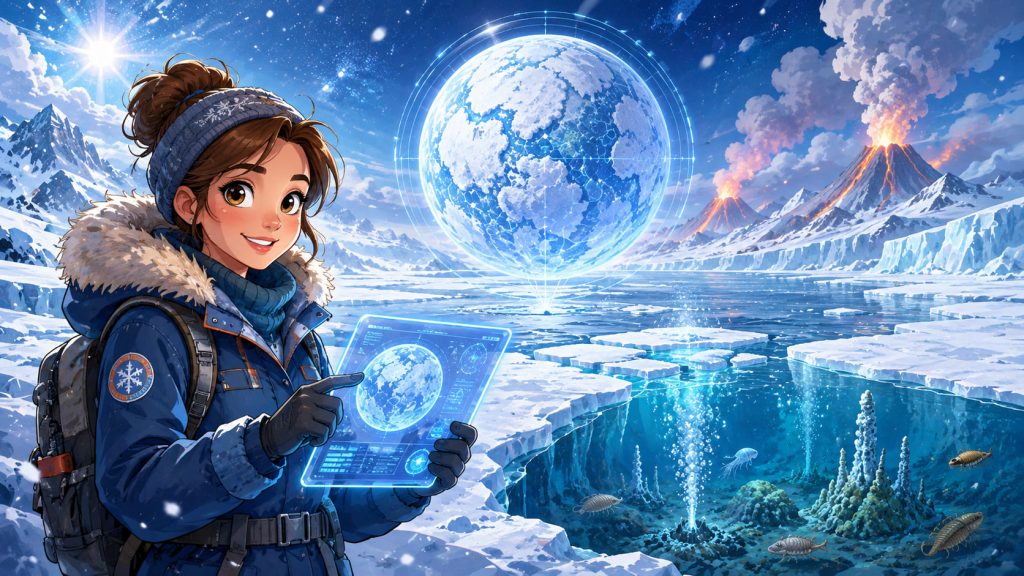
Around 700 million years ago, Earth may have looked almost unrecognizable. Instead of blue oceans and green continents, vast areas of the planet were covered by ice, possibly extending all the way to the equator.
This extraordinary idea is known as the Snowball Earth hypothesis.
The strongest evidence points to several major global glaciations during the Cryogenian Period, especially the Sturtian glaciation, beginning around 717 million years ago, and the later Marinoan glaciation, which ended roughly 635 million years ago.
Scientists agree that these ice ages were exceptionally severe. The biggest question is whether Earth became almost completely frozen or whether some areas of open ocean survived.
What Is the Snowball Earth Hypothesis?
The Snowball Earth hypothesis proposes that during parts of the Cryogenian Period, ice sheets expanded from the poles toward very low latitudes.
In the most extreme version, nearly the entire ocean surface became covered by ice.
This would have created a planet dramatically different from modern Earth.
Continents would have been heavily glaciated, sea ice could have reached tropical regions, and average global temperatures would have fallen far below present-day values.
The remarkable part is that geological evidence for ancient glaciers has been found in rocks that formed close to the equator.
That observation helped transform Snowball Earth from an unusual idea into a major scientific hypothesis.
Why Would Ice Spread So Far?
One of the most important mechanisms is called ice-albedo feedback.
Ice and snow are bright surfaces. They reflect a large proportion of incoming sunlight back into space.
Dark ocean water absorbs much more solar energy.
If the climate cools enough for ice to expand, Earth reflects more sunlight.
That produces additional cooling.
More cooling creates more ice, which reflects still more sunlight.
Under the right conditions, this feedback can become extremely powerful.
Once ice reached sufficiently low latitudes, the planet may have entered a runaway freezing process.
What Could Have Triggered the Freeze?
Scientists continue to investigate the precise causes.
Several factors may have contributed.
The continents were positioned differently from today. Large landmasses were located in tropical regions, where warm and wet conditions could accelerate the chemical weathering of rocks.
Weathering removes carbon dioxide from the atmosphere over geological timescales.
Because carbon dioxide is an important greenhouse gas, lower atmospheric concentrations could weaken Earth’s greenhouse effect.
The Sun was also slightly less luminous hundreds of millions of years ago than it is today.
Together, continental arrangement, carbon dioxide removal, changes in atmospheric chemistry, and other climate processes may have pushed Earth toward extreme cooling.
The Evidence Hidden in Ancient Rocks
Geologists have discovered ancient glacial deposits on multiple continents.
Some contain dropstones, large rocks that appear to have been carried by floating ice and dropped into marine sediments when the ice melted.
Other formations show characteristics associated with glaciers, including scratched rocks and poorly sorted sediment.
The most surprising evidence comes from paleomagnetism.
When certain rocks form, magnetic minerals can record information about Earth’s magnetic field.
Scientists can use these signals to estimate the latitude at which the rocks formed.
Several Cryogenian glacial deposits appear to have originated at very low latitudes.
In other words, glaciers apparently existed close to the ancient equator.
Was Earth Really Completely Frozen?
This remains one of the most interesting questions.
The classic “hard Snowball” model suggests that sea ice covered almost the entire ocean.
Another model, sometimes called Slushball Earth, proposes that belts of open water remained near the equator.
There are also intermediate possibilities involving relatively thin tropical ice, seasonal openings, or isolated regions of exposed ocean.
These differences matter because life already existed during the Cryogenian.
If the entire ocean had been sealed beneath thick ice, photosynthetic organisms would have faced severe challenges.
Areas of thin ice, cracks, open water, hydrothermal environments, or isolated refuges could have allowed ecosystems to survive.
How Did Life Survive?
Life had existed on Earth for billions of years before Snowball Earth.
Most organisms were microscopic, including bacteria, archaea, algae, and early eukaryotes.
They did not simply disappear during the great glaciations.
Possible refuges may have included:
- Open or seasonally open ocean water
- Thin areas of sea ice where sunlight could penetrate
- Meltwater environments on ice surfaces
- Coastal regions near volcanic activity
- Hydrothermal vents on the ocean floor
- Small isolated bodies of liquid water
Microorganisms can survive in remarkably extreme environments.
Modern life exists beneath Antarctic ice, inside glaciers, in deep ocean sediments, and around hydrothermal vents.
These examples provide possible models for how ancient organisms survived prolonged global cold.
How Could a Frozen Earth Ever Thaw?
This is one of the most elegant parts of the hypothesis.
Even on a frozen planet, volcanoes would continue releasing carbon dioxide.
Normally, chemical weathering removes some of that carbon dioxide from the atmosphere.
But if continents were buried under ice, weathering would become much weaker.
Carbon dioxide could therefore accumulate for millions of years.
Eventually, its greenhouse effect might become powerful enough to overcome the cooling produced by the bright icy surface.
Temperatures would begin rising.
Once significant melting started, darker ocean water would become exposed and absorb more sunlight.
The ice-albedo feedback would then operate in reverse.
Earth may have shifted from extreme freezing to extremely rapid warming on a geological timescale.
The Strange Rocks That Appeared After the Ice
One of the strongest clues about the end of Snowball Earth is the presence of unusual carbonate layers directly above many glacial deposits.
These are called cap carbonates.
Carbonate rocks normally form under conditions very different from glaciers.
Their sudden appearance immediately after ancient glacial sediments suggests a dramatic environmental transition.
Scientists think intense greenhouse conditions, changing ocean chemistry, rapid weathering, and high concentrations of dissolved carbon may all have contributed.
Cap carbonates provide evidence that the end of these glaciations was not a slow return to normal conditions.
It may have been an abrupt planetary transformation.
Expert Perspective: Snowball Earth Was Extreme, but the Details Remain Open
Geologists and climate scientists generally accept that Cryogenian glaciations reached unusually low latitudes and were among the most severe ice ages in Earth’s history.
What remains debated is exactly how complete the ice cover became.
Computer climate models can produce near-global glaciation under certain atmospheric conditions, while geological and biological evidence leaves room for regions of open water.
This is an important distinction.
Science does not require every detail of a hypothesis to be settled before the larger picture becomes convincing.
The evidence strongly supports an extraordinarily cold planet, while researchers continue refining what that frozen world actually looked like.
Did Snowball Earth Help Complex Life Evolve?
Soon after the great Cryogenian glaciations, Earth entered a period of major biological change.
The later Ediacaran Period saw the appearance of increasingly large and complex organisms.
This has led scientists to ask whether Snowball Earth somehow influenced evolution.
Glaciation could have changed ocean nutrients, oxygen levels, ecological competition, and environmental conditions.
When ice sheets melted, enormous amounts of weathered material may have entered the oceans.
This could have delivered nutrients that stimulated biological productivity.
However, there is no simple proof that Snowball Earth directly caused the rise of complex animals.
The connection remains an important area of research.
A Planet Capable of Extreme Change
Snowball Earth demonstrates that planetary climate can shift far beyond the conditions humans have ever experienced.
Earth has not always looked like modern Earth.
Its atmosphere, continents, oceans, temperature, and ecosystems have changed repeatedly.
Yet life survived some of the most extreme known episodes in planetary history.
The Cryogenian glaciations reveal a world that may have approached complete freezing, remained locked in severe cold for millions of years, and then escaped through powerful geological and atmospheric feedbacks.
Snowball Earth is one of the clearest examples of how geology, climate, and life can reshape one another on a planetary scale.
Interesting Facts
- The Cryogenian Period lasted from roughly 720 to 635 million years ago.
- The Sturtian glaciation began around 717 million years ago and may have lasted for tens of millions of years.
- The Marinoan glaciation ended approximately 635 million years ago.
- Glacial deposits from the Cryogenian have been found on several modern continents.
- Paleomagnetic evidence indicates that some ancient glaciers reached very low latitudes.
- Ice-albedo feedback can amplify both cooling and warming.
- Volcanoes could continue releasing carbon dioxide even while much of Earth was frozen.
- Cap carbonates commonly appear directly above Cryogenian glacial deposits.
- Life survived the glaciations despite extraordinarily harsh conditions.
- The Ediacaran Period, which followed the Cryogenian, saw major changes in complex life.
Glossary
- Snowball Earth — The hypothesis that Earth experienced periods of near-global or possibly global ice cover during the Cryogenian Period.
- Cryogenian Period — A geological period approximately 720–635 million years ago, famous for extreme glaciations.
- Sturtian Glaciation — One of the major Cryogenian ice ages, beginning around 717 million years ago.
- Marinoan Glaciation — A major Cryogenian glaciation that ended around 635 million years ago.
- Ice-Albedo Feedback — A climate process in which expanding ice increases sunlight reflection, producing further cooling.
- Albedo — The proportion of incoming light reflected by a surface.
- Paleomagnetism — The study of magnetic information preserved in ancient rocks.
- Dropstone — A rock fragment transported by floating ice and released into sediment when the ice melts.
- Cap Carbonate — A distinctive carbonate rock layer found directly above many ancient glacial deposits.
- Greenhouse Effect — Atmospheric warming caused when certain gases absorb and re-emit heat.
- Chemical Weathering — The breakdown of rocks through chemical reactions, a process that can remove carbon dioxide from the atmosphere.
- Slushball Earth — A less extreme version of the Snowball Earth hypothesis in which some tropical ocean remained ice-free.