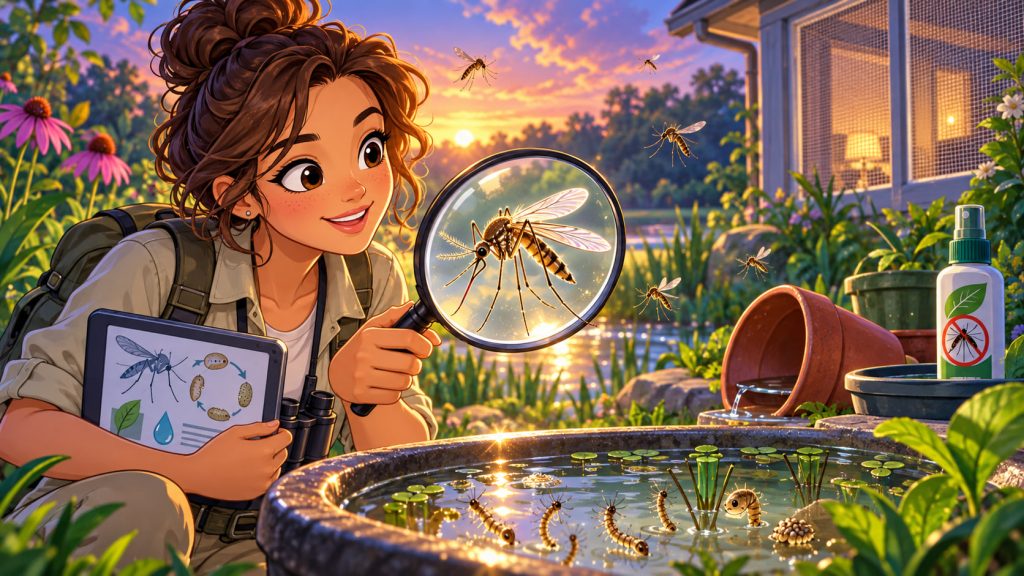
Mosquitoes are among the most familiar insects on Earth. They appear in gardens, forests, wetlands, cities, and tropical regions, often becoming most noticeable at dusk or during warm, humid weather.
Most people think of mosquitoes mainly as an annoyance because of their itchy bites. But these small insects are far more important than they seem.
Mosquitoes are not only pests. Some species can transmit serious diseases, while others play roles in food webs and ecosystems.
Understanding how mosquitoes live, why they bite, and what attracts them can make prevention much more effective.
What Exactly Is a Mosquito?
Mosquitoes are small flying insects belonging to the family Culicidae.
Thousands of mosquito species exist worldwide, although only a fraction regularly bite humans.
Like other insects, mosquitoes have six legs, a pair of wings, antennae, and a segmented body.
Their life cycle includes four stages:
- Egg
- Larva
- Pupa
- Adult
The first three stages depend heavily on water.
This is why even small amounts of standing water can become breeding sites.
Why Do Mosquitoes Bite?
Not all mosquitoes bite people.
Male mosquitoes usually feed on plant sugars such as nectar.
Females of many species also consume nectar, but they often require a blood meal to obtain nutrients needed for egg development.
The female pierces the skin using specialized mouthparts and draws blood from small vessels.
At the same time, saliva enters the skin.
This saliva contains substances that help keep blood flowing.
The itchy bump after a mosquito bite is mainly caused by the body’s immune reaction to mosquito saliva.
Why Do Some People Get Bitten More?
Mosquitoes do not choose people randomly.
They use several signals to locate potential hosts.
Important factors include carbon dioxide from breathing, body heat, skin odors, movement, and certain chemicals produced by the skin and its microorganisms.
Pregnancy, body size, activity level, clothing, and genetics may also influence how attractive someone appears to mosquitoes.
Dark clothing can sometimes make a person easier for mosquitoes to detect visually.
This helps explain why one person in a group may receive many bites while another gets very few.
Mosquitoes Are Surprisingly Good Hunters
Female mosquitoes have specialized sensory systems.
They can detect carbon dioxide in exhaled breath from a distance.
As they move closer, body heat and skin odors become increasingly important.
Some species are especially active at dusk and dawn, while others prefer daytime feeding.
Different mosquito species behave differently, so there is no single pattern that applies to all mosquitoes.
This is also important for disease prevention because different disease-carrying mosquitoes have different feeding habits.
Why Mosquito Bites Itch
After a mosquito feeds, the immune system recognizes proteins in the saliva as foreign.
This triggers the release of chemicals such as histamine.
Histamine contributes to redness, swelling, and itching.
Scratching may temporarily feel satisfying, but it can damage the skin and increase irritation.
Frequent scratching may also raise the risk of secondary bacterial infection.
For most bites, symptoms disappear on their own.
Cold compresses and anti-itch treatments can sometimes reduce discomfort.
Mosquitoes and Disease
Mosquitoes are important from a medical perspective because certain species can transmit pathogens between humans or animals.
Mosquito-borne diseases include:
- Malaria
- Dengue
- Yellow fever
- Zika
- Chikungunya
- West Nile disease
- Japanese encephalitis
A mosquito does not automatically transmit disease simply because it bites.
It must belong to a capable species and have previously acquired the relevant pathogen.
The microorganism may then develop or multiply inside the mosquito before it can be transmitted to another host.
Disease risk depends strongly on location, mosquito species, climate, and local public-health conditions.
Why Standing Water Is So Important
Mosquito larvae develop in water.
Some species prefer ponds, marshes, or floodwater.
Others can reproduce in surprisingly small containers.
Common breeding sites include:
- Buckets
- Plant saucers
- Clogged gutters
- Old tires
- Birdbaths
- Open water barrels
- Children’s toys that collect rain
- Containers left outdoors
Some mosquitoes can complete their aquatic development quickly under warm conditions.
Removing unnecessary standing water is therefore one of the most practical forms of mosquito control around homes.
Do Mosquitoes Have Any Ecological Value?
Mosquitoes are usually discussed only as pests, but they are part of natural ecosystems.
Adult mosquitoes may feed on nectar and can contribute to pollination in some environments.
Mosquito larvae consume microorganisms and organic material in water.
They also serve as food for fish, aquatic insects, amphibians, birds, bats, and other animals.
This does not make disease-carrying mosquitoes harmless.
It simply means that mosquitoes exist within wider ecological relationships.
Expert Perspective: Prevention Works Best in Layers
Public-health and infectious-disease specialists generally recommend combining several protective measures rather than relying on only one.
For example, reducing breeding sites around the home is useful, but it will not stop mosquitoes arriving from nearby areas.
Repellents help reduce bites, while screens and clothing provide physical barriers.
The strongest protection usually comes from using several methods at the same time.
This layered approach becomes especially important in areas where mosquito-borne diseases are actively circulating.
How to Prevent Mosquito Bites
Practical protection can begin with clothing.
Long sleeves, long trousers, and closed footwear reduce the amount of exposed skin.
Light-colored clothing may also make mosquitoes less visually attracted in some situations.
Window and door screens can prevent insects from entering homes.
Air conditioning and fans may also help because moving air can make it harder for mosquitoes to fly and land.
Mosquito repellents are particularly useful outdoors.
Products containing well-established active ingredients can provide several hours of protection when used correctly.
Always follow product instructions, especially when applying repellents to children.
Does Natural Mosquito Repellent Work?
Many plants and essential oils are promoted as natural mosquito repellents.
Some botanical substances can temporarily discourage mosquitoes.
However, effectiveness varies greatly, and protection may not last as long as that provided by well-tested repellents.
Simply growing aromatic plants near a patio usually does not create a reliable protective barrier.
Smoke, citronella candles, and similar products may reduce mosquito activity in small areas under certain conditions, but they should not be treated as complete protection.
A pleasant smell is not the same thing as scientifically reliable mosquito control.
What About Mosquito-Repelling Devices?
The market includes ultrasonic devices, bracelets, lamps, traps, coils, and many other mosquito-control products.
Their effectiveness varies widely.
Some traps can reduce mosquito numbers in particular environments, especially when they are designed to attract specific species.
However, small consumer devices rarely eliminate mosquitoes from an entire property.
Ultrasonic repellents have not consistently shown reliable protection.
The most effective approach usually remains a combination of source reduction, barriers, repellents, and community mosquito-control programs when necessary.
Why Mosquitoes Become Worse After Rain
Rain can create temporary breeding habitats.
Containers, puddles, drainage areas, and flooded ground may suddenly hold water.
Warm temperatures accelerate mosquito development.
This means mosquito numbers can rise rapidly after suitable weather.
However, very heavy rain can sometimes flush larvae out of certain breeding sites.
The relationship between rainfall and mosquitoes therefore depends on local conditions and mosquito species.
Climate and Mosquito Distribution
Mosquitoes are strongly influenced by temperature and moisture.
Warm conditions can speed up development and increase feeding activity.
Climate also affects how long mosquitoes remain active during the year.
Some species are expanding into new regions through international travel, trade, and environmental change.
This is one reason mosquito surveillance has become increasingly important.
Health authorities monitor both mosquito populations and the pathogens they may carry.
When a Mosquito Bite Needs Medical Attention
Most mosquito bites are minor.
However, medical care may be necessary if a bite causes severe swelling, breathing difficulty, widespread hives, or signs of serious allergic reaction.
A healthcare professional should also be consulted if a person develops fever, severe headache, unusual weakness, rash, joint pain, confusion, or other concerning symptoms after mosquito exposure in an area where mosquito-borne disease is possible.
Infection from scratching can also occur.
Increasing redness, warmth, pain, swelling, or pus around a bite may indicate a secondary skin infection.
Interesting Facts
- Only female mosquitoes of many species require blood meals for egg production.
- Male mosquitoes generally feed on nectar and other plant sugars.
- Mosquitoes can detect carbon dioxide from human and animal breath.
- Some mosquito eggs can survive dry conditions for surprisingly long periods.
- A small container of water can sometimes produce many mosquitoes.
- Mosquitoes have existed for tens of millions of years.
- Different mosquito species prefer different hosts, including humans, birds, mammals, reptiles, and amphibians.
- Mosquito larvae live in water but breathe air in different ways depending on the species.
- Not every mosquito species is capable of transmitting human disease.
- Removing standing water can interrupt the mosquito life cycle before adults emerge.
Glossary
- Mosquito — A small flying insect belonging to the family Culicidae.
- Larva — The immature aquatic stage of a mosquito between the egg and pupa stages.
- Pupa — A developmental stage between larva and adult.
- Host — A human or animal from which a mosquito may obtain a blood meal.
- Vector — An organism capable of transmitting a pathogen from one host to another.
- Pathogen — A microorganism or biological agent capable of causing disease.
- Repellent — A substance designed to discourage insects from landing or biting.
- Histamine — A chemical released by the immune system that contributes to itching and swelling.
- Standing Water — Water that remains collected in one place long enough for mosquitoes to breed.
- Source Reduction — The removal or treatment of mosquito breeding sites.
- Mosquito-Borne Disease — An illness transmitted through the bite of an infected mosquito.
- Culicidae — The scientific family that includes mosquitoes.