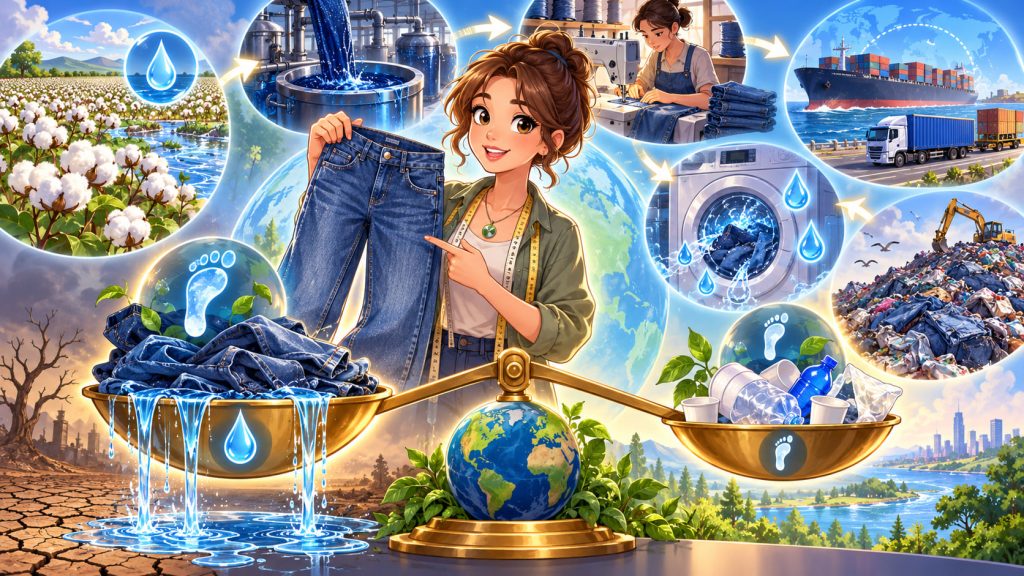
Jeans seem simple: cotton, thread, metal buttons, dye, and a familiar blue finish. Yet behind a single pair lies a surprisingly complex environmental story involving agriculture, water, chemicals, energy, transport, washing, and waste.
Plastic has become one of the most visible symbols of pollution, but clothing can create a broader environmental footprint than people expect.
In some comparisons, a pair of jeans can have a larger total environmental impact than an equivalent volume of common plastic products, especially when water use, dyeing, energy consumption, farming, transport, and repeated washing are included.
The reason is that environmental damage is not determined by volume alone. It depends on the entire life cycle of the product.
Cotton Looks Natural, but It Is Resource-Intensive
Most traditional denim is made primarily from cotton.
Cotton is a natural fiber, but growing it can require substantial amounts of water, agricultural land, fertilizers, and pesticides.
The exact water footprint varies greatly depending on climate, irrigation methods, rainfall, farming practices, and location.
In dry regions, irrigation can place significant pressure on rivers and groundwater.
A plastic object, by comparison, does not require agricultural land or irrigation water.
This does not make plastic environmentally harmless, but it highlights an important point:
“Natural” does not automatically mean low-impact.
A Pair of Jeans Starts in a Field
The environmental footprint begins long before denim reaches a factory.
Cotton plants must be grown, harvested, cleaned, and processed.
Agricultural machinery consumes fuel.
Fertilizer production requires energy.
Irrigation systems require infrastructure and pumping.
After harvesting, cotton fibers are separated from seeds, spun into yarn, and transported to textile mills.
Every stage adds energy use and emissions.
Only then can the yarn become denim fabric.
Denim Production Uses Large Amounts of Water
Making denim requires several wet-processing stages.
Cotton may be washed and treated before dyeing.
Yarn is dyed repeatedly to achieve the characteristic blue color.
Fabric may then undergo washing, softening, fading, and finishing.
Traditional denim production can therefore consume significant quantities of water before the jeans ever reach a store.
Modern factories can reduce this dramatically through water recycling and improved dyeing technologies, but older or less efficient facilities may still use large volumes.
Indigo Dye Creates Its Own Environmental Burden
The famous blue color of jeans usually comes from indigo dye.
Modern denim typically uses synthetic indigo rather than indigo extracted from plants.
Indigo does not naturally dissolve easily in water.
It must be chemically converted into a soluble form before it can bond with cotton fibers.
After exposure to air, it oxidizes and returns to its blue state.
This process may be repeated multiple times to build up the desired color.
Chemical reducing agents, salts, surfactants, and other substances may also be involved.
If wastewater is poorly treated, textile dyeing can contribute to serious water pollution.
Distressed Jeans Require Even More Processing
Fashion trends can increase the footprint further.
Consumers often want jeans that look aged, faded, soft, torn, or worn even when they are brand new.
Manufacturers may use:
- Stone washing
- Enzymes
- Bleaching
- Ozone treatments
- Laser finishing
- Chemical fading
- Mechanical abrasion
Modern laser and ozone systems can reduce resource use compared with some older techniques.
However, heavily processed denim still generally requires more manufacturing steps than untreated fabric.
The more artificial aging a new garment receives, the more resources may be required before it is sold.
Energy Is Used at Almost Every Stage
A pair of jeans passes through many industrial processes.
Cotton is spun into yarn.
Yarn is dyed.
Fabric is woven.
Denim is cut.
Garments are sewn.
Buttons and rivets are manufactured and attached.
Jeans may then be washed several times, dried, finished, packaged, and transported.
Factories need electricity and heat.
If that energy comes from fossil fuels, greenhouse gas emissions increase.
Plastic also has a carbon footprint because it is usually made from fossil feedstocks and requires industrial processing.
But some simple plastic objects can be manufactured in comparatively few steps.
That is why a relatively small item of clothing can sometimes have a surprisingly high life-cycle footprint.
The Environmental Cost Continues After Purchase
The factory is only part of the story.
Jeans continue consuming resources throughout their useful life.
Every wash requires water and electricity.
Hot-water washing increases energy demand.
Dryers can consume even more electricity.
Repeated washing also slowly damages fibers, shortening garment life.
Washing jeans less often, using cooler water, and air-drying can significantly reduce the use-phase footprint.
The environmental impact of clothing depends not only on how it is manufactured, but also on how people care for it.
Why Comparing Jeans with Plastic Is Complicated
Plastic pollution is particularly harmful because many plastics persist in the environment for extremely long periods.
Plastic waste can fragment into microplastics, enter rivers and oceans, harm wildlife, and accumulate in ecosystems.
Jeans create a different type of footprint.
A cotton garment is generally more biodegradable than a conventional plastic object, but producing that garment may require more water, farmland, chemicals, and processing.
So the comparison depends on which environmental problem is being measured.
For carbon emissions, water use, land use, toxicity, waste persistence, and ecosystem damage, the results can be very different.
A product that performs better in one category may perform worse in another.
Synthetic Denim Adds Microplastic Concerns
Modern jeans are not always made from 100 percent cotton.
Stretch jeans often contain polyester, elastane, or other synthetic fibers.
These materials improve flexibility and fit.
However, synthetic fibers can shed microscopic plastic particles during washing and wear.
Those fibers may enter wastewater systems.
Wastewater treatment plants capture some of them, but not all.
This creates an unusual hybrid problem: a garment may carry both the agricultural footprint of cotton and the microplastic footprint of synthetic fibers.
Fast Fashion Magnifies the Damage
The biggest environmental problem may not be the jeans themselves, but how quickly they are replaced.
Fast-fashion systems encourage consumers to purchase more clothing and use each item for shorter periods.
Producing a resource-intensive pair of jeans becomes much harder to justify environmentally if it is worn only a few times.
By contrast, a durable pair worn for many years spreads its manufacturing footprint across hundreds of uses.
Extending garment life is one of the simplest ways to reduce fashion’s environmental impact.
What Happens to Old Jeans?
Some used jeans are donated, resold, recycled, exported, or repurposed.
Others are burned or sent to landfill.
Textile recycling remains challenging.
Pure cotton is easier to recycle than fabrics containing several fiber types, but repeated mechanical recycling can shorten fibers and reduce quality.
Blended fabrics containing cotton, polyester, and elastane are especially difficult to separate.
New chemical recycling technologies aim to recover cellulose from cotton and polymers from synthetic textiles, but these systems are not yet universal.
Could Recycled Cotton Help?
Recycled cotton reduces demand for virgin agricultural fiber.
Post-industrial textile scraps and old garments can be mechanically processed into new fibers.
This saves some agricultural land and water.
However, recycled cotton fibers are often shorter and weaker.
Manufacturers may need to blend them with virgin cotton or other fibers.
Even so, recycled content can significantly reduce the environmental burden of new denim.
Expert Perspective
Sustainability specialists increasingly emphasize life-cycle assessment rather than judging products only by whether they are natural, synthetic, recyclable, or biodegradable.
A complete assessment considers raw materials, farming, manufacturing, energy, transport, consumer use, and disposal.
From that perspective, denim demonstrates why environmental impact can be hidden.
A pair of jeans may look simple, but its history can involve farms, chemical plants, dye houses, textile mills, shipping networks, washing machines, and waste systems.
How to Make Jeans More Sustainable
The most sustainable pair of jeans is often the one that is already in your wardrobe.
Wearing clothes longer reduces demand for new manufacturing.
Other useful choices include buying durable denim, choosing recycled fibers, avoiding unnecessary replacement, washing less often, using cold water, and air-drying when possible.
Repairing worn knees, seams, pockets, and zippers can extend life considerably.
Second-hand clothing can also reduce the need for new production.
Reducing consumption usually has a greater impact than constantly searching for a theoretically perfect material.
Interesting Facts
- Traditional denim is usually woven from cotton yarn using a distinctive twill structure.
- Indigo mainly colors the outer surface of cotton yarn, helping denim develop its characteristic fading pattern.
- A new pair of distressed jeans may already have undergone multiple industrial washing and finishing cycles.
- Stretch denim often contains synthetic fibers such as elastane.
- Synthetic fibers can release microplastics during washing.
- Washing clothes in colder water can reduce household energy use.
- Air-drying generally requires much less energy than tumble drying.
- Recycled cotton usually has shorter fibers than virgin cotton.
- Clothing longevity strongly affects its environmental footprint per wear.
- Textile dyeing and finishing can be major sources of industrial water pollution when wastewater is poorly managed.
- Denim made with recycled materials can reduce demand for virgin cotton.
- Repairing clothing can significantly extend its useful life and delay replacement.
Glossary
- Environmental Footprint — The total effect a product or activity has on resources, emissions, pollution, ecosystems, and waste.
- Life-Cycle Assessment — A method for evaluating environmental impacts from raw-material production through manufacturing, use, and disposal.
- Denim — A strong cotton twill fabric commonly used to make jeans.
- Indigo — A blue dye traditionally derived from plants and now usually produced synthetically for denim.
- Twill — A weaving pattern that creates characteristic diagonal lines in fabric.
- Virgin Cotton — Cotton fiber produced directly from newly harvested plants rather than recycled textiles.
- Recycled Cotton — Cotton fiber recovered from textile waste or used garments.
- Fast Fashion — A business model based on rapid production, low prices, frequent trends, and high clothing turnover.
- Microplastic — A very small plastic particle or fiber that can enter water, soil, and ecosystems.
- Elastane — A synthetic elastic fiber commonly added to stretch clothing.
- Textile Finishing — Processes used after fabric production to change appearance, softness, color, texture, or performance.
- Stone Washing — A finishing process designed to make denim look and feel worn.
- Wastewater — Water discharged from industrial, agricultural, or household processes that may contain pollutants.
- Biodegradable — Capable of being broken down by biological processes under suitable conditions.
- Circular Fashion — An approach that aims to keep clothing and textile materials in use through repair, reuse, resale, and recycling.