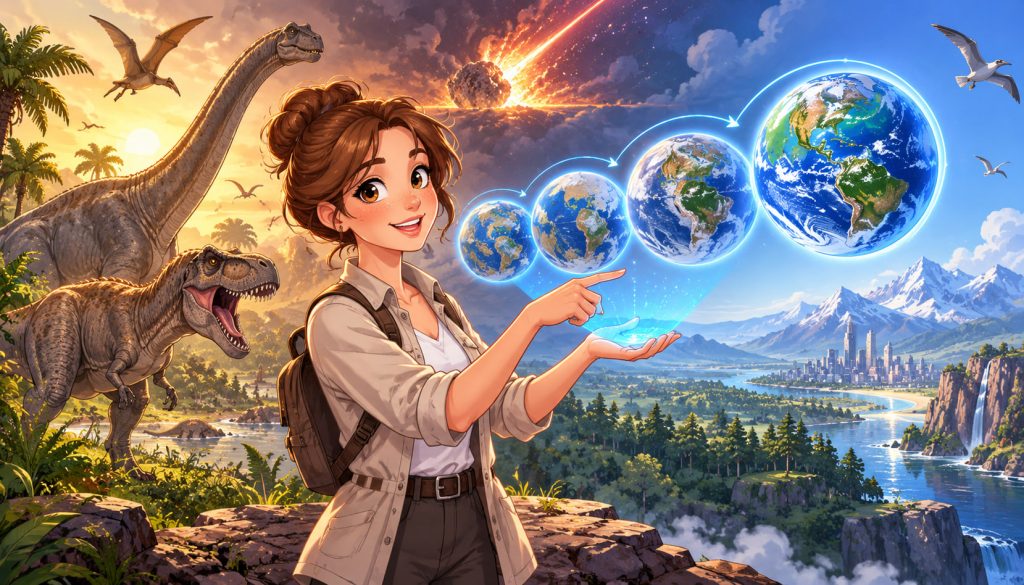
About 66 million years ago, Earth experienced one of the most dramatic turning points in its history. A massive asteroid impact, combined with ongoing volcanic activity and severe environmental disruption, helped trigger the extinction of the non-avian dinosaurs.
Since then, our planet has changed enormously.
Continents have shifted, mountains have risen, oceans have changed shape, climates have swung from warm greenhouse conditions to repeated ice ages, and entirely new ecosystems have developed. Mammals diversified, grasslands spread, whales entered the oceans, and eventually humans appeared.
The Earth we know today is the result of tens of millions of years of geological, climatic, and biological transformation.
The World Immediately After the Dinosaurs
The extinction event at the end of the Cretaceous Period eliminated about three-quarters of Earth’s species.
The asteroid that struck near what is now the Yucatán Peninsula released enormous amounts of energy. Dust, soot, and aerosols entered the atmosphere, reducing sunlight and disrupting photosynthesis.
Food chains collapsed.
Many large animals disappeared, including all non-avian dinosaurs. However, some groups survived, including birds, small mammals, crocodilians, turtles, amphibians, insects, and many plants.
The planet did not recover instantly.
Ecosystems required thousands to millions of years to rebuild, and the biological world that emerged afterward looked increasingly different from the one dominated by dinosaurs.
The Continents Moved Dramatically
One of the biggest changes since the dinosaurs disappeared has been continental drift.
During the late Cretaceous, the continents were already separating from the ancient supercontinent Pangaea, but their positions were still very different from today.
India, for example, was once an isolated landmass moving rapidly northward across the Indian Ocean.
Eventually, it collided with Asia.
That collision helped create the Himalayas, which are still rising today as the Indian and Eurasian tectonic plates continue to push against each other.
Australia gradually separated from Antarctica and moved northward.
South America remained isolated for millions of years before becoming connected to North America.
The modern map of the world is therefore relatively recent in geological terms.
The Himalayas and Other Mountains Rose
Mountain building has dramatically reshaped landscapes since the age of dinosaurs.
The Himalayas began forming tens of millions of years ago as India collided with Asia. The Alps also rose through tectonic collisions involving Africa and Eurasia.
Other mountain systems continued evolving as plates shifted and crustal forces pushed land upward.
Mountain formation influenced more than scenery.
Large mountain ranges can alter wind patterns, rainfall, erosion, and even global climate.
The rise of the Himalayas and Tibetan Plateau, for example, has had major effects on atmospheric circulation and the Asian monsoon system.
Earth Became Much Cooler
The world of the late dinosaurs was generally warmer than the modern world.
Polar regions were far less icy, and there were long periods when permanent ice sheets were largely absent.
Over millions of years, however, Earth gradually cooled.
One major change occurred around 34 million years ago, when a large permanent ice sheet developed on Antarctica.
Later, cooling intensified in the Northern Hemisphere.
By roughly 2.6 million years ago, Earth had entered the Quaternary Period, characterized by repeated glacial and interglacial cycles.
During glacial periods, enormous ice sheets covered large parts of North America and northern Europe.
Modern humans evolved on a planet much colder and more climatically variable than the one inhabited by the last dinosaurs.
Antarctica Changed Beyond Recognition
Antarctica was not always a frozen desert.
During parts of the dinosaur era and early Cenozoic Era, the continent supported forests and relatively mild ecosystems.
Its transformation into an ice-covered continent depended on several factors.
Continental movement isolated Antarctica more effectively from warmer ocean currents. Atmospheric carbon dioxide levels also declined over long periods.
Eventually, large-scale glaciation developed.
Today, Antarctica stores the majority of Earth’s freshwater ice and plays a crucial role in global climate and sea level.
Mammals Took Over Many Ecological Roles
Mammals existed alongside dinosaurs for more than 100 million years, but most remained relatively small.
After the extinction of non-avian dinosaurs, many ecological niches suddenly became available.
Mammals diversified rapidly.
Some became large herbivores. Others evolved into predators, tree-dwellers, burrowers, runners, swimmers, and flyers.
Over time, mammals produced elephants, horses, bats, primates, whales, cats, dogs, and many other familiar groups.
This expansion was one of the most important biological consequences of the dinosaur extinction.
Without that extinction, the evolutionary history of mammals might have been radically different.
Whales Returned to the Sea
One of the most remarkable transformations after the dinosaur era was the evolution of whales.
The ancestors of modern whales were land-dwelling mammals.
Over millions of years, some populations became increasingly adapted to aquatic life.
Their limbs changed, bodies became streamlined, nostrils shifted toward the top of the head, and tails evolved powerful swimming structures.
Eventually, fully marine whales appeared.
Today, the largest animal known to have ever lived, the blue whale, is a mammal that evolved long after the disappearance of non-avian dinosaurs.
Grasslands Changed the Planet
For much of the dinosaur era, flowering plants were expanding, but vast modern grasslands did not dominate landscapes in the way they later would.
Grasslands became increasingly widespread during the Cenozoic.
This ecological shift transformed animal evolution.
Grazing mammals developed specialized teeth and digestive systems to process tough grasses.
Horses, antelopes, cattle, and many other grazing animals became major components of terrestrial ecosystems.
Open grasslands also favored faster running and new predator-prey relationships.
Birds Are Living Dinosaurs
Dinosaurs did not completely disappear.
Modern birds evolved from small feathered theropod dinosaurs.
This means that pigeons, eagles, penguins, chickens, and hummingbirds are part of the surviving dinosaur lineage.
Birds diversified dramatically after the mass extinction.
They eventually occupied environments ranging from deserts and tropical forests to polar oceans.
In evolutionary terms, the dinosaur age never ended completely because one branch of dinosaurs is still alive today.
Primates and Humans Appeared Very Late
Primates diversified during the Cenozoic, but humans arrived extremely late in Earth’s post-dinosaur history.
Early members of the human evolutionary lineage appeared only several million years ago.
Modern Homo sapiens emerged roughly 300,000 years ago.
Compared with the 66 million years since the extinction of non-avian dinosaurs, human history occupies only a tiny fraction of time.
If the entire period since the dinosaurs disappeared were compressed into a single day, modern humans would appear only during the final few seconds.
Oceans Also Changed
Ocean ecosystems underwent major restructuring after the mass extinction.
Marine reptiles such as mosasaurs and plesiosaurs disappeared.
Over time, new groups became dominant.
Whales and dolphins evolved, modern sharks diversified further, coral reef communities changed, and new marine food webs developed.
Ocean circulation also changed as continents shifted.
The opening and closing of seaways altered how heat moved around the planet.
Changes in ocean currents helped influence climate, rainfall, and polar ice formation.
The Mediterranean Nearly Dried Out
One of the most dramatic recent geological events occurred around 6 million years ago.
Connections between the Atlantic Ocean and Mediterranean region became restricted.
As a result, evaporation caused much of the Mediterranean basin to lose enormous quantities of water.
This episode is known as the Messinian Salinity Crisis.
Huge salt deposits formed on the seafloor.
Later, Atlantic waters returned and refilled the basin.
Events like this show that even familiar modern geographical features can change dramatically over geological time.
Expert Perspective
Paleontologists and Earth scientists generally view the extinction 66 million years ago not simply as the end of the dinosaurs, but as the beginning of a completely new phase of planetary evolution.
Researchers studying the Cenozoic Era emphasize that life, climate, oceans, and geology constantly influence one another.
Mountain building can change climate. Climate can reshape ecosystems. Extinction can open ecological opportunities. Continental movement can redirect ocean currents.
Earth’s history is therefore not a series of isolated events.
It is a connected system in which geological and biological evolution continually reshape the planet.
Is Earth Still Changing Today?
Absolutely.
Tectonic plates continue moving several centimeters per year.
The Himalayas are still rising.
Volcanoes continue building and destroying land.
Rivers reshape continents through erosion.
Species continue evolving.
Climate is also changing rapidly today, with human activities now becoming a major influence on atmospheric composition, ecosystems, glaciers, and sea level.
Earth is not a finished planet. It is still changing every second.
Interesting Facts
- The non-avian dinosaurs disappeared about 66 million years ago.
- Birds are the only surviving dinosaur lineage.
- India traveled thousands of kilometers before colliding with Asia.
- The Himalayas are geologically young compared with many ancient mountain systems.
- Antarctica once supported forests before becoming heavily glaciated.
- The ancestors of whales originally lived on land.
- Grasslands expanded greatly during the Cenozoic Era and transformed mammal evolution.
- Modern humans appeared extremely recently compared with the time since the dinosaur extinction.
- The Mediterranean Sea nearly dried out about 6 million years ago.
- Blue whales evolved long after the dinosaurs disappeared and became larger than any known dinosaur.
- Continents are still moving today because tectonic plates remain active.
- Earth has experienced repeated ice ages during the past few million years.
Glossary
- Cretaceous Period — The geological period that ended about 66 million years ago with a major mass extinction.
- Cenozoic Era — The geological era beginning after the extinction of non-avian dinosaurs and continuing to the present.
- Mass Extinction — A relatively rapid global loss of a large proportion of species.
- Tectonic Plates — Large moving sections of Earth’s outer shell.
- Continental Drift — The long-term movement of continents caused by plate tectonics.
- Glaciation — The development and expansion of large ice sheets or glaciers.
- Interglacial — A warmer period between major glacial phases.
- Ecological Niche — The role a species plays within an ecosystem.
- Theropod — A group of mostly meat-eating dinosaurs that includes the ancestors of modern birds.
- Evolution — Change in inherited biological characteristics across generations.
- Ocean Circulation — Large-scale movement of seawater around the planet.
- Messinian Salinity Crisis — A period when much of the Mediterranean Sea experienced extreme evaporation and major water loss.
- Pangaea — An ancient supercontinent that once contained most of Earth’s landmasses.