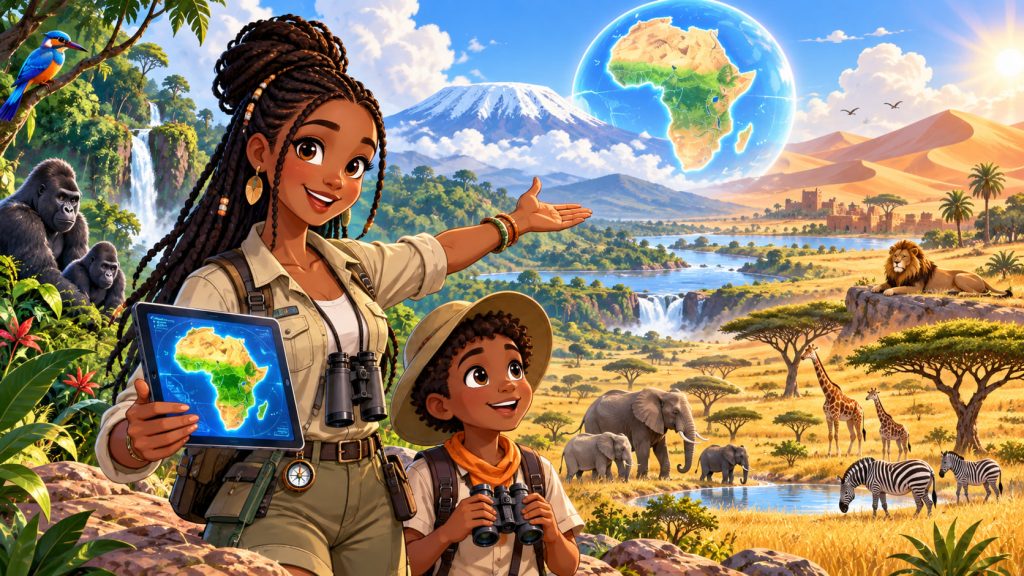
Africa is often described in simple terms: deserts, safaris, ancient civilizations, and dramatic landscapes. In reality, it is one of the most diverse regions on Earth, with vast differences in climate, language, culture, ecology, and economic development.
It is the second-largest continent by both land area and population, and it plays a central role in human history, biodiversity, global trade, and the future of the world economy.
From the Sahara Desert to tropical rainforests, from modern megacities to remote savannas, Africa cannot be understood as a single story.
How Large Is Africa?
Africa covers more than 30 million square kilometers, making it the second-largest continent after Asia.
Its size is often underestimated on flat maps because common map projections distort the relative dimensions of continents.
Africa is enormous enough to contain many major countries and regions within its boundaries.
The continent is usually divided into several broad geographical regions:
- North Africa
- West Africa
- Central Africa
- East Africa
- Southern Africa
Each has its own landscapes, historical development, languages, and cultural traditions.
Africa is not a country but a continent made up of 50+ sovereign states, each with its own political and social identity.
The Sahara: The World’s Largest Hot Desert
The Sahara dominates much of North Africa.
It stretches across millions of square kilometers and includes sand dunes, rocky plateaus, dry valleys, mountains, and salt flats.
Despite its image as a lifeless desert, the Sahara supports highly adapted plants, animals, and human communities.
Temperatures can vary dramatically between day and night, and some mountain regions experience surprisingly cold conditions.
The Sahara has also changed over geological time.
Thousands of years ago, parts of the region were much greener, with lakes, grasslands, and large animal populations.
Africa’s Great Rivers and Lakes
Africa contains some of the world’s most important freshwater systems.
The Nile is one of the longest rivers on Earth and has supported agriculture and settlement for thousands of years.
The Congo River carries enormous volumes of water through Central Africa and drains one of the largest tropical forest regions in the world.
Other major rivers include the Niger, Zambezi, Limpopo, and Orange rivers.
Africa is also home to enormous lakes.
Lake Victoria is one of the largest freshwater lakes by surface area, while Lake Tanganyika is among the deepest lakes in the world.
These water systems are essential for drinking water, agriculture, transportation, fisheries, hydropower, and ecosystems.
The African Savanna
For many people, the savanna is the landscape most strongly associated with Africa.
Savannas are grasslands with scattered trees, shaped by rainfall patterns, fire, grazing animals, and seasonal drought.
They support some of the planet’s most famous wildlife.
Elephants, giraffes, zebras, antelopes, lions, cheetahs, hyenas, and many other species live in African savanna ecosystems.
The relationship between predators and herbivores helps shape the landscape.
Large grazing animals influence vegetation, while predators help regulate prey populations.
The savanna is a complex ecological system, not simply an open grassland filled with animals.
Africa’s Rainforests
Central Africa contains the Congo Basin, one of the world’s largest tropical rainforest regions.
These forests store enormous amounts of carbon and support extraordinary biodiversity.
They are home to gorillas, chimpanzees, forest elephants, okapis, and thousands of plant species.
Tropical forests also influence rainfall and regional climate.
Their loss can affect not only wildlife but also water cycles, local temperatures, and communities that depend on forests for food, materials, and livelihoods.
The Birthplace of Humanity
Africa has a unique place in human evolution.
Some of the oldest known fossils of early human ancestors have been discovered on the continent.
Evidence from genetics and archaeology strongly supports the idea that modern humans originated in Africa before populations later spread across the world.
East Africa, southern Africa, and other regions have provided important fossils and archaeological sites that help scientists reconstruct human evolutionary history.
Africa therefore is not merely one part of human history.
It is deeply connected to the origins of our species.
Ancient African Civilizations
African history extends far beyond the period of European colonialism.
Ancient Egypt developed one of the world’s most famous civilizations along the Nile.
Other powerful societies and kingdoms developed across the continent, including Kush, Aksum, Mali, Songhai, Great Zimbabwe, and many others.
Trade networks connected African regions with the Mediterranean, Middle East, Asia, and later Europe.
Gold, salt, ivory, textiles, metals, and other goods moved through these networks.
Cities such as Timbuktu became important centers of scholarship, commerce, and Islamic learning.
Africa Is Linguistically Extraordinary
Africa is one of the most linguistically diverse places on Earth.
Thousands of languages are spoken across the continent.
Major language families include Afroasiatic, Niger-Congo, Nilo-Saharan, and Khoisan-related groups, although linguistic classification can be complex.
Arabic, Swahili, Hausa, Amharic, Yoruba, Zulu, Somali, and many other languages are spoken by millions of people.
European languages such as English, French, Portuguese, and Spanish are also official or widely used in several countries because of colonial history.
Multilingualism is normal in many African societies.
A person may use one language at home, another in the local community, and another in education or government.
Africa’s Modern Cities
Africa is becoming increasingly urban.
Cities such as Cairo, Lagos, Johannesburg, Nairobi, Kinshasa, Addis Ababa, Casablanca, and Dar es Salaam are major centers of business, technology, culture, finance, and education.
Some African cities are among the fastest-growing urban areas in the world.
This growth creates enormous opportunities, but it also brings challenges involving housing, transportation, electricity, water, and public services.
Africa’s future will be shaped significantly by how its cities develop.
Africa and the Global Economy
Africa has large reserves of many valuable natural resources.
These include:
- Copper
- Cobalt
- Gold
- Diamonds
- Oil
- Natural gas
- Platinum-group metals
- Lithium and other strategic minerals
Some of these resources are increasingly important for electronics, batteries, electric vehicles, and renewable-energy technologies.
However, natural-resource wealth does not automatically create prosperity.
Economic development depends on infrastructure, governance, education, political stability, local industry, and the ability to create value within national economies.
Renewable Energy Potential
Africa has enormous renewable-energy potential.
Many regions receive intense sunlight throughout the year, making solar power particularly promising.
Some areas also have strong wind resources, major hydropower potential, and geothermal energy.
East Africa’s Rift Valley, for example, contains substantial geothermal resources.
Expanding reliable electricity access could transform education, healthcare, agriculture, manufacturing, and digital services.
Energy infrastructure is likely to be one of the most important factors shaping Africa’s economic future.
Africa’s Young Population
Africa has one of the youngest populations in the world.
In many countries, a large proportion of the population is under 25.
This demographic structure creates both opportunity and pressure.
A large young workforce can support rapid economic growth if enough jobs, education, healthcare, and infrastructure are available.
At the same time, rapid population growth can place pressure on cities, schools, housing, and natural resources.
The continent’s demographic changes will increasingly influence global economics and politics during the coming decades.
Expert Perspective
Demographers, economists, and development specialists increasingly emphasize that Africa’s importance in the 21st century will grow substantially because of its population trends, urbanization, natural resources, and expanding technology sectors.
Experts also caution against treating Africa as one homogeneous region.
Economic conditions, political systems, climate, public health, education, and infrastructure vary enormously between countries.
Understanding Africa therefore requires looking at individual countries and regions rather than relying on broad stereotypes.
Africa’s Wildlife and Conservation
Africa contains some of the world’s most iconic species, but many face serious pressure.
Habitat loss, illegal wildlife trade, climate change, agricultural expansion, and conflict between wildlife and human communities can threaten populations.
Protected areas play a major role in conservation.
However, modern conservation increasingly recognizes that local communities must also benefit from wildlife protection.
Successful conservation often requires balancing biodiversity protection with agriculture, tourism, employment, and human development.
Interesting Facts
- Africa is the second-largest continent after Asia.
- The Sahara is the largest hot desert in the world.
- The Nile is among the longest rivers on Earth.
- The Congo Basin contains one of the planet’s largest tropical rainforest systems.
- Africa is home to more countries than any other continent.
- Thousands of languages are spoken across Africa.
- Modern humans are believed to have originated in Africa.
- Mount Kilimanjaro is the highest mountain in Africa.
- Lake Tanganyika is one of the deepest freshwater lakes in the world.
- The continent includes deserts, rainforests, alpine environments, wetlands, grasslands, and Mediterranean ecosystems.
- Africa has enormous potential for solar energy because many regions receive strong sunlight throughout the year.
Glossary
- Savanna — A tropical or subtropical grassland ecosystem with scattered trees and seasonal rainfall.
- Sahara — The vast hot desert covering much of North Africa.
- Congo Basin — A large drainage region in Central Africa containing extensive tropical rainforest.
- Biodiversity — The variety of living organisms within an ecosystem, region, or the entire planet.
- Urbanization — The increasing proportion of people living in towns and cities.
- Demography — The study of human populations, including their size, age structure, and growth.
- Geothermal Energy — Energy obtained from heat stored beneath Earth’s surface.
- Hydropower — Electricity generated using moving water.
- Natural Resources — Materials and energy sources found in nature that can be used by humans.
- Ecosystem — A community of organisms interacting with each other and with their physical environment.
- Multilingualism — The regular use or knowledge of more than one language.