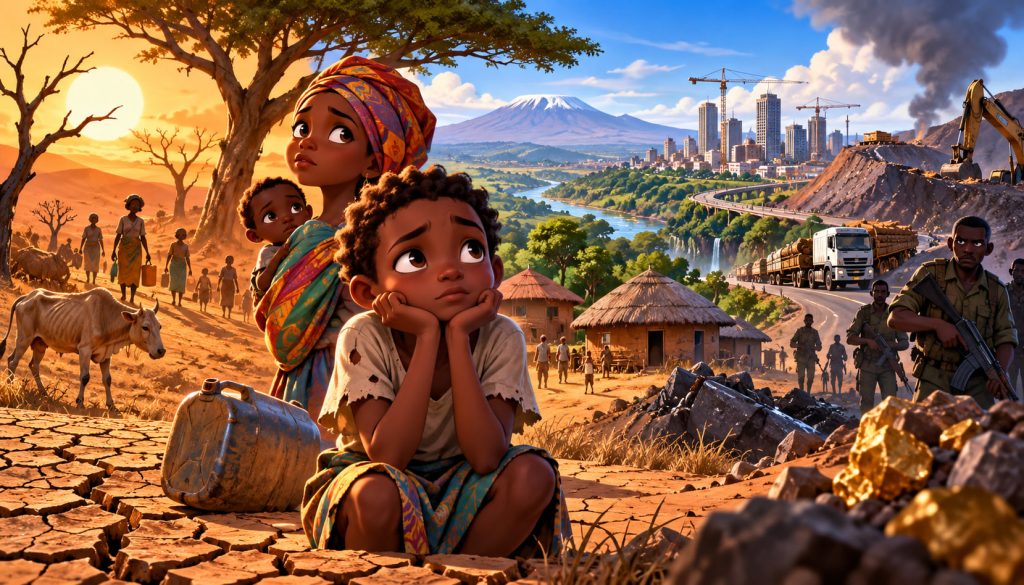
Africa is one of the most diverse and resource-rich continents on Earth, yet many of its countries still face serious development challenges.
These challenges include poverty, weak infrastructure, conflict, rapid population growth, limited access to healthcare and education, climate stress, and political instability.
The important point is that Africa’s problems are deeply interconnected. Poverty can weaken education. Weak education can reduce economic opportunity. Poor infrastructure can limit trade. Political instability can discourage investment. Climate change can make agriculture less reliable.
This is why there is rarely a single solution.
Poverty and Economic Inequality
Poverty remains a major challenge in many parts of Africa.
Millions of people still live without reliable access to electricity, clean water, healthcare, transportation, or stable employment.
However, poverty is not distributed evenly across the continent.
Some African countries have rapidly growing economies, expanding middle classes, and modern urban industries. Others remain heavily dependent on agriculture, raw-material exports, or foreign aid.
One major problem is that economic growth does not always reach the entire population.
A country can become richer while large groups of people remain poor.
This often happens when wealth is concentrated in a few industries, regions, or social groups.
Weak Infrastructure Slows Development
Infrastructure is one of the foundations of economic growth.
Roads, ports, railways, electricity networks, water systems, schools, hospitals, and internet access all make it easier for people and businesses to function.
In many African countries, infrastructure development has not kept pace with population growth.
Poor roads can make it difficult for farmers to bring crops to market.
Unreliable electricity can increase costs for factories and businesses.
Weak transport networks can limit trade between neighboring countries.
Without strong infrastructure, even talented workers and promising businesses struggle to reach their potential.
Rapid Population Growth
Africa has the youngest population of any continent, and its population is growing quickly.
This creates enormous possibilities.
A large young population can become a powerful workforce, support innovation, and drive consumer demand.
But rapid growth also places pressure on governments.
More people require:
- Schools
- Jobs
- Housing
- Hospitals
- Food
- Transport
- Electricity
- Clean water
If economic growth and public services do not expand quickly enough, unemployment and social pressure can rise.
The challenge is not population growth itself.
The challenge is creating opportunities fast enough for a rapidly expanding population.
Education Is Improving, but Gaps Remain
Education is one of the strongest tools for reducing poverty.
Many African countries have made substantial progress in increasing school enrollment.
Yet serious challenges remain.
Some children still leave school early, while others attend schools with overcrowded classrooms, limited materials, or shortages of trained teachers.
Rural areas can be especially difficult to serve.
Girls may face additional barriers in some regions, including early marriage, household responsibilities, poverty, and concerns about safety.
Improving education takes time because the effects are generational.
Building schools is important, but countries also need trained teachers, strong curricula, reliable funding, and pathways from education into employment.
Healthcare Systems Face Heavy Pressure
Healthcare has improved in many parts of Africa, but access remains uneven.
Some countries face shortages of doctors, nurses, medicines, hospitals, and diagnostic equipment.
Long travel distances can make medical care difficult for rural communities.
Communicable diseases such as malaria, tuberculosis, and HIV continue to affect millions of people, while non-communicable diseases such as diabetes, cancer, and cardiovascular disease are also increasing.
This creates a double burden.
Health systems must fight infectious diseases while also responding to chronic diseases associated with aging and changing lifestyles.
Conflict and Political Instability
Conflict remains one of the most destructive obstacles to development.
Wars and political instability can destroy infrastructure, interrupt education, reduce investment, displace communities, and weaken government institutions.
Conflict can have many causes.
These may include competition over political power, ethnic tensions, land disputes, weak institutions, extremist groups, and struggles over natural resources.
Once conflict begins, it becomes difficult to escape.
Poverty can fuel instability, while instability creates more poverty.
This is one of the clearest examples of a development trap.
Colonial Borders and Historical Legacies
Many modern African borders were shaped during European colonial rule.
These borders often ignored existing ethnic, linguistic, political, and economic relationships.
After independence, new states had to build national institutions inside boundaries that were not always designed around local realities.
This does not mean that colonial borders alone explain modern conflicts.
Political leadership, institutions, economics, regional rivalries, and international influences also matter.
However, historical legacies continue to influence governance, trade, land ownership, and social structures.
Many modern problems cannot be understood without understanding how colonial systems shaped the continent.
Dependence on Raw Materials
Africa contains enormous reserves of oil, natural gas, copper, cobalt, gold, diamonds, and other valuable resources.
In theory, this should create wealth.
In practice, heavy dependence on raw-material exports can create economic instability.
Commodity prices rise and fall.
When global prices fall, government revenues can decline sharply.
Resource-based economies may also struggle to develop manufacturing and other industries.
This is sometimes connected to the idea of a resource curse, where countries rich in natural resources experience corruption, conflict, or weak economic diversification.
The problem is not the resources themselves.
The key issue is how resource wealth is managed.
Corruption and Weak Institutions
Strong institutions help countries enforce laws, collect taxes, protect property, manage public money, and provide services.
When institutions are weak, corruption can become more damaging.
Public funds may be diverted.
Businesses may face unpredictable regulations.
Citizens may lose trust in government.
Investors may hesitate to commit long-term capital.
Corruption exists in every region of the world, but in countries with fragile institutions its effects can be especially severe.
Development depends not only on money but also on whether governments can use resources effectively.
Climate Change Adds Another Layer of Pressure
Africa is particularly vulnerable to climate change because many communities depend heavily on agriculture and natural resources.
Rising temperatures, changing rainfall patterns, droughts, floods, and extreme weather can damage crops and water supplies.
Some regions already face desertification and soil degradation.
Farmers with limited irrigation or financial reserves are especially vulnerable.
A failed rainy season can quickly become a food-security crisis.
Climate adaptation requires investment in irrigation, drought-resistant crops, early-warning systems, water storage, and stronger infrastructure.
These measures can be expensive for countries already facing other financial pressures.
Urbanization Is Happening Extremely Fast
African cities are expanding rapidly.
Urbanization can create jobs, improve access to education, and encourage innovation.
But when cities grow faster than infrastructure, serious problems appear.
Housing shortages can lead to informal settlements.
Traffic congestion increases.
Water and sanitation networks become overloaded.
Waste management becomes more difficult.
At the same time, cities also create opportunity.
Large urban centers can become hubs for technology, finance, manufacturing, culture, and entrepreneurship.
The challenge is to manage growth rather than stop it.
Why Foreign Aid Alone Cannot Solve the Problems
Foreign aid can save lives and support education, healthcare, infrastructure, and emergency relief.
But aid alone cannot create sustainable development.
Long-term progress requires functioning institutions, local businesses, tax systems, education, infrastructure, political stability, and domestic investment.
External programs can help, but they cannot replace effective national and local systems.
The strongest development model is one in which countries build the capacity to finance and manage their own growth.
Expert Perspective
Development economists often emphasize that Africa’s challenges must be understood as systems rather than isolated problems.
Poor infrastructure affects education and business.
Weak education reduces productivity.
Low productivity limits tax revenues.
Low revenues make infrastructure harder to finance.
Political instability can intensify every part of this cycle.
Experts therefore increasingly support integrated strategies that combine education, infrastructure, health, governance, energy, and economic diversification.
There is no universal formula because conditions vary greatly between countries.
Why Solutions Take So Long
Large social and economic transformations usually take decades.
Building roads can take years.
Training doctors and teachers takes even longer.
Creating trustworthy institutions often requires generations.
Economic diversification cannot happen instantly.
Even successful reforms may produce results slowly.
This is one reason African development can appear frustratingly difficult.
The problems are large, interconnected, and historically deep, while effective solutions require long-term consistency.
Reasons for Optimism
Africa should not be viewed only through its problems.
Many countries are experiencing rapid innovation in digital payments, mobile banking, renewable energy, telecommunications, agriculture, and entrepreneurship.
Technology can allow countries to bypass older infrastructure models.
Mobile banking is one example.
Instead of waiting for traditional banking networks to expand everywhere, millions of people have gained financial access through mobile systems.
Solar power can provide electricity to areas that are difficult to connect to national grids.
The continent’s young population also creates enormous potential for future economic growth.
Interesting Facts
- Africa has the youngest population of any continent.
- Many African economies have expanded rapidly during periods of the 21st century.
- Mobile banking became particularly important in parts of Africa where traditional banking infrastructure was limited.
- The continent has enormous reserves of minerals needed for batteries and renewable-energy technologies.
- Africa contains some of the world’s fastest-growing cities.
- Agriculture remains a major source of employment across much of the continent.
- Several African countries have significant geothermal, solar, wind, and hydropower potential.
- Economic conditions vary enormously between African countries, making continent-wide generalizations difficult.
- Better regional trade could significantly expand markets for African businesses.
Glossary
- Infrastructure — Physical systems such as roads, electricity networks, water supplies, ports, schools, and telecommunications.
- Economic Diversification — The development of multiple industries so an economy does not depend heavily on one sector.
- Resource Curse — A situation in which natural-resource wealth contributes to economic or political problems rather than broad prosperity.
- Commodity — A raw material such as oil, copper, coffee, or gold that is traded internationally.
- Urbanization — The growth of towns and cities as a larger share of the population moves into urban areas.
- Institution — An organized political, legal, or social system that helps a society function.
- Governance — The way public institutions make decisions, manage resources, and exercise authority.
- Food Security — Reliable access to enough safe and nutritious food.
- Desertification — Land degradation in dry regions that reduces the productivity of soil and vegetation.
- Human Capital — The knowledge, health, education, and skills that allow people to participate productively in an economy.
- Development Trap — A self-reinforcing cycle in which one problem strengthens another, making progress difficult.