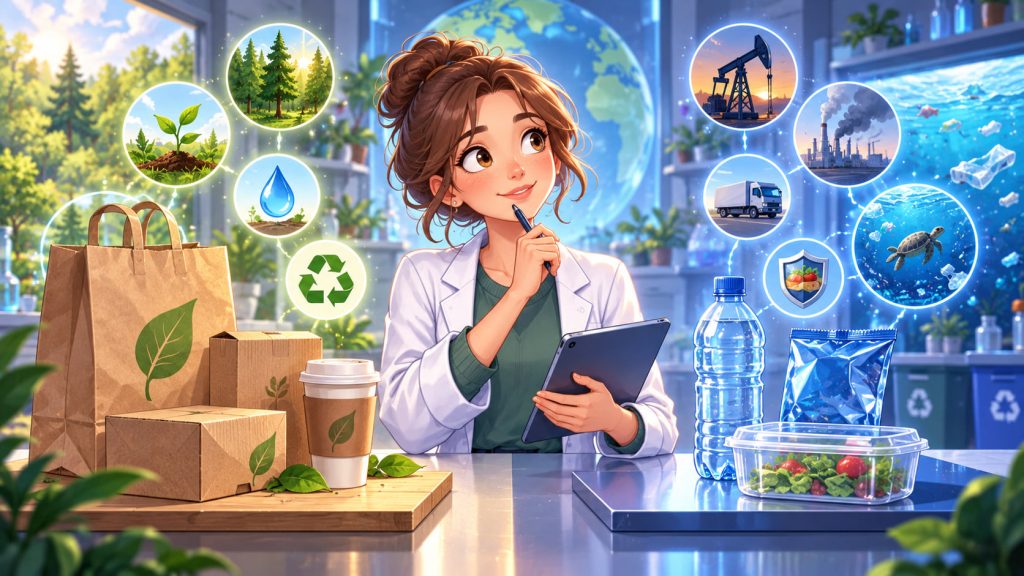
Paper packaging has become a symbol of environmental responsibility. Grocery stores replace plastic bags with paper ones, restaurants switch to cardboard containers, and brands proudly advertise “plastic-free” packaging.
At first glance, the logic seems obvious: paper comes from trees, breaks down naturally, and can be recycled. Plastic is made from fossil fuels and can remain in the environment for decades or centuries.
But the environmental comparison is more complicated.
Paper is often better in some areas, especially litter and biodegradability, while plastic can perform better in others, including weight, transport efficiency, and water use.
The real answer depends on how the packaging is produced, used, reused, recycled, and discarded.
Why Paper Feels More Environmentally Friendly
Paper has several clear advantages.
It is made primarily from renewable biological material rather than fossil-fuel-based polymers. When responsibly sourced, forests used for pulp can be managed and replanted.
Paper also breaks down much faster in natural environments than conventional plastic.
This matters because plastic litter can fragment into smaller particles rather than truly disappearing.
Paper packaging is also widely accepted in recycling systems when it is clean and free from problematic coatings.
For consumers, this creates a strong impression that paper is automatically the greener choice.
But biodegradability alone does not determine the total environmental impact of a product.
Paper Requires a Lot of Resources to Produce
Turning wood into paper is an industrial process.
Trees must be harvested, transported, debarked, pulped, processed, dried, and converted into packaging.
These stages require energy and significant quantities of water.
Paper production can also involve chemicals used for pulping, bleaching, strengthening, and surface treatment.
Modern paper mills have become much more efficient, and some generate energy from wood-processing residues. Even so, manufacturing paper packaging is not environmentally free.
Paper products are also generally heavier than equivalent plastic packaging.
That extra weight can increase fuel consumption and emissions during transportation.
Why Plastic Can Have a Smaller Production Footprint
Plastic has a major environmental weakness: it is usually produced from fossil fuels and persists for a very long time if it escapes waste-management systems.
However, plastic is extremely lightweight and strong.
A very thin plastic bag can carry the same groceries as a much heavier paper bag.
Plastic bottles, films, trays, and pouches can also use relatively little material while providing excellent protection against moisture, oxygen, and contamination.
This efficiency can reduce packaging weight and transport emissions.
A material can therefore have serious end-of-life problems while still being highly efficient during production and transportation.
That is one reason packaging comparisons cannot be reduced to “paper good, plastic bad.”
The Paper Bag vs Plastic Bag Problem
Shopping bags are one of the best-known examples.
A paper bag requires more material and is heavier than a thin plastic carrier bag.
Because of this, producing a paper bag can require more energy and water.
Its transport footprint can also be higher because fewer paper bags fit into the same truck.
However, paper bags are much less persistent if they become litter.
A paper bag that escapes into the environment can break down, while plastic may remain and fragment into microplastics.
The biggest difference often comes from reuse.
A strong bag reused many times can be more environmentally sensible than repeatedly taking new disposable bags, regardless of the material.
Recycling Changes the Calculation
Paper is one of the most established recycled materials in the world.
Used cardboard and paper fibers can be collected, pulped again, and turned into new products.
However, paper fibers become shorter after repeated recycling and eventually cannot be reused indefinitely.
Fresh fiber must therefore continue to enter the system.
Plastic recycling is more difficult.
There are many types of plastics, additives, colors, multilayer structures, and contamination problems.
Some plastic packaging is highly recyclable, while other forms are difficult or economically unattractive to process.
A clean plastic bottle may have a very different recycling future from a multilayer snack wrapper.
The recyclability of a package depends not only on the material but also on its design and the local waste system.
When Paper Packaging Is Not Really Just Paper
One of the biggest sources of confusion is coated paper.
Many paper cups, takeaway containers, cartons, and food wrappers need a barrier to stop grease, water, or oxygen.
That barrier may be made from plastic, wax, aluminum, or another coating.
These combinations can improve performance but make recycling more difficult.
A package that looks like cardboard may therefore be a multilayer product.
This does not automatically make it environmentally harmful, but it means the familiar brown-paper appearance can be misleading.
“Paper-based” does not always mean plastic-free, compostable, or easily recyclable.
Food Waste Can Matter More Than Packaging
Packaging has another environmental role that is often overlooked: protecting the product.
For food, this can be extremely important.
Producing food requires land, water, fertilizer, energy, transport, refrigeration, and labor.
If better packaging keeps food fresh longer and prevents it from being thrown away, the environmental benefit can sometimes outweigh the impact of the packaging itself.
A lightweight plastic film that extends the life of vegetables, for example, may reduce food waste.
Replacing it with heavier packaging that protects the food less effectively could produce an unintended environmental cost.
The best packaging is therefore not always the one that uses the most “natural-looking” material.
What About Biodegradable and Compostable Packaging?
Biodegradable packaging sounds like an ideal solution, but the terminology requires care.
Some materials break down only under controlled industrial composting conditions involving specific temperatures, moisture levels, and microorganisms.
They may not decompose quickly in ordinary soil, seawater, or home compost.
Compostable plastics can also contaminate conventional plastic recycling if they enter the wrong collection stream.
Paper generally has an advantage in natural biodegradability, but coatings and additives can change its behavior.
The destination of the packaging matters almost as much as the material itself.
Expert Perspective: Think in Terms of the Entire Life Cycle
Environmental scientists commonly evaluate packaging using a method called life cycle assessment.
Instead of looking only at what happens after disposal, this approach considers multiple stages:
- Raw material extraction
- Manufacturing
- Energy use
- Water consumption
- Transportation
- Product protection
- Reuse
- Recycling
- Disposal
This broader perspective explains why there is rarely one material that is best in every category.
A package should be judged across its full life cycle, not simply by whether it is made from paper or plastic.
So When Is Paper the Better Choice?
Paper can be especially attractive when the packaging is simple, responsibly sourced, recyclable, and likely to enter an effective paper-recycling system.
It is also preferable in situations where litter risk is high because it is much less persistent in the environment than conventional plastic.
Uncoated cardboard boxes, paper envelopes, and many dry-food packages are good examples.
Paper becomes less advantageous when it requires large amounts of material, heavy coatings, excessive energy, or complex multilayer construction.
When Can Plastic Make Sense?
Plastic may perform well when very little material is needed to provide strong protection.
It can be particularly effective for lightweight, moisture-resistant packaging and applications where product preservation is critical.
The environmental problem becomes much greater when plastic is used briefly and then poorly collected, not recycled, or released into nature.
Reducing unnecessary plastic remains important, but replacing every plastic item with heavier paper is not automatically the best solution.
The Most Sustainable Packaging Is Often Less Packaging
One principle applies across nearly every material.
Reducing unnecessary packaging is usually better than simply replacing one disposable material with another.
Refillable containers, reusable bags, concentrated products, lightweight packaging, and improved recycling systems can all reduce environmental pressure.
Consumers can also make a difference by reusing packaging when practical and sorting waste correctly.
The goal should not be to find a perfect material.
It should be to use fewer resources while keeping products safe and useful.
Interesting Facts
- Paper can usually biodegrade much faster in natural environments than conventional plastic.
- Paper packaging is generally heavier than plastic packaging with similar functions.
- Recycled paper fibers become shorter each time they are processed.
- Many takeaway paper cups contain a thin barrier coating to prevent leaking.
- Some plastic packaging uses very little material because plastic has a high strength-to-weight ratio.
- Food waste can sometimes create a larger environmental footprint than the packaging protecting the food.
- Cardboard made with recycled fibers can still require some fresh fiber to maintain strength and quality.
- Compostable packaging may require industrial composting rather than ordinary home compost conditions.
- Plastic pollution is especially problematic because it can fragment into microplastics rather than fully biodegrading.
- Packaging design can matter as much as material choice when determining recyclability.
Glossary
- Life Cycle Assessment — A method used to evaluate the environmental impact of a product from raw material extraction through production, use, and disposal.
- Biodegradable — Capable of being broken down by microorganisms into simpler substances under suitable conditions.
- Compostable — Able to break down into compost under defined biological conditions.
- Microplastics — Very small plastic particles formed intentionally or through the breakdown of larger plastic products.
- Pulp — A fibrous material, usually made from wood, used to manufacture paper and cardboard.
- Virgin Fiber — New plant fiber that has not previously been recycled.
- Recycled Fiber — Fiber recovered from previously used paper or cardboard.
- Barrier Coating — A protective layer added to packaging to resist water, grease, oxygen, or other substances.
- Multilayer Packaging — Packaging made from several different layers or materials combined together.
- Carbon Footprint — The total greenhouse-gas emissions associated with a product, activity, or process.
- Renewable Resource — A natural resource that can be replenished over time if managed sustainably.