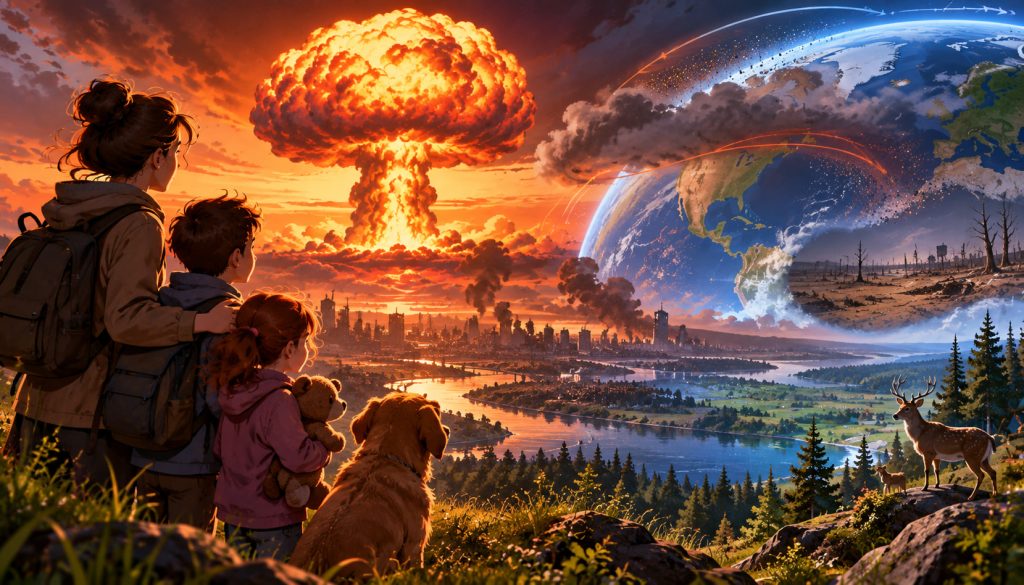
Nuclear weapons are unlike any other military technology in history.
A single detonation can destroy a city in seconds, expose large populations to radiation, contaminate land and water, disrupt ecosystems, and create health effects that may persist for decades. Large-scale nuclear war could produce consequences far beyond the countries directly involved.
Nuclear testing has also left a global environmental legacy. Between 1945 and the present era, more than two thousand nuclear tests were conducted worldwide, including atmospheric, underground, underwater, and high-altitude explosions.
The effects of nuclear weapons are not limited to blast damage. They involve radiation, climate, ecosystems, agriculture, public health, and long-term environmental contamination.
The Immediate Effects of a Nuclear Explosion
A nuclear detonation releases enormous amounts of energy in several forms.
The first is the blast wave.
Extremely high pressure can destroy buildings, infrastructure, vehicles, power systems, hospitals, and transportation networks across a wide area.
The second is thermal radiation.
The fireball produces intense heat capable of causing severe burns and igniting fires kilometers from the center of the explosion.
The third is prompt ionizing radiation.
Gamma rays and neutrons released during the explosion can cause acute radiation exposure among people close enough to survive the initial blast.
These effects occur within seconds, leaving little time for response or evacuation.
Firestorms Can Multiply the Destruction
In densely built areas, thousands of individual fires can merge.
This can create a firestorm.
A firestorm draws in enormous amounts of oxygen and produces extremely strong winds, making fires more difficult to escape or control.
The destruction of water systems, roads, hospitals, and emergency services makes the situation even worse.
Historical experience from Hiroshima and Nagasaki showed that the consequences of nuclear detonations continue long after the initial flash and blast.
Burn injuries, trauma, radiation sickness, infections, and the collapse of medical infrastructure combine into a humanitarian disaster.
What Is Nuclear Fallout?
When a nuclear explosion occurs near the ground, soil, dust, debris, and building materials can be pulled into the radioactive cloud.
These particles become contaminated by radioactive materials and eventually fall back to Earth.
This is known as radioactive fallout.
Some fallout descends relatively close to the explosion.
Other particles can travel hundreds or thousands of kilometers depending on wind, altitude, particle size, and the nature of the detonation.
Fallout can contaminate:
- Soil
- Rivers
- Lakes
- Crops
- Buildings
- Pastureland
- Drinking water
- Food chains
The danger changes over time because different radioactive isotopes decay at different rates.
Radiation Can Affect Health for Years
Ionizing radiation can damage DNA and cells.
Very high doses can cause acute radiation syndrome, involving symptoms such as nausea, weakness, internal damage, infection, and organ failure.
Lower doses may not cause immediate illness but can increase long-term cancer risk.
Children and developing fetuses are especially vulnerable to some effects of radiation.
Radioactive iodine can accumulate in the thyroid.
Other isotopes, such as cesium-137 and strontium-90, can persist in the environment for decades.
Radiation exposure is not a single event. Its consequences depend on dose, duration, isotope, exposure pathway, and individual biology.
Nuclear Testing Created Global Contamination
Atmospheric nuclear testing was especially significant because explosions released radioactive materials directly into the environment.
During the 1950s and early 1960s, powerful atmospheric tests by several nuclear states distributed radioactive fallout across large parts of the planet.
Some radioactive isotopes entered food chains and were detected far from test sites.
Strontium-90 became particularly concerning because it behaves chemically somewhat like calcium and can accumulate in bones.
Public concern over radioactive fallout helped drive international pressure to restrict atmospheric testing.
The 1963 Partial Test Ban Treaty prohibited nuclear tests in the atmosphere, underwater, and in outer space among participating states, pushing most subsequent testing underground.
Underground Tests Are Not Impact-Free
Underground testing reduces atmospheric fallout, but it does not eliminate environmental risk.
A sufficiently deep and well-contained underground explosion may trap much of the radioactive material below the surface.
However, containment can fail.
Cracks, geological faults, and poorly sealed test shafts can allow radioactive gases or particles to escape.
Underground explosions can also create cavities, fractures, ground deformation, and local contamination.
Some former test sites remain restricted or environmentally damaged decades later.
Islands and Indigenous Communities Paid a Heavy Price
Many nuclear tests were conducted in remote regions, deserts, islands, and territories inhabited by relatively small populations.
These places were often politically easier to use than major population centers.
But “remote” did not mean uninhabited.
Communities in parts of the Pacific, Central Asia, North America, and elsewhere experienced displacement, fallout exposure, contaminated food, restricted access to traditional lands, and long-term health concerns.
In some cases, people were relocated permanently.
The history of nuclear testing is also a history of unequal environmental and human burden.
Marine Ecosystems Can Be Affected
Underwater and island-based detonations can disturb marine environments.
Blast waves can kill or injure marine organisms.
Radioactive material can enter sediments and food webs.
Some contaminated locations remain scientifically important today because researchers continue studying how radioactive isotopes move through coral reefs, oceans, soils, and biological systems.
Radioactive contamination does not necessarily remain where it was originally deposited.
It can be redistributed by erosion, storms, currents, plant growth, and animal movement.
Could Nuclear War Change the Global Climate?
One of the most serious concerns about large-scale nuclear war is nuclear winter.
If nuclear weapons ignite widespread urban and industrial fires, enormous quantities of black carbon and smoke could rise into the atmosphere.
Some climate models suggest that enough soot reaching the upper atmosphere could reduce sunlight reaching Earth’s surface.
That could lower temperatures and disrupt rainfall patterns.
The effects could extend far beyond the countries involved in the war.
Agricultural growing seasons could shorten, crop yields could decline, and global food supplies could come under severe pressure.
A major nuclear conflict could therefore become a global climate and food-security crisis, not merely a military event.
Even a Regional Nuclear War Could Have Wider Effects
Nuclear climate research has examined scenarios involving conflicts smaller than a full-scale exchange between the world’s largest nuclear powers.
The concern is that fires in large cities could still generate enough smoke to affect atmospheric conditions.
The exact scale of cooling depends on many uncertain variables, including weapon yields, targets, fuel loads, fire behavior, and how much soot reaches the stratosphere.
However, the broader principle is well established: modern civilization is globally interconnected.
A large disruption in food production, trade, transportation, or energy supply in one region can quickly affect many others.
Nuclear Explosions Can Damage the Ozone Layer
Large nuclear exchanges could also affect atmospheric chemistry.
Heating of the upper atmosphere and chemical reactions involving nitrogen oxides and other substances may contribute to ozone depletion.
The ozone layer protects life from much of the Sun’s harmful ultraviolet radiation.
A substantial reduction in ozone could increase ultraviolet exposure at Earth’s surface.
This could affect human health, crops, phytoplankton, and ecosystems already stressed by other consequences of war.
Electromagnetic Pulse Can Damage Technology
A nuclear explosion, particularly at high altitude, can produce an electromagnetic pulse, or EMP.
An EMP can generate intense electrical fields over large areas.
Depending on altitude, weapon characteristics, and infrastructure protection, it may damage or disrupt:
- Electrical grids
- Communications
- Electronic systems
- Satellites
- Control equipment
Modern societies depend heavily on electricity and digital networks.
This means that some consequences of nuclear weapons are technological rather than directly radiological.
Ecosystems Can Recover, but Contamination Can Persist
Nature can return to damaged areas surprisingly quickly when human activity declines.
Vegetation may regrow.
Wildlife may recolonize abandoned areas.
But ecological recovery does not mean contamination has disappeared.
Long-lived radionuclides can remain in soil and sediment for decades or longer.
Their movement depends on local geology, rainfall, plants, animals, and human land use.
Some environments may become usable again relatively quickly, while others require prolonged monitoring.
Expert Perspective
Scientists who study nuclear effects generally emphasize that the most serious danger lies in the combination of consequences.
A nuclear explosion is not simply a larger conventional bomb.
It combines blast, extreme heat, ionizing radiation, radioactive contamination, infrastructure collapse, and potentially large-scale atmospheric effects.
Climate researchers studying nuclear-war scenarios also stress that the indirect consequences could kill people far from the actual detonations through agricultural disruption and food shortages.
This is why nuclear risk is treated as both a national-security issue and a planetary environmental issue.
The Long Shadow of Nuclear Weapons
Nuclear weapons can produce damage on radically different timescales.
The blast lasts seconds.
Fires may burn for hours or days.
Radiation sickness can develop over days and weeks.
Cancer risks can persist for decades.
Radioactive isotopes may remain measurable for generations.
Environmental, political, psychological, and cultural consequences may last even longer.
Few human technologies combine such intense immediate destruction with such potentially long-lived global consequences.
Interesting Facts
- More than 2,000 nuclear tests have been conducted worldwide since 1945.
- The first nuclear explosion was the Trinity test in New Mexico in July 1945.
- Atmospheric nuclear testing spread detectable radioactive fallout around the world.
- Cesium-137 has a half-life of about 30 years.
- Strontium-90 also has a half-life of roughly 29 years.
- The 1963 Partial Test Ban Treaty sharply reduced atmospheric nuclear testing among participating countries.
- High-altitude nuclear explosions can produce electromagnetic pulses over very large areas.
- Nuclear winter research focuses largely on smoke and soot generated by burning cities and industrial areas.
- Radioactive material from historical nuclear tests can still be detected in some soils, sediments, and biological samples.
- Some former nuclear test sites remain restricted many decades after testing ended.
Glossary
- Nuclear Weapon — A weapon that releases enormous energy through nuclear fission, fusion, or both.
- Fallout — Radioactive particles that descend from the atmosphere after a nuclear explosion.
- Ionizing Radiation — Radiation energetic enough to remove electrons from atoms and damage biological tissue.
- Radionuclide — An unstable radioactive form of an element.
- Cesium-137 — A radioactive isotope produced by nuclear fission that can persist in the environment for decades.
- Strontium-90 — A radioactive isotope that can enter food chains and accumulate in bones.
- Half-Life — The time required for half of a radioactive substance to decay.
- Nuclear Winter — A proposed period of global cooling caused by smoke and soot from large-scale nuclear fires blocking sunlight.
- Electromagnetic Pulse (EMP) — A burst of electromagnetic energy capable of disrupting electrical and electronic systems.
- Acute Radiation Syndrome — Illness caused by exposure to a high dose of ionizing radiation over a short period.
- Ozone Layer — A region of the stratosphere containing ozone that absorbs much of the Sun’s harmful ultraviolet radiation.
- Atmospheric Nuclear Test — A nuclear explosion conducted above ground or in the atmosphere, capable of spreading radioactive material widely.
- Underground Nuclear Test — A nuclear explosion conducted below the Earth’s surface to contain much of the radioactive material.