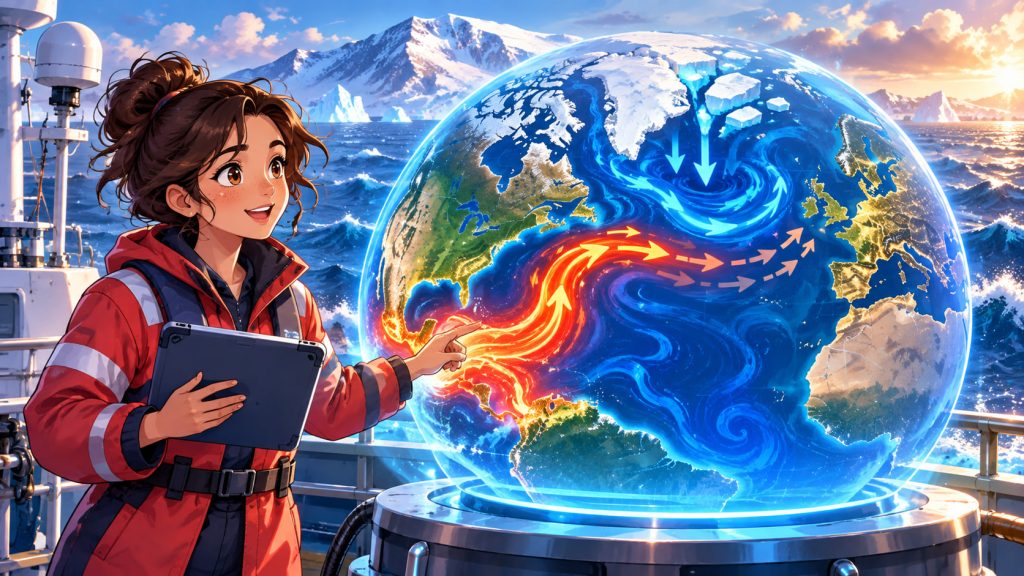
The Gulf Stream is often described as one of the great engines of Earth’s climate. It carries enormous amounts of warm water northward through the Atlantic and helps shape weather conditions across North America and Europe.
In recent years, headlines have warned that the Gulf Stream is slowing down — or could even collapse.
The reality is more precise. Scientists are mainly concerned about a larger system called the Atlantic Meridional Overturning Circulation, or AMOC, of which the Gulf Stream is an important part. Climate models indicate that the AMOC is likely to weaken as the planet warms, but the Gulf Stream itself is not expected simply to switch off.
Understanding the difference is essential for making sense of what is actually happening in the Atlantic Ocean.
What Is the Gulf Stream?
The Gulf Stream is a powerful, fast-moving ocean current that begins near the Gulf of Mexico and flows along the eastern coast of the United States before turning northeast across the Atlantic.
It transports warm tropical water toward higher latitudes.
Near the surface, the current can move several kilometers per hour and carries an enormous volume of water.
The Gulf Stream exists partly because of prevailing winds and Earth’s rotation.
This means that the Gulf Stream is not powered solely by differences in water temperature and salinity.
That is one reason claims that it could suddenly disappear entirely are misleading.
What Is the AMOC?
The Atlantic Meridional Overturning Circulation is a much larger system.
It includes northward movement of warm surface water and southward movement of colder, denser water at depth.
In the North Atlantic, surface water loses heat to the atmosphere.
As it cools, and in some regions becomes saltier, it grows denser and can sink.
That deep water then flows southward, forming part of a vast global circulation system.
This process helps redistribute heat around the planet.
When scientists discuss a possible major slowdown in Atlantic circulation, they are usually talking about the AMOC rather than the Gulf Stream alone.
Why Could the AMOC Slow Down?
Global warming changes several of the physical processes that support deep-water formation.
Warmer water is less dense than colder water.
At the same time, melting glaciers and the Greenland Ice Sheet add freshwater to the North Atlantic.
Freshwater contains less salt than seawater and is therefore less dense.
Increasing rainfall in some regions can add even more freshwater.
If surface waters become warmer and fresher, they may become less likely to sink.
That can weaken the overturning circulation.
Climate change therefore affects both temperature and salinity — two of the main factors controlling seawater density.
Is the AMOC Already Slowing?
This is one of the most difficult questions in climate science.
Direct, continuous measurements of the AMOC are relatively recent.
Major monitoring programs have been observing the circulation since the early 2000s, but a few decades is a short period for detecting long-term trends in an ocean system with strong natural variability.
Measurements show that AMOC strength changes substantially from year to year.
Some research using historical ocean temperatures, sediments, corals, and other indirect evidence suggests that the circulation may have weakened compared with previous centuries.
However, estimating past AMOC strength is complicated.
Scientists are more confident that the AMOC will weaken during continued global warming than they are about exactly how much weakening has already occurred.
What Do Climate Models Predict?
Climate models consistently project a weakening of the AMOC during the 21st century under continued greenhouse-gas warming.
The exact magnitude depends on future emissions and on how the atmosphere, ocean, ice sheets, and freshwater cycle interact.
The Intergovernmental Panel on Climate Change has assessed that the AMOC is very likely to weaken during this century.
However, weakening is not the same as collapse.
A slowdown could mean that the circulation continues operating but carries less heat northward.
An abrupt collapse would represent a much more dramatic change in the climate system.
Current scientific assessments generally consider a major weakening plausible, while the timing and probability of a complete collapse remain much more uncertain.
Could the Gulf Stream Stop Completely?
The popular image of the Gulf Stream suddenly stopping is not scientifically accurate.
The Gulf Stream is strongly influenced by winds and Earth’s rotation, so those forces would continue to drive ocean circulation even if the AMOC weakened substantially.
What could change is the amount of heat transported northward and the structure of currents across the Atlantic.
A weaker AMOC would not produce a motionless Atlantic Ocean.
Instead, it would reorganize heat transport, regional temperatures, rainfall patterns, sea level, and marine ecosystems.
Would Europe Suddenly Freeze?
Another common claim is that an AMOC collapse would instantly trigger a new ice age in Europe.
That is an exaggeration.
Western Europe is relatively mild partly because the Atlantic transports heat northward, but ocean currents are not the only reason.
Atmospheric circulation and geography also play major roles.
A major AMOC weakening could reduce warming over parts of the North Atlantic and Europe compared with what would otherwise occur.
Some areas could experience significant regional cooling.
However, this would happen against the background of a globally warming climate.
The likely result would be complex regional climate change, not an overnight transformation of Europe into an ice-covered continent.
What Could Happen to Weather?
The AMOC influences large-scale patterns in the atmosphere.
A substantial slowdown could affect rainfall over Europe, Africa, and the Americas.
It could also shift tropical rain belts and influence monsoon systems.
Changes in North Atlantic sea-surface temperatures can alter atmospheric pressure patterns and storm tracks.
Scientists are also investigating possible connections between AMOC changes and heat waves, droughts, hurricanes, and winter weather.
Not every individual storm or unusual season can be blamed on Atlantic circulation.
The effects operate through large-scale climate patterns rather than as a simple one-to-one relationship.
Why Sea Level Could Rise Along the U.S. East Coast
Ocean circulation influences sea level as well as temperature.
The Gulf Stream helps maintain differences in sea level across the western North Atlantic.
If parts of the circulation weaken, water can redistribute.
This could contribute to higher sea levels along portions of the eastern coast of North America.
Such changes would occur in addition to global sea-level rise caused by melting land ice and thermal expansion of warming seawater.
For coastal cities, even relatively small circulation-related changes can increase the consequences of storm surges and high tides.
What Would Happen to Marine Ecosystems?
The Atlantic circulation transports much more than heat.
It also moves oxygen, nutrients, carbon, and marine organisms.
Changes in current strength could influence where nutrients are delivered and how productive different regions of the ocean become.
Fish populations may shift as water temperatures change.
Plankton communities can also respond to altered temperature, salinity, and nutrient availability.
The AMOC is additionally involved in the ocean’s uptake and storage of carbon dioxide.
A major circulation change would therefore affect both climate and the biological functioning of the Atlantic Ocean.
Expert Perspective: Weakening Is Not the Same as Collapse
Oceanographers emphasize the importance of separating three different ideas: natural variability, long-term weakening, and complete collapse.
The AMOC naturally becomes stronger and weaker over time.
Climate change is expected to push the system toward a weaker average state.
A collapse would be a much more extreme transition.
Experts therefore monitor temperature, salinity, current velocity, deep-water formation, and freshwater input throughout the North Atlantic.
Long-term observations are particularly important because a few unusual years cannot establish a permanent trend.
The strongest scientific message is that continued warming increases the risk of significant AMOC weakening, while the possibility and timing of an abrupt collapse remain uncertain.
Could the AMOC Reach a Tipping Point?
A tipping point is a threshold beyond which a system changes rapidly or becomes difficult to restore to its previous state.
The AMOC is considered a potential climate tipping element.
If enough freshwater enters the North Atlantic and deep-water formation weakens substantially, feedbacks could theoretically amplify the change.
Researchers study this possibility using climate models, observations, and evidence from Earth’s past.
Paleoclimate records show that Atlantic circulation has changed dramatically during earlier periods of Earth’s history.
Those ancient events occurred under conditions different from today’s, but they demonstrate that large ocean circulation changes are physically possible.
Interesting Facts
- The Gulf Stream transports more water than all of Earth’s rivers combined.
- The Gulf Stream and the AMOC are related but are not the same thing.
- Earth’s rotation helps shape the Gulf Stream through the Coriolis effect.
- Temperature and salinity both influence the density of seawater.
- Greenland’s melting ice adds freshwater to the North Atlantic.
- Scientists continuously measure Atlantic circulation using instruments anchored deep in the ocean.
- Ocean currents transport heat, nutrients, oxygen, carbon, and marine organisms.
- Large changes in Atlantic circulation have occurred naturally during Earth’s past.
- A weaker AMOC could influence regional sea level as well as temperature.
- Climate models project AMOC weakening during the 21st century under continued warming.
Glossary
- Gulf Stream — A powerful warm ocean current flowing from the Gulf of Mexico along North America and toward the North Atlantic.
- AMOC — Atlantic Meridional Overturning Circulation, a large system of surface and deep ocean currents transporting water and heat through the Atlantic.
- Ocean Circulation — The large-scale movement of seawater driven by winds, density differences, Earth’s rotation, and other forces.
- Salinity — The concentration of dissolved salts in water.
- Deep-Water Formation — The process in which dense surface water sinks into the deep ocean.
- Coriolis Effect — The apparent deflection of moving air and water caused by Earth’s rotation.
- Thermal Expansion — The increase in volume that occurs when seawater warms.
- Tipping Point — A threshold beyond which a system may undergo a large and potentially self-reinforcing change.
- Paleoclimate — Earth’s climate during periods before modern instrumental measurements.
- Climate Model — A computer-based mathematical representation of Earth’s atmosphere, oceans, land, and ice.
- Natural Variability — Climate fluctuations that occur naturally over months, years, decades, or longer periods.
- Freshwater Input — The addition of low-salinity water from rainfall, rivers, melting glaciers, or ice sheets into the ocean.