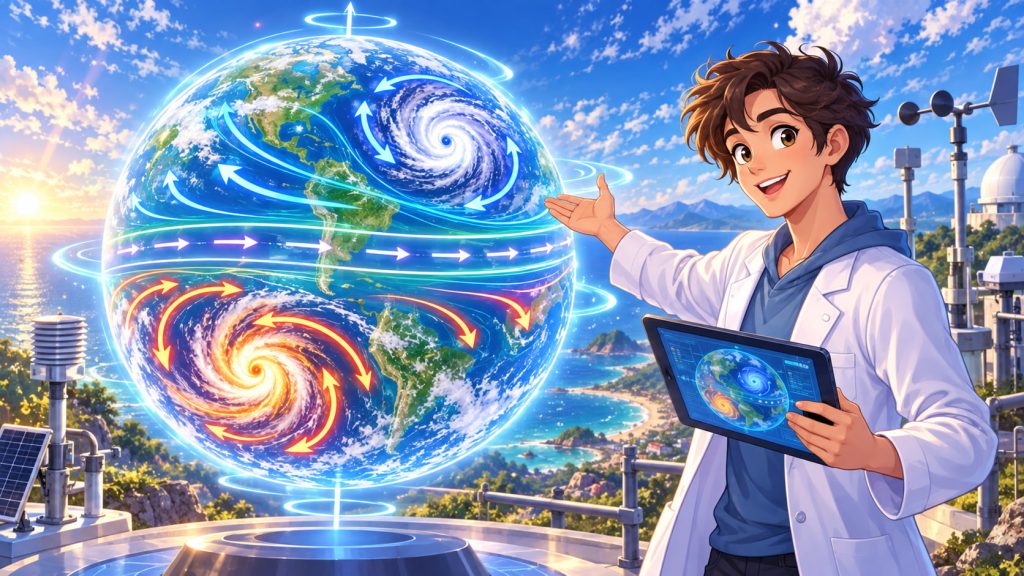
The Coriolis effect is one of those scientific ideas that seems mysterious until you realize it comes from something very familiar: Earth is rotating beneath everything moving across its surface.
It helps explain why major wind systems curve, why ocean currents form vast rotating gyres, and why hurricanes spin in opposite directions in the Northern and Southern Hemispheres.
The Coriolis effect does not push objects in the same way gravity does. Instead, it is an apparent deflection observed when motion is described from a rotating frame of reference.
On Earth, that rotating frame is the planet itself.
What Is the Coriolis Effect?
Imagine standing on a rotating platform and throwing a ball straight toward someone on the opposite side.
From your point of view, the ball may appear to bend sideways.
But if an observer could watch from above without rotating with the platform, the ball would travel along a much straighter path.
The same principle applies on Earth.
Because Earth rotates from west to east, moving air, water, aircraft, and other objects can appear to curve relative to the rotating surface.
In the Northern Hemisphere, moving objects are deflected to the right of their direction of travel. In the Southern Hemisphere, they are deflected to the left.
This is the Coriolis effect.
Why Does Earth’s Rotation Create This Deflection?
Different parts of Earth move at different linear speeds.
Near the equator, the surface must travel a large distance during one complete rotation.
Closer to the poles, the circumference of the circle traveled is much smaller.
As a result, the eastward speed of Earth’s surface is greatest near the equator and decreases toward the poles.
Air moving northward from the tropics carries some of the eastward momentum it had at lower latitudes.
Because the ground beneath it is moving eastward more slowly at higher latitudes, the air appears to move ahead of the surface.
It therefore curves eastward relative to the ground.
A similar process occurs when air moves toward the equator.
This change in motion is one of the ways to visualize the Coriolis effect.
Why Is There Almost No Coriolis Effect at the Equator?
The Coriolis effect depends strongly on latitude.
It is weakest at the equator and becomes progressively stronger toward the poles.
At the equator, the component of Earth’s rotation responsible for horizontal Coriolis deflection is effectively zero.
Near the poles, the effect is strongest.
This is one reason large tropical storms generally do not form extremely close to the equator.
They need enough Coriolis influence to organize their rotating circulation.
How the Coriolis Effect Shapes Global Winds
Without Earth’s rotation, atmospheric circulation would look very different.
Warm air near the equator would rise and move toward the poles, while colder air would move back toward the equator.
But Earth’s rotation bends these movements.
This helps create major global wind belts such as:
- The trade winds
- The prevailing westerlies
- The polar easterlies
For example, air moving toward the equator in the tropics is deflected westward.
This produces the trade winds that have influenced ocean navigation for centuries.
The Coriolis effect helps transform simple north-south air movement into the complex global wind patterns we observe today.
Why Hurricanes Rotate
One of the most dramatic examples of the Coriolis effect is the rotation of large tropical cyclones.
Air flows toward the low-pressure center of a developing storm.
As it moves inward, Coriolis deflection causes the flow to curve.
In the Northern Hemisphere, this contributes to counterclockwise rotation.
In the Southern Hemisphere, tropical cyclones rotate clockwise.
The effect becomes increasingly important as the storm grows into a large organized system.
However, the Coriolis effect does not create hurricanes by itself.
Warm ocean water, moisture, atmospheric instability, and suitable wind conditions are also necessary.
Does the Coriolis Effect Control Water Going Down a Sink?
This is one of the most famous myths about the Coriolis effect.
People often claim that toilets and sinks drain clockwise in one hemisphere and counterclockwise in the other.
For ordinary household sinks and toilets, this is generally false.
The Coriolis effect is extremely weak over such small distances and short time periods.
The direction of draining water is dominated by factors such as:
- Shape of the container
- Position of the drain
- Initial movement of the water
- Plumbing design
- Small asymmetries
In carefully controlled scientific experiments involving very large containers and extremely calm water, Coriolis effects can become measurable.
But in a normal bathroom, local conditions overwhelm them.
How the Coriolis Effect Influences Ocean Currents
Ocean water is constantly moved by wind, temperature differences, salinity differences, tides, and Earth’s rotation.
As winds push surface water, the Coriolis effect changes the direction of its movement.
This contributes to the formation of enormous rotating ocean systems called gyres.
Major ocean gyres rotate clockwise in much of the Northern Hemisphere and counterclockwise in much of the Southern Hemisphere.
The Coriolis effect also contributes to processes such as Ekman transport, where surface water moves at an angle relative to the wind.
This can push water away from coastlines and allow colder, nutrient-rich water to rise from below.
That process is known as upwelling and can support highly productive marine ecosystems.
Why Weather Systems Curve Instead of Moving Straight
Large high-pressure and low-pressure systems are strongly affected by the Coriolis effect.
Air naturally tends to move from higher pressure toward lower pressure.
If Earth did not rotate, winds would travel much more directly across pressure differences.
Instead, Coriolis deflection bends the flow.
In the Northern Hemisphere, air around low-pressure systems generally circulates counterclockwise, while high-pressure systems rotate clockwise.
In the Southern Hemisphere, the directions are reversed.
The balance between pressure forces and the Coriolis effect is fundamental to large-scale meteorology.
Does the Coriolis Effect Affect Airplanes and Missiles?
Yes, especially over long distances.
Aircraft, artillery, missiles, and long-range projectiles move through a rotating reference frame.
For short journeys, the effect may be relatively small.
For long-range navigation or precision targeting, it can become important enough that calculations must account for Earth’s rotation.
Modern navigation systems automatically include these effects.
The Coriolis effect also matters in satellite tracking, atmospheric science, and geophysics.
Is the Coriolis Effect a Real Force?
This depends on how the problem is described.
From an inertial frame outside Earth’s rotation, there is no mysterious sideways force physically pushing the object.
The apparent deflection arises because the observer is rotating with Earth.
In rotating-frame physics, however, Coriolis force is introduced mathematically as a fictitious or inertial force.
This makes calculations much easier.
The word “fictitious” does not mean unimportant or imaginary.
It means that the force appears because the coordinate system itself is accelerating or rotating.
Expert Perspective: Scale Is Everything
Meteorologists and oceanographers emphasize that the Coriolis effect becomes important mainly over large distances and long periods of time.
It is crucial for global winds, ocean currents, and large storms.
It is usually negligible for walking across a room, throwing a ball in a garden, or watching water drain from a bathtub.
This is why the effect can seem confusing.
It is always related to Earth’s rotation, but whether it matters depends heavily on the scale of the motion.
The larger and longer-lasting the movement, the more important Coriolis deflection can become.
The Mathematics Behind the Effect
The strength of the Coriolis acceleration depends on velocity and latitude.
It increases as an object moves faster and as it travels farther from the equator.
In atmospheric science, this dependence is often represented using the Coriolis parameter.
Near the equator, the value is very small.
Toward the poles, it becomes much larger.
This simple mathematical relationship helps meteorologists predict how winds and ocean currents will respond to pressure gradients and other forces.
Why the Coriolis Effect Matters So Much
The Coriolis effect is essential for understanding the planet as a connected system.
It influences weather, climate, ocean circulation, storm rotation, atmospheric transport, and navigation.
Without Earth’s rotation, wind belts would be radically different.
Ocean currents would reorganize.
Storm systems would behave differently.
Even the distribution of heat around the planet would change.
The Coriolis effect is one of the main reasons Earth’s atmosphere and oceans move in large rotating patterns instead of simple straight lines.
Interesting Facts
- Earth rotates from west to east.
- Coriolis deflection is to the right in the Northern Hemisphere and to the left in the Southern Hemisphere.
- The effect is weakest at the equator.
- The effect becomes strongest near the poles.
- Hurricanes rarely form directly on the equator because Coriolis influence there is too weak.
- Large ocean gyres owe part of their rotation to the Coriolis effect.
- Long-range artillery calculations must account for Earth’s rotation.
- Ordinary sinks and toilets are too small for Coriolis forces to determine drainage direction reliably.
- The Coriolis effect also occurs on other rotating planets.
- Jupiter’s rapid rotation strongly influences its powerful atmospheric bands and storms.
- The Coriolis effect becomes more important as the speed, distance, and duration of motion increase.
Glossary
- Coriolis Effect — The apparent deflection of moving objects when observed from a rotating reference frame.
- Coriolis Force — A mathematical inertial force used to describe Coriolis deflection in a rotating coordinate system.
- Rotating Reference Frame — A coordinate system that is itself rotating, such as the surface of Earth.
- Latitude — The angular distance north or south of the equator.
- Trade Winds — Persistent tropical winds that generally blow from east to west.
- Prevailing Westerlies — Mid-latitude winds that generally blow from west to east.
- Ocean Gyre — A large circular system of ocean currents.
- Ekman Transport — The net movement of surface ocean water at an angle to the wind due partly to the Coriolis effect.
- Upwelling — The rise of cold, nutrient-rich deep water toward the ocean surface.
- Pressure Gradient — A difference in atmospheric pressure across a distance that drives air movement.
- Inertial Force — An apparent force introduced when motion is analyzed in an accelerating or rotating reference frame.
- Coriolis Parameter — A mathematical quantity representing how strongly Earth’s rotation affects horizontal motion at a given latitude.