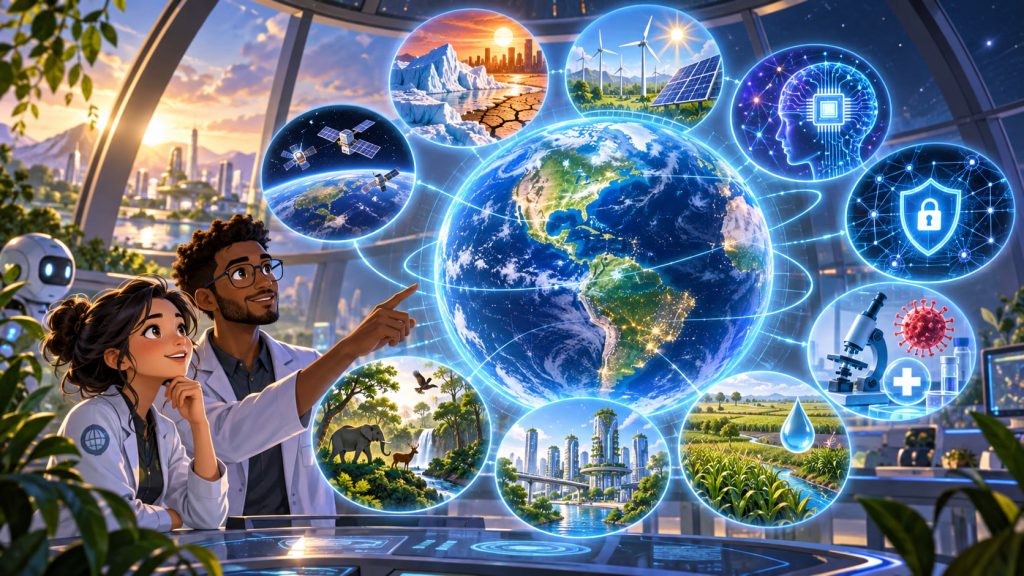
The 21st century has already become one of the most transformative periods in human history. Humanity possesses extraordinary technologies, unprecedented scientific knowledge, global communication networks, and the ability to produce more food, energy, and information than any previous civilization.
Yet these achievements have created new vulnerabilities.
Climate change, artificial intelligence, resource pressure, demographic shifts, pandemics, environmental degradation, cyber threats, and the destructive potential of modern weapons are increasingly interconnected.
The defining challenge of the 21st century is not simply solving individual problems, but learning how to manage complex global systems without creating new crises elsewhere.
Climate Change and a Warming Planet
Climate change is one of the most significant long-term challenges facing civilization.
Human activities and cyclical climate change are changing Earth’s energy balance, raising average temperatures and influencing rainfall, ice cover, oceans, ecosystems, and extreme weather.
The problem is not that every location will simply become warmer.
Climate change can alter:
- Water availability
- Agricultural productivity
- Coastal conditions
- Wildfire risk
- Heat extremes
- Ocean ecosystems
- Infrastructure requirements
Sea-level rise creates an especially long-term challenge because coastlines contain many of the world’s largest cities, ports, industries, and transport networks.
Adapting to climate change will be required even while societies work to limit future warming.
Energy: Powering Civilization Without Destabilizing It
Modern civilization depends on enormous quantities of energy.
Electricity powers hospitals, factories, homes, computers, transportation systems, water infrastructure, and global communications.
The challenge is to expand reliable energy supplies while reducing environmental damage.
Solar and wind power are growing rapidly, while nuclear energy, hydropower, geothermal systems, energy storage, and improved electrical grids may all contribute to future energy systems.
Fossil fuels remain deeply embedded in the world economy, meaning the transition cannot happen simply by replacing one technology overnight.
A successful energy transition requires reliability, affordability, storage, transmission infrastructure, and technological innovation at the same time.
Artificial Intelligence and the Automation Revolution
Artificial intelligence could become one of the most powerful technologies developed during this century.
AI systems are increasingly capable of analyzing scientific data, creating software, translating languages, assisting medical research, automating industrial processes, and solving complex problems.
Future systems may accelerate discoveries in materials science, biology, mathematics, engineering, and energy.
But powerful AI also creates new questions.
How should society deal with automated decision-making, job disruption, misinformation, cybercrime, autonomous systems, and machines that may eventually outperform humans across many cognitive tasks?
The challenge is not simply making AI more powerful.
Humanity must learn how to make increasingly capable artificial intelligence reliable, controllable, and beneficial.
Cybersecurity and the Invisible Infrastructure of Civilization
Much of modern civilization now depends on software.
Banking systems, electrical grids, hospitals, satellites, factories, communication networks, transportation systems, and government services all rely on interconnected computers.
This creates enormous efficiency but also new vulnerabilities.
A cyberattack does not need to destroy a building physically to cause serious disruption.
Malicious software can potentially interrupt payments, steal confidential information, disable services, or interfere with industrial equipment.
As artificial intelligence improves, both cybersecurity tools and automated attacks may become more sophisticated.
Digital resilience is therefore becoming as important as physical infrastructure security.
Pandemics and Global Health
Modern transportation allows people and goods to move around the planet within hours.
Unfortunately, infectious diseases can also travel rapidly.
Future pandemics may emerge naturally when pathogens cross from animals into humans, but biotechnology also introduces new risks involving laboratory accidents or deliberate misuse.
At the same time, antimicrobial resistance is making some bacterial infections increasingly difficult to treat.
The global health challenge therefore includes more than developing medicines.
Countries need surveillance systems, diagnostic technology, hospital capacity, vaccine platforms, trained medical staff, reliable supply chains, and rapid international information sharing.
A pathogen emerging in one region can become a global problem surprisingly quickly.
Water and Food Security
Human civilization depends on reliable supplies of freshwater and food.
Agriculture already uses enormous quantities of land and water, while population growth and rising living standards can increase demand.
Climate change may complicate the situation by altering rainfall patterns and increasing drought or heat stress in some agricultural regions.
Technology offers important solutions.
Precision agriculture, drought-resistant crops, improved irrigation, desalination, wastewater recycling, alternative proteins, and better food storage could reduce pressure on resources.
Another major opportunity is reducing waste.
Large amounts of food are lost between farms, transport systems, shops, restaurants, and households.
Producing food that is never eaten wastes water, land, energy, fertilizer, and labor.
Biodiversity and Ecosystem Decline
Civilization depends on natural systems more than everyday life makes obvious.
Forests influence water cycles and store carbon.
Wetlands reduce flooding.
Insects pollinate crops.
Marine ecosystems provide food.
Soils support agriculture and store enormous quantities of organic material.
Habitat destruction, pollution, invasive species, overexploitation, and climate change can weaken these systems.
Species extinction is irreversible on human timescales.
Protecting biodiversity is therefore not merely about saving attractive animals.
Healthy ecosystems provide services that modern economies would find extremely expensive or impossible to reproduce artificially.
Population Growth, Aging, and Demographic Change
The demographic challenge of the 21st century is not simply population growth.
Different regions face very different situations.
Some societies continue to experience rapid population increases and need more housing, schools, jobs, food, and infrastructure.
Others face aging populations and low birth rates.
An aging population can place pressure on healthcare systems, pensions, and the available workforce.
Meanwhile, rapid urbanization is creating enormous metropolitan areas.
Cities will need efficient transport, clean energy, housing, water systems, and climate-resistant infrastructure.
Demography will increasingly shape economics, technology, migration, and social organization.
Nuclear Weapons and Advanced Military Technology
Humanity continues to possess weapons capable of causing destruction on an extraordinary scale.
Nuclear weapons remain the clearest example.
Modern technology is also introducing autonomous weapons, inexpensive drones, advanced missiles, cyber capabilities, and increasingly sophisticated surveillance systems.
Future conflicts could combine conventional warfare with attacks on satellites, communication networks, power infrastructure, and digital systems.
The underlying challenge is that technological progress can increase destructive capability as easily as productive capability.
Civilization must continually develop mechanisms that reduce the probability that powerful technologies are used catastrophically.
Space Is Becoming Critical Infrastructure
Space is no longer primarily a domain of exploration.
Satellites support navigation, weather forecasting, communications, banking, agriculture, disaster monitoring, and scientific observation.
As more spacecraft enter orbit, problems such as orbital debris become increasingly important.
A collision can generate thousands of fragments capable of damaging other satellites.
Future lunar activity, asteroid mining, large satellite constellations, and eventual human settlements beyond Earth could create entirely new technical and economic questions.
Space infrastructure may become as important to future civilization as maritime routes became to earlier global societies.
Inequality and Unequal Access to Technology
Technological progress does not automatically benefit everyone equally.
Advanced medicine, education, clean energy, digital connectivity, and automation can dramatically improve living standards.
But access to these technologies can vary enormously.
One of the major challenges of this century will be ensuring that innovation expands opportunity rather than creating increasingly separated technological societies.
Education is especially important.
As automation changes employment, people may need to learn new skills multiple times during their working lives.
Misinformation and the Battle for Reliable Knowledge
The internet made information available to billions of people.
It also made misinformation easier to spread.
Artificially generated images, videos, voices, and articles can make the difference between authentic and fabricated material increasingly difficult to recognize.
This creates challenges for science, public health, finance, journalism, and everyday decision-making.
Future societies will need stronger systems for verifying information.
Critical thinking, scientific literacy, transparent institutions, and technical authentication tools may become essential components of digital life.
Expert Perspective: The Risks Are Connected
Researchers studying global risks increasingly emphasize that major challenges should not be viewed independently.
A prolonged drought can reduce food production.
Food shortages can increase economic pressure.
Economic instability can weaken healthcare and infrastructure.
Cyberattacks during an emergency can amplify disruption.
Climate change can increase pressure on water, agriculture, migration, and ecosystems simultaneously.
The greatest danger may come not from one isolated crisis, but from several stresses interacting at the same time.
This also creates an opportunity.
Solutions can reinforce one another.
Cleaner energy can reduce air pollution. Better cities can reduce energy consumption. Improved agriculture can protect ecosystems. Stronger healthcare systems can increase resilience to future pandemics.
Science May Be Civilization’s Greatest Advantage
The same century that contains enormous risks also contains extraordinary possibilities.
Gene editing could treat diseases that were once incurable.
Fusion energy may eventually provide another major energy source.
Artificial intelligence could accelerate scientific discovery.
Advanced batteries could transform transportation and electrical grids.
Reusable rockets are lowering the cost of accessing space.
New materials may improve construction, electronics, medicine, and energy technologies.
Human civilization has never possessed more powerful tools for understanding and changing the world.
The central question of the 21st century is whether humanity can develop its ability to manage powerful technologies as quickly as it develops the technologies themselves.
Interesting Facts
- More than half of humanity now lives in urban areas.
- Modern satellites are essential for navigation, weather forecasting, communications, and environmental monitoring.
- Antibiotic resistance can develop when microorganisms evolve mechanisms that allow them to survive medicines previously effective against them.
- Forests, soils, and oceans naturally store enormous quantities of carbon.
- Desalination can transform seawater into freshwater, although it requires substantial energy and infrastructure.
- Artificial intelligence is increasingly being used in scientific research, including mathematics, biology, chemistry, and materials discovery.
- Food production depends heavily on healthy soils, freshwater, pollinators, and stable ecosystems.
- A single collision between satellites can create large numbers of potentially dangerous orbital debris fragments.
- Many technologies developed to solve one global challenge can simultaneously help address others.
- Civilization today is more globally interconnected than at any previous point in human history.
Glossary
- Global Challenge — A large-scale problem whose effects extend across countries or the entire planet.
- Climate Change — Long-term changes in Earth’s climate, including modern warming driven largely by greenhouse-gas emissions.
- Artificial Intelligence — Computer systems capable of performing tasks associated with learning, reasoning, prediction, or decision-making.
- Cybersecurity — Protection of computer systems, networks, and digital infrastructure from attacks or unauthorized access.
- Antimicrobial Resistance — The ability of microorganisms to survive medicines that previously killed or controlled them.
- Biodiversity — The variety of genes, species, and ecosystems found on Earth.
- Ecosystem Services — Benefits that natural ecosystems provide, such as pollination, water purification, soil formation, and climate regulation.
- Demographic Change — Changes in the size, age structure, distribution, or characteristics of a population.
- Orbital Debris — Human-made objects or fragments in space that no longer serve a useful function but can threaten spacecraft.
- Desalination — The process of removing dissolved salts from seawater or brackish water to produce freshwater.
- Resilience — The ability of a system or society to withstand disruption and recover.
- Automation — The use of machines or software to perform tasks with reduced human involvement.
- Critical Infrastructure — Systems such as energy, water, communications, healthcare, and transportation that are essential for society to function.