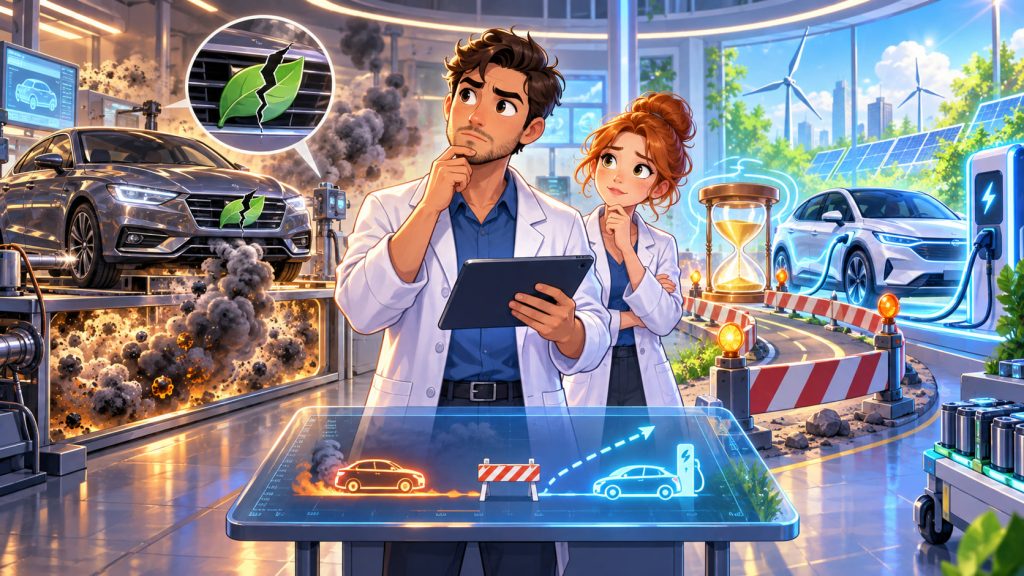
For years, diesel was presented as a smart answer to the automotive world’s biggest problems. It promised better fuel economy than gasoline, lower carbon dioxide emissions per kilometer, strong torque, and—thanks to modern emissions technology—much cleaner exhaust than older diesel engines.
Then came the emissions scandal that shattered that image.
The Volkswagen “Dieselgate” scandal, revealed in 2015, exposed the use of software designed to recognize laboratory emissions testing and temporarily reduce nitrogen oxide emissions. In normal driving, some affected vehicles emitted far more pollution than official tests suggested.
The scandal damaged more than one manufacturer. It undermined public trust in “clean diesel,” distorted investment decisions, changed regulation, and complicated the timing of the global shift toward electric vehicles.
Why Clean Diesel Looked So Attractive
Diesel engines are efficient because they operate at high compression ratios and use fuel with high energy density.
For many years, this made diesel especially popular in Europe.
Compared with similar gasoline cars, diesel vehicles often consumed less fuel and produced less carbon dioxide per kilometer.
Governments concerned about climate change therefore encouraged diesel ownership through tax policies and fuel pricing.
Automakers invested heavily in diesel engines, turbochargers, particulate filters, exhaust treatment systems, and advanced fuel injection.
By the early 2000s, diesel was marketed not merely as economical but increasingly as clean, sophisticated, and environmentally responsible.
That perception mattered.
It convinced consumers, regulators, and manufacturers that internal combustion technology still had plenty of room to improve.
What the Diesel Scandal Revealed
The scandal centered on emissions control software.
Certain diesel vehicles could detect when they were undergoing standardized laboratory testing.
Under test conditions, emissions-control systems operated more aggressively.
During normal road driving, however, emissions could be significantly higher.
The main pollutant involved was nitrogen oxides, commonly abbreviated as NOx.
These pollutants contribute to smog formation and can worsen respiratory problems.
The discovery showed that official laboratory results did not always reflect real-world pollution.
The problem was not simply that a particular engine polluted too much. The deeper problem was that the testing and regulatory system had been manipulated.
Trust in Diesel Collapsed
Before Dieselgate, automakers often described modern diesel as part of the transition toward cleaner transport.
After the scandal, that message became much harder to sell.
Consumers began questioning whether official emissions figures could be trusted.
Cities became more interested in restricting older diesel vehicles.
Regulators introduced tougher testing procedures, including measurements under real-world driving conditions.
Diesel sales began declining sharply in several important markets.
This created an enormous strategic problem for automakers that had spent billions developing diesel technology.
How Diesel Delayed Electric Investment
One of the less obvious effects of the clean diesel era was opportunity cost.
Automakers have limited engineering budgets, manufacturing capacity, and management attention.
During the 1990s and 2000s, many established manufacturers invested heavily in making internal combustion engines cleaner and more efficient.
That money could not simultaneously be spent on batteries, electric motors, charging systems, and dedicated electric vehicle platforms.
Diesel appeared to offer a bridge.
If automakers could continue reducing emissions from combustion engines, the industry might delay the expensive transition toward battery-electric vehicles.
The stronger the belief in clean diesel became, the less urgent full electrification appeared.
This did not stop electric vehicle research, but it reduced the strategic pressure for rapid change.
The Irony: Dieselgate Also Accelerated Electrification
The relationship between Dieselgate and electric vehicles is complicated because the scandal both delayed and later accelerated the transition.
Before 2015, diesel helped extend the perceived life of combustion technology.
After the scandal, however, diesel became a reputational and regulatory liability.
Manufacturers suddenly needed another path.
Electric vehicles became much more attractive.
Volkswagen, in particular, later committed enormous resources to battery-electric vehicles, dedicated EV platforms, battery supply chains, and charging infrastructure.
Other European manufacturers also accelerated electrification plans.
So the scandal created a paradox:
clean diesel helped delay electrification before the scandal, but the collapse of clean diesel helped accelerate electrification afterward.
Billions Spent on the Wrong Technological Direction
Developing modern diesel technology was expensive.
Automakers invested in:
- High-pressure common-rail injection
- Turbocharging
- Diesel particulate filters
- Exhaust gas recirculation
- Selective catalytic reduction
- Urea-based exhaust treatment
- Complex engine-management software
These systems became remarkably sophisticated.
But every additional layer of complexity increased development costs.
At the same time, battery prices were falling and electric powertrains were becoming more practical.
In hindsight, some of the money spent extracting further improvements from diesel could have been directed earlier toward batteries and electric platforms.
That does not mean diesel research was useless. It improved efficiency and reduced some pollutants dramatically.
But strategically, the industry spent years perfecting a technology that would soon face increasing regulatory and political pressure.
Governments Were Also Invested in Diesel
Automakers were not acting alone.
Government policies helped create the clean-diesel era.
In Europe, fuel taxation and vehicle taxation frequently favored diesel because of its lower carbon dioxide emissions.
This encouraged consumers to purchase diesel cars.
As diesel market share increased, governments became economically and politically invested in the technology.
Infrastructure, manufacturing jobs, suppliers, taxation systems, and vehicle fleets developed around diesel.
Changing direction therefore became harder.
A rapid transition toward electric vehicles would have disrupted existing industries.
Technological transitions are often slowed not because the new technology is impossible, but because the old system has become economically entrenched.
Dieselgate Exposed the Difference Between CO2 and Local Pollution
One of the most important lessons from the scandal was that “clean” can mean different things.
Diesel engines can be relatively efficient in terms of fuel consumption and carbon dioxide.
But reducing CO2 does not automatically mean reducing every harmful pollutant.
Nitrogen oxides and particulate pollution affect local air quality.
Climate emissions affect the global atmosphere.
A vehicle technology can perform better in one category and worse in another.
The scandal forced policymakers to look more carefully at the entire emissions profile of vehicles.
This strengthened the argument for zero-tailpipe-emission technologies such as battery-electric vehicles.
Expert Perspective: Technology Lock-In Matters
Energy and transportation researchers often describe situations like this using the concept of technological lock-in.
Once an industry has invested heavily in a particular technology, changing direction becomes increasingly expensive.
Factories, suppliers, engineers, regulations, repair networks, and consumer expectations all become organized around the existing system.
Diesel was a classic example.
Its apparent environmental advantages encouraged manufacturers and governments to keep improving combustion engines rather than abandoning them.
When the underlying assumptions changed, the industry had to redirect enormous investment very quickly.
Electric Cars Were Improving in the Background
While diesel dominated much of Europe, electric vehicle technology was quietly improving.
Lithium-ion batteries became cheaper.
Energy density increased.
Electric motors and power electronics improved.
Charging networks began expanding.
Tesla demonstrated that electric vehicles could compete not only as small urban cars but also as high-performance premium vehicles.
Nissan, Renault, BMW, and other manufacturers also launched early mass-market electric models.
By the time Dieselgate damaged confidence in diesel, the electric alternative was far more mature than it had been a decade earlier.
This timing helped electrification accelerate rapidly after the scandal.
Regulation Became Much Tougher
Dieselgate also changed the regulatory environment.
Authorities became more skeptical of laboratory-only testing.
Real-driving emissions procedures became more important.
Manufacturers faced stricter scrutiny of software and emissions-control strategies.
At the same time, European carbon dioxide targets became increasingly demanding.
Meeting both local pollution limits and long-term CO2 requirements using combustion engines became progressively more difficult and expensive.
Battery-electric vehicles offered manufacturers a simpler route to eliminating tailpipe emissions entirely.
Why the Scandal Still Matters
Dieselgate remains important because it illustrates how a seemingly cleaner version of an old technology can delay adoption of a fundamentally different technology.
Incremental improvement is not always the same as transformation.
Clean diesel promised to solve environmental problems while preserving the familiar combustion-engine system.
Electric vehicles required a much larger change: new batteries, factories, charging infrastructure, supply chains, software, and consumer habits.
For years, diesel made that disruption seem less urgent.
Once confidence in clean diesel collapsed, the calculation changed.
The industry moved from trying to perfect combustion to preparing for a world in which combustion itself might become unnecessary for most passenger cars.
Interesting Facts
- Diesel engines generally use less fuel than comparable gasoline engines because of their higher thermodynamic efficiency.
- Nitrogen oxide emissions became one of the central technical issues in the Dieselgate scandal.
- Modern diesel vehicles often use urea-based selective catalytic reduction systems to reduce NOx emissions.
- Diesel particulate filters can remove a large proportion of soot particles from exhaust when operating correctly.
- The Volkswagen emissions scandal became public in 2015.
- After the scandal, regulators placed greater emphasis on real-world emissions testing.
- European passenger-car diesel market share fell substantially during the years following Dieselgate.
- Several major automakers later redirected billions of dollars toward electric vehicle development.
- Battery-electric vehicles produce no exhaust emissions while driving.
- Electric vehicle manufacturing still has environmental impacts, particularly from battery production, but these occur differently from the continuous tailpipe emissions of combustion vehicles.
- Technological transitions often accelerate after public trust in the previous technology collapses.
Glossary
- Dieselgate — The emissions scandal involving the use of software to manipulate diesel vehicle emissions testing.
- Clean Diesel — A marketing and engineering term describing modern diesel engines equipped with advanced emissions-control technologies.
- NOx — Nitrogen oxides, pollutants produced during high-temperature combustion that contribute to smog and respiratory problems.
- CO2 — Carbon dioxide, a greenhouse gas produced when fossil fuels are burned.
- Diesel Particulate Filter (DPF) — A device that captures soot particles from diesel exhaust.
- Selective Catalytic Reduction (SCR) — An exhaust-treatment system that reduces nitrogen oxide emissions, often using a urea solution.
- Real-Driving Emissions — Emissions measurements performed during actual road driving rather than only under laboratory conditions.
- Battery-Electric Vehicle (BEV) — A vehicle powered entirely by electricity stored in rechargeable batteries.
- Power Electronics — Electronic systems that control and convert electrical power in technologies such as electric vehicles.
- Technological Lock-In — A situation in which previous investment and infrastructure make it difficult to switch from an established technology to a new one.
- Opportunity Cost — The value of the alternative that is sacrificed when resources are committed to one option.
- Tailpipe Emissions — Pollutants released directly from a vehicle’s exhaust system.
- Electrification — The transition from technologies powered by fossil-fuel combustion toward technologies powered primarily by electricity.