As renewable electricity expands, the energy system faces a simple problem: solar and wind power are not always generated when electricity demand is highest.
Batteries can solve part of this problem, but lithium-ion storage is not the only option. Engineers are also developing systems that store energy using gravity.
The idea sounds almost too simple: use excess electricity to lift a heavy mass, then lower it later to generate electricity.
Old mine shafts may be particularly suitable because they already provide the enormous vertical distances that gravity storage needs.
Gravity energy storage could become a durable, low-maintenance alternative for some forms of stationary electricity storage, especially where deep mines and heavy infrastructure already exist.
How Gravity Energy Storage Works
Gravity storage converts electrical energy into gravitational potential energy.
When electricity is abundant, motors use that electricity to lift a heavy object.
The raised mass now contains stored potential energy.
When electricity is needed again, the mass is lowered in a controlled manner.
Its downward movement drives a generator, converting the stored gravitational energy back into electricity.
The basic principle is similar to pumped-storage hydropower, where water is pumped uphill and later released through turbines.
Instead of moving water between reservoirs, mine-based gravity systems move solid weights vertically through shafts.
Why Mine Shafts Are So Attractive
A gravity battery becomes more useful when the weight can move through a large vertical distance.
Deep mines provide exactly that.
Some mine shafts extend hundreds of meters underground, while particularly deep mines can reach much farther.
Existing shafts may already contain:
- Hoisting equipment
- Strong structural supports
- Electrical connections
- Access tunnels
- Industrial buildings
- Transportation infrastructure
This can potentially reduce the amount of new construction required.
A mine that has stopped producing coal or minerals could therefore gain a second life as an energy-storage facility.
The Physics Is Extremely Simple
The amount of gravitational energy stored depends mainly on three things:
- The mass being lifted
- The vertical distance it moves
- The strength of gravity
Increasing either the weight or the height increases the amount of energy stored.
This simplicity is one of gravity storage’s major attractions.
There is no complex electrochemistry inside the weight.
A block of rock, concrete, metal, or other dense material can remain physically stable for decades.
The storage medium itself does not gradually lose chemical capacity in the same way an electrochemical battery can.
What Happens Inside a Mine Battery?
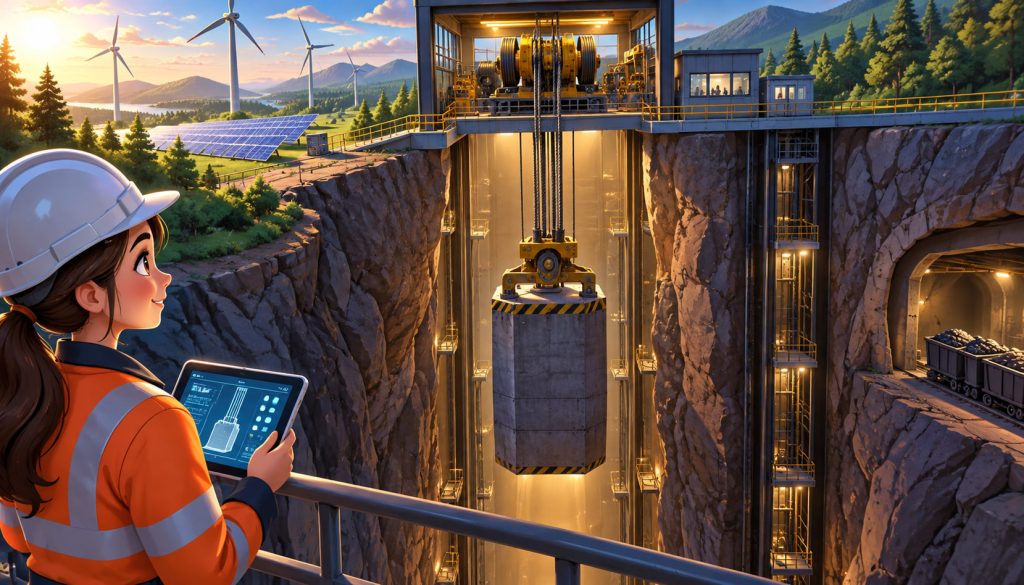
Imagine an abandoned mine shaft several hundred meters deep.
A large weight hangs from powerful cables connected to motor-generators at the surface.
When renewable electricity production exceeds demand, the motor lifts the weight.
The system is now charged.
When electricity demand increases, the weight descends.
The motor operates in reverse as a generator and sends electricity back to the grid.
Advanced versions could use multiple weights or containers moving independently through several shafts.
Control software could continuously decide when to lift or lower loads according to electricity prices, renewable generation, and grid demand.
Could Mine Waste Become the Weight?
One particularly interesting idea is to use materials already present around mining sites.
Mine waste, crushed rock, sand, or other dense materials could potentially serve as gravity-storage masses.
This has an important advantage.
Transporting millions of kilograms of specialized weights could make a project expensive.
Using local materials reduces transportation requirements and gives otherwise low-value material a useful function.
Researchers have also proposed systems where containers filled with sand move between different underground levels.
Gravity storage does not necessarily require expensive energy-storage materials. It mainly requires mass, height, machinery, and reliable control systems.
Why Compare Gravity Storage With Lithium Batteries?
Lithium-ion batteries dominate many modern energy-storage projects because they are efficient, compact, responsive, and increasingly affordable.
They are excellent for electric vehicles, electronics, and many grid applications.
But lithium batteries have limitations.
They require processed materials including lithium, graphite, nickel, iron, phosphate, copper, and other industrial inputs depending on battery chemistry.
Battery cells also gradually degrade with cycling and age.
Gravity systems use a fundamentally different approach.
The main storage component can be an inexpensive physical mass rather than chemically active battery material.
Motors, generators, cables, bearings, power electronics, and control equipment still require maintenance, but the basic weight does not become chemically exhausted.
Is Gravity Storage Actually Cheaper?
Potentially—but not everywhere.
The economics depend strongly on the site.
A gravity-storage project using an existing deep shaft may avoid some expensive excavation and construction.
A completely new shaft built only for energy storage could be far more expensive.
Other factors include:
- Shaft depth
- Structural condition
- Available lifting capacity
- Grid connection
- Local electricity prices
- Required storage duration
- Construction and maintenance costs
This means gravity storage should not be described as universally cheaper than lithium.
Its strongest economic advantage may appear where valuable infrastructure already exists and would otherwise be abandoned.
Long Life Could Be a Major Advantage
Lithium-ion batteries are designed for thousands of charge-discharge cycles, but their usable capacity gradually declines.
Mechanical gravity-storage systems could potentially operate for much longer periods if components are maintained or replaced.
Cables, motors, bearings, and generators can wear out, but they are familiar industrial technologies.
A heavy concrete block does not need to be replaced because its chemical composition has aged.
This could make gravity storage especially attractive for infrastructure expected to operate for several decades.
Efficiency Still Matters
No storage technology returns every unit of electricity put into it.
Energy is lost through friction, electrical resistance, motor inefficiency, mechanical losses, and power conversion.
Gravity storage systems can potentially achieve good round-trip efficiency, but actual performance depends on engineering design.
Lithium-ion batteries typically have excellent round-trip efficiency, which is one reason they are so competitive.
Gravity storage therefore needs other advantages—such as long operating life, low material cost, long-duration storage, or use of existing infrastructure—to justify installation.
Gravity Storage Is Not a Battery Replacement Everywhere
Gravity systems are poorly suited to smartphones, laptops, or electric cars.
They are stationary technologies.
They also need substantial vertical height or large structures.
Lithium batteries can be installed almost anywhere, from garages to shipping containers.
Gravity storage is much more geographically constrained.
For this reason, the two technologies are more likely to coexist than completely replace one another.
Lithium batteries may dominate applications requiring compactness and rapid deployment, while gravity storage may serve large stationary projects where space and suitable infrastructure are available.
Abandoned Mines Could Become Energy Assets
Many regions face the expensive task of managing abandoned mines.
Mines can require long-term monitoring, water management, site security, and environmental rehabilitation.
Energy storage could potentially give some of these sites a new economic purpose.
Former mining communities could benefit from new engineering, maintenance, and grid-related jobs.
The same infrastructure once used to extract fossil fuels or minerals could help balance renewable electricity.
That symbolic transition is especially striking.
A coal mine that once supplied fuel for power stations might eventually help store electricity generated by wind and solar farms.
Expert Perspective: Storage Needs Diversity
Energy-system experts generally emphasize that future electricity grids will require multiple storage technologies rather than one universal battery.
Different technologies solve different problems.
Lithium-ion batteries are highly effective for fast response and storage lasting several hours.
Pumped hydropower can provide enormous storage capacity where suitable geography exists.
Hydrogen may become useful for very long-duration or seasonal energy storage.
Thermal storage can serve heating and industrial applications.
Gravity systems using mine shafts could occupy another niche, particularly where deep existing infrastructure makes them economical.
The important question is not whether gravity replaces lithium everywhere, but where gravity provides better lifetime economics for stationary storage.
How Gravity Storage Helps Renewable Energy
Wind and solar power can sometimes produce more electricity than the grid immediately needs.
Without storage, some renewable generation may have to be reduced or curtailed.
Gravity systems could absorb part of this excess energy.
Later, when wind decreases, clouds reduce solar output, or evening demand rises, the system could generate electricity.
This makes renewable electricity more flexible.
A network containing many different forms of storage could reduce reliance on fossil-fuel power plants that currently provide backup when renewable generation falls.
What Are the Biggest Engineering Challenges?
Mine shafts were designed for mining, not necessarily for continuous energy-storage cycles.
Engineers must carefully assess structural integrity.
Cables and lifting systems need extremely high reliability.
Emergency braking systems must safely control enormous moving masses.
Water intrusion, corrosion, underground temperature conditions, and geological stability also matter.
Older abandoned mines may require substantial rehabilitation before any equipment can be installed.
The system must also meet modern electrical and industrial safety standards.
The physics may be simple, but safely moving hundreds or thousands of tons repeatedly is a serious engineering challenge.
A Second Life for Industrial Infrastructure
Gravity energy storage represents a broader trend in the energy transition.
Instead of replacing every piece of old infrastructure, engineers are asking whether some of it can be repurposed.
Mines already provide deep underground spaces.
Industrial sites already have grid connections.
Existing engineering knowledge already covers hoists, cables, motors, generators, and heavy lifting.
Combining these systems with modern power electronics and renewable energy could create a storage technology that is mechanically straightforward and potentially very durable.
For the right locations, a mine shaft could effectively become a giant underground rechargeable battery powered by gravity.
Interesting Facts
- Pumped-storage hydropower already uses gravity to store enormous amounts of electricity worldwide.
- Gravity storage does not require lithium as the primary energy-storage medium.
- The deeper a mine shaft is, the more energy the same weight can theoretically store.
- Increasing the mass being lifted also increases storage capacity.
- Heavy local materials such as rock, sand, or mine waste could potentially serve as storage weights.
- Motors used to lift weights can often operate as generators when the weights descend.
- Some abandoned mine shafts extend hundreds or even thousands of meters underground.
- Gravity-storage masses can theoretically remain usable for very long periods because they do not rely on chemical reactions.
- Existing electrical connections at former mining sites may improve project economics.
- Gravity batteries and lithium batteries could complement rather than replace one another.
Glossary
- Gravity Energy Storage — A system that stores energy by lifting a mass and recovers it by lowering the mass through a generator.
- Gravitational Potential Energy — Energy stored because an object has been raised against gravity.
- Mine Shaft — A vertical or steeply inclined passage providing access to underground mining operations.
- Hoist — A mechanical system used to raise and lower heavy loads.
- Motor-Generator — A machine capable of using electricity to create motion and operating in reverse to generate electricity.
- Round-Trip Efficiency — The percentage of stored energy that can eventually be recovered as useful energy.
- Lithium-Ion Battery — An electrochemical rechargeable battery widely used in electronics, vehicles, and grid storage.
- Pumped-Storage Hydropower — Energy storage that pumps water uphill and later releases it through turbines.
- Grid-Scale Storage — Large energy-storage systems designed to support an electrical power network.
- Long-Duration Energy Storage — Storage designed to supply energy for extended periods, typically beyond the short-duration role of conventional batteries.
- Curtailment — Deliberate reduction of electricity generation because production exceeds what the grid can use or transmit.
- Power Electronics — Electronic equipment used to control and convert electrical power.
- Energy Arbitrage — Storing electricity when it is inexpensive and selling or using it when prices are higher.
- Stationary Storage — Energy storage installed permanently at a fixed location rather than inside a vehicle or portable device.