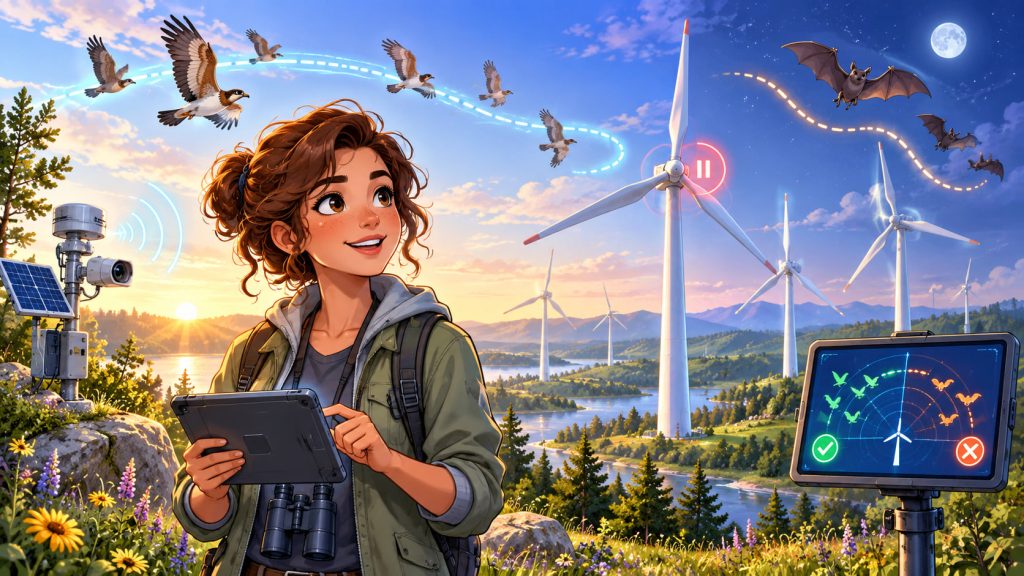
Renewable energy is essential for reducing dependence on fossil fuels, but no energy system is completely free of environmental impact. Wind farms, solar installations, power lines, and other clean-energy infrastructure can affect wildlife, especially birds and bats.
The issue is real, but it is also more complex than headlines such as “wind turbines kill birds” suggest.
The key question is not whether renewable energy affects wildlife, but how large the impact is, where it occurs, and how effectively it can be reduced.
With careful planning, better technology, and wildlife monitoring, many of these risks can be significantly lowered.
Why Wind Turbines Can Kill Birds
Bird collisions with wind turbine blades are one of the most visible wildlife concerns associated with renewable energy.
Modern turbine blades can move surprisingly fast at their tips, even when the rotor appears to turn slowly from a distance.
Birds may collide with blades while flying through a wind farm, especially when turbines are located near:
- Migration corridors
- Feeding areas
- Nesting sites
- Mountain passes
- Coastal routes
- Areas with large populations of soaring birds
Large raptors can be particularly vulnerable because they often focus their attention on the ground while hunting.
Some species also use air currents near ridges and hills, which may overlap with locations that are attractive for wind-energy development.
Why Bats Face a Different Risk
Bats are also vulnerable around wind turbines, but their situation is different from that of many birds.
Some bats are killed through direct collisions with moving blades.
However, scientists have also investigated another possible mechanism known as barotrauma.
Rapid pressure changes near rotating turbine blades may damage delicate tissues in bats, particularly their lungs.
The importance of barotrauma compared with direct collision remains an area of scientific investigation, but it is clear that wind turbines can cause significant bat mortality in certain locations.
Migratory tree-roosting bats appear especially vulnerable during late summer and autumn.
Why Do Bats Fly Near Wind Turbines?
Researchers have proposed several explanations.
Tall turbines may resemble large trees or other landscape features that bats naturally investigate. Bats may also approach turbines while searching for insects.
Lights, heat, or local insect concentrations around infrastructure could potentially influence bat behavior as well.
Weather matters too.
Bat activity is often higher during nights with relatively low wind speeds, when insects are active and flying conditions are easier.
That observation has led to one of the most effective strategies for reducing bat deaths.
Slowing Turbines at the Right Time
Wind turbines do not always need to begin producing electricity at the lowest possible wind speed.
Operators can temporarily increase the wind speed at which turbines start generating power. This technique is often called curtailment or increased cut-in speed.
Because bats tend to fly more frequently during lower wind conditions, temporarily stopping or slowing turbines during high-risk periods can substantially reduce mortality.
The strategy can be targeted to specific seasons, temperatures, wind speeds, and times of night.
Smart curtailment attempts to protect wildlife while minimizing lost electricity production.
Instead of shutting down a wind farm for long periods, operators can use environmental data to identify when risk is highest.
Can Painting Turbine Blades Help?
One surprisingly simple idea is changing the visual appearance of turbine blades.
Experiments have investigated whether painting one blade black can make rotating turbines more visible to birds.
Some studies have reported promising reductions in bird collisions, although more research is needed before the approach can be considered universally effective.
Other methods include improved lighting, acoustic deterrents, radar systems, cameras, and automated shutdown technology.
The long-term goal is to create wind farms that can detect vulnerable animals and react before collisions occur.
Location Matters More Than Almost Anything Else
One of the strongest tools for protecting wildlife is simply putting renewable-energy infrastructure in the right places.
A wind farm placed in a major migration corridor can create far greater ecological risk than a similar project located several kilometers away.
Before construction, developers can survey wildlife populations, migration routes, nesting areas, and feeding grounds.
Modern planning can use:
- Radar monitoring
- Satellite tracking
- GPS tags
- Acoustic bat detectors
- Camera systems
- Long-term field surveys
Avoiding high-risk habitat is usually more effective than trying to fix problems after construction.
This is why environmental assessment has become such an important part of renewable-energy development.
Solar Farms Also Affect Wildlife
Solar panels do not have rotating blades, but large solar installations can still alter ecosystems.
Utility-scale solar farms may occupy extensive areas of land.
Construction can remove or fragment habitat, disturb nesting sites, alter vegetation, and change how animals move through the landscape.
Some solar technologies may create additional risks for birds.
Large concentrated solar power facilities use mirrors to focus sunlight toward a receiver. Birds flying through areas of intense concentrated solar radiation may be exposed to dangerous heat.
Conventional photovoltaic solar farms generally do not create this type of concentrated heat, but they can still affect habitat if poorly located.
The Importance of Wildlife-Friendly Solar Design
Solar farms do not necessarily have to become ecological dead zones.
Vegetation can often be maintained beneath and between panels.
Some projects use native grasses, wildflowers, and pollinator-friendly plants instead of gravel or heavily managed ground cover.
Wildlife corridors can help animals move through or around large facilities.
Fencing can also be designed to allow smaller species to pass while still protecting equipment.
In some agricultural regions, solar panels are even combined with grazing or crop production in systems known as agrivoltaics.
These approaches can reduce competition between energy production and other land uses.
Power Lines Are Another Part of the Problem
Renewable electricity usually needs transmission infrastructure.
Birds may collide with power lines, particularly when wires cross wetlands, rivers, migration routes, or open landscapes.
Large birds can also be electrocuted on poorly designed electrical equipment if they touch two energized components simultaneously.
These risks are not unique to renewable energy, but the rapid expansion of clean-energy infrastructure makes careful transmission planning increasingly important.
Visual markers can make power lines easier for birds to see.
Insulating dangerous components and redesigning poles can also reduce electrocution.
Expert Perspective: Think About the Entire Energy System
Wildlife biologists often emphasize that renewable-energy impacts should be evaluated within the broader context of energy production.
Fossil-fuel extraction, mining, air pollution, oil spills, habitat destruction, and climate change also affect birds, bats, and other wildlife.
Climate change itself is already altering habitats, migration patterns, food availability, and breeding conditions for many species.
This means the environmental challenge is not choosing between an impact-free technology and a harmful one.
The real challenge is building energy systems that produce the lowest possible total ecological damage.
Renewable energy can play a major role, but responsible deployment requires wildlife protection to be treated as part of engineering rather than as an afterthought.
Technology Is Making Wildlife Protection Smarter
Artificial intelligence and automated monitoring are becoming increasingly important.
Camera systems can identify approaching birds and estimate their flight paths.
Radar can track large numbers of flying animals across wide areas.
Acoustic detectors can measure bat activity.
Some systems are being designed to trigger temporary turbine shutdowns when vulnerable species approach.
This creates the possibility of highly targeted protection.
Instead of stopping an entire wind farm for hours, individual turbines might eventually react automatically to wildlife activity in real time.
Better Renewable Energy Means Better Planning
The environmental benefits of renewable energy do not eliminate its local ecological impacts.
Wind turbines can kill birds and bats. Solar farms can alter habitats. Transmission infrastructure can create collision and electrocution risks.
But many of these problems can be reduced.
Better siting, seasonal shutdowns, wildlife detection systems, improved turbine design, habitat restoration, and smarter power-line engineering can make renewable energy significantly safer for wildlife.
The future of green energy is therefore not simply about installing more turbines and solar panels.
It is about designing an energy system in which climate protection and biodiversity protection work together.
Interesting Facts
- Turbine blade tips can travel much faster than the rotating hub appears to move.
- Bat fatalities at wind farms often peak during particular migration seasons rather than occurring evenly throughout the year.
- Small changes in turbine operating conditions can sometimes produce large reductions in bat mortality.
- Radar originally developed for aviation and weather monitoring can also help scientists study bird migration.
- Some modern solar farms deliberately grow wildflowers and native vegetation beneath panels.
- Large soaring birds can be especially vulnerable to turbines because they frequently use predictable air currents.
- Bird-safe power-line markers are designed to make thin cables more visible during flight.
- Artificial intelligence may eventually allow individual turbines to stop automatically when protected species approach.
Glossary
- Wind Turbine — A machine that converts the kinetic energy of moving air into electricity.
- Barotrauma — Tissue damage caused by rapid changes in air pressure.
- Curtailment — Temporarily reducing or stopping turbine operation to limit environmental impacts or manage electricity production.
- Cut-In Speed — The minimum wind speed at which a turbine begins generating electricity.
- Migration Corridor — A geographic route regularly used by animals during seasonal migration.
- Habitat Fragmentation — The division of continuous habitat into smaller, separated areas.
- Photovoltaic Solar Power — Technology that converts sunlight directly into electricity using semiconductor solar cells.
- Concentrated Solar Power — A system that uses mirrors to focus solar energy and generate heat for electricity production.
- Agrivoltaics — The combined use of land for both solar-energy production and agriculture.
- Wildlife Corridor — A connected area that allows animals to move safely between habitats.
- Acoustic Detector — A device that records sounds, including ultrasonic bat calls, for wildlife monitoring.
- Biodiversity — The variety of living organisms, ecosystems, and genetic diversity within an environment.