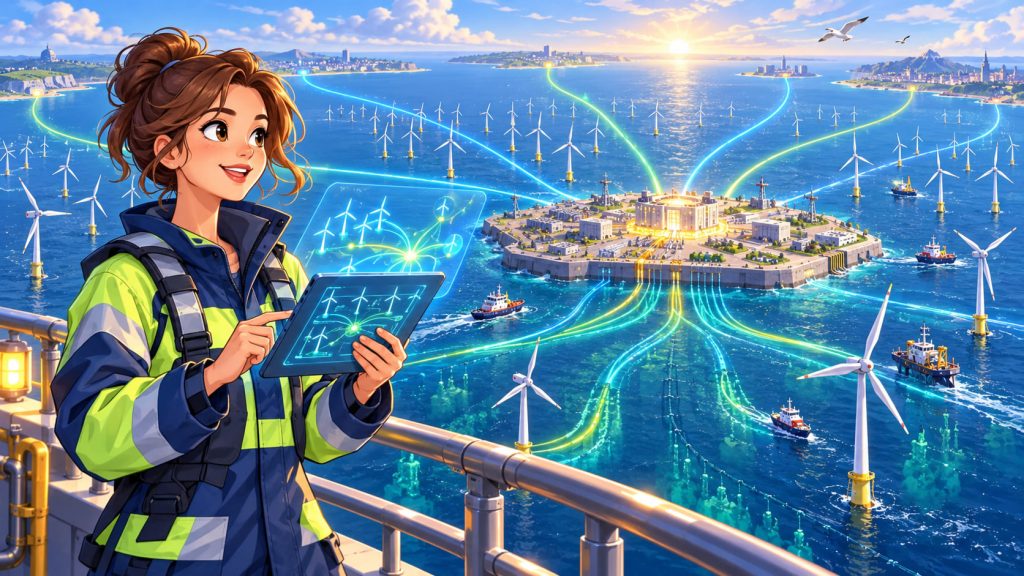
The North Sea is rapidly becoming one of the world’s most important renewable-energy regions. Thousands of offshore wind turbines are being developed across waters belonging to the Netherlands, Belgium, Germany, Denmark, Norway, and the United Kingdom.
But producing enormous amounts of offshore wind power creates a new challenge: how do you efficiently collect, convert, transport, and share all that electricity between different countries?
One ambitious answer is the energy island.
Instead of connecting every offshore wind farm separately to the nearest national grid, an energy island can act as a giant offshore electricity hub. Multiple wind farms feed power into the same center, where electricity can be converted, distributed, stored, or transmitted to several countries.
The concept could transform the North Sea from a collection of national wind farms into something closer to an integrated European offshore power network.
What Is an Energy Island?
An energy island is an offshore hub designed to collect electricity from surrounding renewable-energy installations.
Despite the name, it does not always have to be a conventional natural island. It may be an artificial island, a large offshore platform, or a combination of several structures.
The basic idea is simple.
Wind turbines generate electricity across a large offshore area. Underwater cables carry that electricity to the hub. From there, powerful transmission systems send the electricity toward different countries.
An energy island essentially acts like an offshore electrical junction for massive wind-power networks.
Some future hubs could also include equipment for hydrogen production, energy storage, maintenance facilities, and digital monitoring.
Why Connect Wind Farms Through a Central Hub?
Traditional offshore wind farms are usually connected directly to shore.
That works well when a wind farm is relatively close to one country.
But as offshore wind development expands farther into the North Sea, individual connections become increasingly complex and expensive.
Imagine dozens of large wind farms, each requiring separate high-capacity cables to land.
An offshore hub can consolidate many of those connections.
Several wind farms can feed into one central system, which then distributes electricity through a smaller number of extremely powerful transmission links.
This can reduce duplication and create a much more flexible electricity network.
One Hub Could Serve Several Countries
The most revolutionary feature of the energy-island concept is international connectivity.
Electricity collected offshore does not necessarily have to travel to only one country.
A hub could connect the Netherlands, Belgium, Germany, Denmark, the United Kingdom, or other electricity markets.
If one country needs more electricity, additional wind power could be routed there.
If another country has excess renewable generation, electricity could flow in the opposite direction.
Energy islands could combine offshore wind connections and international interconnectors into the same infrastructure.
These projects are often described as hybrid offshore assets because they perform more than one job at the same time.
Why the North Sea Is Ideal for Energy Islands
The North Sea has several advantages for large-scale offshore wind.
It contains extensive areas of relatively shallow water, strong and consistent winds, major industrial economies nearby, and established ports with decades of offshore engineering experience.
Countries surrounding the sea also have enormous electricity demand.
As European energy systems electrify transportation, heating, manufacturing, and industrial processes, demand for low-carbon electricity could increase substantially.
The North Sea therefore has the potential to become something like a renewable-energy power plant shared by multiple countries.
Denmark’s North Sea Energy Island Vision
Denmark became one of the most visible supporters of the energy-island concept.
Its North Sea plans envisioned an offshore hub capable of collecting electricity from several gigawatts of surrounding wind capacity and eventually supporting much larger renewable-energy development.
The project demonstrated how dramatically offshore wind infrastructure is evolving.
Instead of viewing a wind farm as an isolated power plant, planners began thinking about entire offshore energy systems involving wind farms, electricity cables, international markets, and potentially hydrogen production.
Large energy-island projects are technically and financially demanding, however, and designs, schedules, and investment structures can change as governments and developers reassess costs.
Belgium Is Building an Offshore Energy Hub
Belgium has also moved forward with the energy-island model through the Princess Elisabeth Island project in the Belgian North Sea.
The artificial island is designed to host electrical infrastructure linking offshore wind generation with Belgium’s transmission network.
It is also intended to support future international electricity connections.
That makes the island much more than a substation surrounded by water.
It represents a new generation of offshore infrastructure where wind power and cross-border electricity trading can become physically integrated.
How Electricity Travels From Turbines to Countries
Electricity generated by offshore wind turbines normally begins as alternating current.
Within large offshore networks, substations collect electricity from many turbines and raise its voltage.
For very long transmission distances, high-voltage direct current, or HVDC, can become particularly useful.
HVDC systems reduce transmission losses over long distances and allow large quantities of electricity to move efficiently through submarine cables.
At an energy hub, powerful converter stations can transform electricity between alternating current and direct current.
From there, submarine cables can carry electricity hundreds of kilometers toward national grids.
Energy Islands Could Also Produce Hydrogen
Electricity does not always have to travel directly to shore.
When offshore wind production is extremely high, some future hubs could use electricity to produce hydrogen through electrolysis.
Electrolyzers split water into hydrogen and oxygen using electricity.
If renewable electricity powers the process, the resulting fuel is generally described as renewable or green hydrogen.
Hydrogen could potentially supply industries that are difficult to electrify directly, including parts of steelmaking, chemical production, shipping, and heavy industry.
An offshore energy hub could therefore become both an electricity center and a future fuel-production center.
What Happens When the Wind Changes?
One common misconception is that connecting wind farms together eliminates the variability of wind power.
It does not.
Wind generation still rises and falls depending on weather conditions.
However, larger interconnected networks can help manage variability.
Wind conditions are rarely identical across the entire North Sea.
A calm period in one region may coincide with stronger winds elsewhere.
International transmission allows electricity to move between those regions, making the overall system more flexible.
Energy storage, flexible demand, conventional generation, hydropower, batteries, and hydrogen could provide additional balancing options.
Energy Islands Could Reduce Grid Bottlenecks
Building offshore wind turbines is only part of the energy transition.
Electricity must also reach consumers.
Many European electricity grids already face congestion when large amounts of power attempt to travel through limited transmission capacity.
Energy hubs can create alternative pathways.
Instead of forcing every new wind farm through the same coastal connection points, offshore networks could distribute power among several countries and landing locations.
This may help create a more resilient electricity system.
The Engineering Challenge Is Enormous
Constructing infrastructure in the North Sea is expensive.
Equipment must withstand powerful waves, corrosion, saltwater, storms, and decades of continuous operation.
Submarine cables must be installed and protected across long distances.
Electrical equipment must handle enormous power flows.
Artificial islands require huge quantities of construction material and careful environmental planning.
Maintenance is another challenge because technicians may need ships, helicopters, or specialized offshore vessels to reach equipment.
Energy islands are not simply wind farms with an extra platform. They are major pieces of international energy infrastructure.
Expert Perspective: The Grid Is Becoming as Important as the Turbines
Energy-system specialists increasingly emphasize that expanding renewable generation without expanding electricity networks creates bottlenecks.
Building additional wind turbines is useful only if their electricity can reach homes, factories, data centers, transportation systems, and other consumers.
This is why offshore transmission hubs are receiving so much attention.
The long-term value of an energy island comes from its ability to combine renewable generation with transmission infrastructure and international electricity exchange.
In this sense, the North Sea energy transition is becoming as much a grid-engineering project as a wind-energy project.
From National Wind Farms to an Offshore Supergrid
Early offshore wind farms were largely national projects.
A country developed a wind farm in its waters and connected it directly to its own electricity grid.
Energy islands introduce a different model.
Wind farms, offshore cables, international interconnectors, converter stations, and potentially hydrogen infrastructure can become part of the same network.
Over time, several offshore hubs could potentially connect with one another.
The result would resemble an offshore supergrid capable of moving renewable electricity across borders on a scale that traditional wind farms were never designed to achieve.
Interesting Facts
- The North Sea has some of the strongest and most commercially attractive offshore wind resources in Europe.
- Offshore wind turbines are becoming dramatically larger, allowing individual machines to generate far more electricity than earlier generations.
- Energy islands can function as both wind-farm connection points and international electricity interconnectors.
- HVDC technology is particularly valuable for transmitting large amounts of electricity over long submarine-cable routes.
- Artificial energy islands may contain electrical substations, converter equipment, maintenance facilities, and future hydrogen infrastructure.
- Electricity can potentially flow in different directions depending on demand and market conditions.
- Offshore electricity hubs may reduce the need for every individual wind farm to have its own completely separate connection to land.
- Several North Sea countries are exploring increasingly interconnected offshore electricity networks rather than purely national systems.
Glossary
- Energy Island — An offshore hub that collects and distributes electricity from multiple renewable-energy installations.
- Offshore Wind Farm — A group of wind turbines installed at sea to generate electricity.
- Interconnector — A high-capacity electricity cable linking the power systems of different regions or countries.
- Hybrid Offshore Asset — Infrastructure that combines offshore renewable-energy connections with cross-border electricity transmission.
- HVDC — High-Voltage Direct Current, a technology used to transport large quantities of electricity efficiently over long distances.
- Converter Station — Equipment that converts electricity between alternating current and direct current.
- Submarine Cable — A power or communications cable installed beneath the sea.
- Electrolysis — A process that uses electricity to split water into hydrogen and oxygen.
- Green Hydrogen — Hydrogen produced using renewable electricity.
- Grid Congestion — A situation in which electricity transmission infrastructure cannot carry all the power producers or consumers want to transmit.
- Offshore Supergrid — A large interconnected network of offshore electricity generation and transmission infrastructure spanning multiple regions or countries.
- Gigawatt (GW) — A unit of power equal to one billion watts.