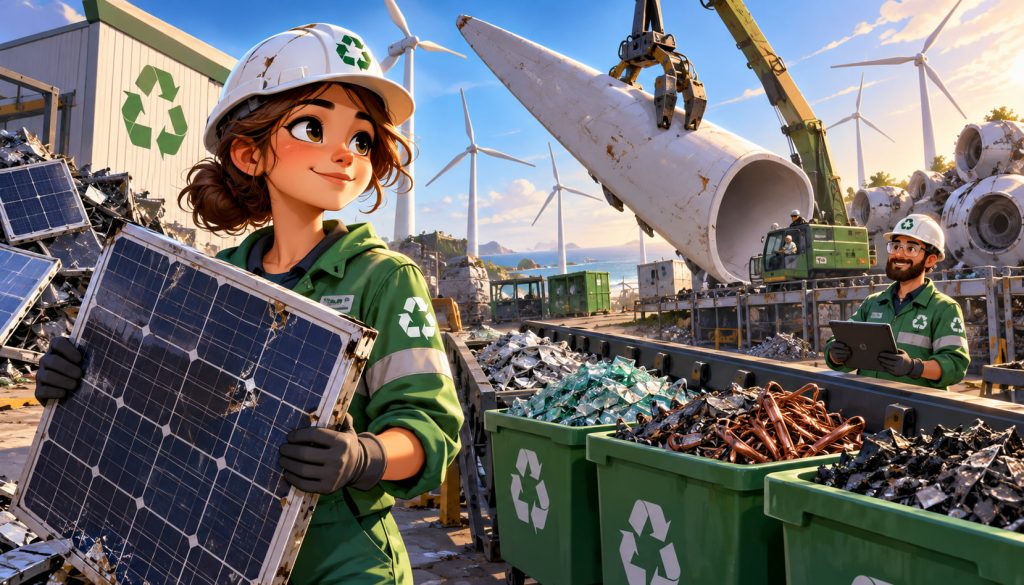
Renewable energy is usually associated with clean electricity, lower carbon emissions, and a future less dependent on fossil fuels. But every solar panel, wind turbine, battery, and power cable eventually reaches the end of its useful life.
That raises an important question: what happens to renewable energy equipment when it is no longer needed?
The answer is increasingly important as the first generations of large solar and wind installations approach retirement. Most renewable-energy equipment contains valuable materials that can be recovered, but recycling is not equally simple for every component.
Steel, aluminum, copper, and glass are relatively easy to reuse. Composite turbine blades, laminated solar panels, and lithium-ion batteries are more complicated.
The next stage of the energy transition will therefore involve not only producing clean electricity, but also creating a circular renewable-energy industry.
Why Renewable Energy Equipment Eventually Becomes Waste
Renewable technologies are designed for long service lives, but they do not last forever.
Solar photovoltaic panels commonly operate for around 25 to 30 years or longer. Wind turbines are often designed for roughly 20 to 30 years of operation, although individual components can be replaced or upgraded.
Battery systems generally have shorter lifetimes because repeated charging and discharging gradually reduce their capacity.
Equipment may also be retired before reaching its theoretical maximum lifespan.
Older wind turbines, for example, are sometimes replaced by larger and more efficient machines in a process known as repowering.
The challenge is not simply disposing of old equipment, but recovering as much useful material as possible.
Solar Panel Recycling
A conventional solar panel looks simple, but it is actually a layered structure.
Most crystalline-silicon photovoltaic modules contain:
- Glass
- Aluminum frames
- Silicon solar cells
- Copper wiring
- Polymers
- Small quantities of silver and other metals
Glass and aluminum account for much of the panel’s mass and can be recovered relatively easily.
The difficult part is separating the tightly bonded layers inside the module.
Solar cells are encapsulated in durable polymers specifically designed to survive decades of heat, rain, wind, and ultraviolet radiation.
That durability becomes a recycling challenge.
Mechanical processes can crush panels and separate major materials, while more advanced thermal and chemical processes can recover higher-value components such as silicon and metals.
Can Old Solar Panels Be Reused?
Not every retired solar panel is actually unusable.
Panels gradually lose efficiency over time, but many still generate electricity after decades of service.
Some modules removed from commercial installations can therefore enter a second-life market.
A panel that is no longer efficient enough for a premium rooftop installation might still be useful for lower-demand applications.
Testing and certification are important because second-hand panels must still be electrically safe and structurally sound.
Extending the useful life of equipment can sometimes be environmentally preferable to immediately recycling it.
Wind Turbines Are Mostly Recyclable
Modern wind turbines are enormous machines containing large quantities of valuable material.
Their towers are commonly made from steel. Generators and electrical systems contain copper and other metals. Foundations contain concrete and steel reinforcement.
Many of these materials already have established recycling industries.
Steel can be melted and reused. Copper can be recovered. Electrical components can be refurbished, recycled, or sold as spare parts.
The most difficult part of a wind turbine is usually the blade.
Why Wind Turbine Blades Are Hard to Recycle
Wind turbine blades must be lightweight, strong, flexible, and resistant to extreme weather.
To achieve these properties, manufacturers commonly use composite materials made from fibers embedded in polymer resins.
Fiberglass has traditionally been widely used, while some large modern blades also incorporate carbon fiber.
Composite materials are excellent for engineering but difficult to separate.
Unlike steel, they cannot simply be melted and reshaped.
Historically, some retired blades were sent to landfills.
Today, the industry is developing alternatives including mechanical shredding, chemical recycling, thermal processing, and reuse in construction materials.
Old blade material can potentially become part of cement production, composite products, or other industrial materials.
Recyclable Wind Turbine Blades Are Emerging
Manufacturers are increasingly designing turbine blades with end-of-life recovery in mind.
One promising approach uses resin systems that can later be chemically separated from reinforcing fibers.
This allows valuable fibers and other materials to be recovered rather than permanently bonded together.
The principle is known as design for recycling.
Instead of asking how to recycle a product after it has already been manufactured, engineers consider its eventual disassembly during the design stage.
This idea is becoming increasingly important across the entire renewable-energy sector.
Battery Recycling Is Critical
Battery storage is becoming a major part of renewable-energy systems.
Lithium-ion batteries help store electricity generated during sunny or windy periods and release it when demand rises.
They also contain valuable materials.
Depending on battery chemistry, these can include:
- Lithium
- Nickel
- Cobalt
- Copper
- Aluminum
- Graphite
- Iron and phosphate compounds
Battery recycling can recover some of these materials and return them to manufacturing.
This reduces dependence on newly mined resources and lowers the amount of battery waste requiring disposal.
How Lithium-Ion Batteries Are Recycled
Several recycling methods are available.
Mechanical processing typically begins by dismantling or shredding batteries and separating materials.
Hydrometallurgical recycling uses chemical solutions to extract valuable metals.
Pyrometallurgical recycling uses high-temperature processing to recover selected materials.
Newer techniques aim to preserve more of the battery’s original chemical structure.
This approach, sometimes called direct recycling, could potentially reduce the energy required to manufacture new battery materials.
Battery recycling is becoming a strategic resource issue, not simply a waste-management issue.
Recovered lithium, nickel, copper, and other materials can become part of future energy-storage systems.
Second-Life Batteries Can Delay Recycling
A battery does not necessarily become useless when it can no longer meet the demanding requirements of an electric vehicle or high-performance system.
It may still have enough capacity for less demanding stationary applications.
Used batteries can potentially store electricity for buildings, renewable-energy systems, or backup power.
Second-life applications can extend the value of the original materials before final recycling.
However, batteries must be carefully tested for remaining capacity, safety, and degradation.
What Happens to Hydroelectric and Geothermal Equipment?
Hydropower facilities can operate for many decades.
Turbines, generators, transformers, and electrical systems are often repaired or modernized rather than replacing the entire facility.
Many major components contain steel, copper, and other recyclable metals.
Hydroelectric dams present a different challenge because their massive concrete structures may remain in place even after electricity production ends.
Geothermal plants also contain large quantities of conventional industrial equipment such as steel piping, turbines, pumps, and generators.
Much of this infrastructure can enter existing metal-recycling systems.
Offshore Renewable Energy Creates Extra Challenges
Offshore wind farms contain more than turbines.
They require foundations, submarine power cables, offshore substations, and sometimes large converter platforms.
At the end of a project’s operating life, operators may need to remove or carefully manage this infrastructure.
Marine environments make decommissioning expensive and technically demanding.
Structures can also become artificial habitats for marine organisms.
As a result, decisions about complete removal versus partial removal may involve both engineering and ecological considerations.
Expert Perspective: Recycling Must Begin at the Design Stage
Circular-economy specialists increasingly emphasize that recycling should not be treated as the final step in a product’s life.
The most recyclable energy technology is one designed from the beginning to be repaired, disassembled, reused, and recovered.
This means reducing unnecessary material combinations, improving access to components, labeling materials clearly, and choosing adhesives or resins that can later be separated.
The renewable-energy industry is gradually moving toward this model.
Future solar panels, batteries, and turbine blades may be designed not only for high performance during operation but also for efficient recovery decades later.
Recycling Can Reduce the Need for New Mining
Renewable technologies require large quantities of industrial materials.
As global deployment grows, demand for copper, lithium, aluminum, nickel, rare earth elements, and other resources can increase.
Recycling creates a secondary supply.
A copper cable recovered from an old wind farm can potentially become part of another electrical system.
Metals recovered from batteries can be used in new batteries.
Aluminum from solar-panel frames can return to manufacturing.
A mature renewable-energy system could increasingly use materials recovered from previous generations of clean-energy equipment.
Interesting Facts
- Most of the physical mass of a conventional solar panel consists of materials such as glass and aluminum that already have established recycling pathways.
- Wind turbine towers contain large amounts of recyclable steel.
- Turbine blades are difficult to recycle because they are designed from extremely durable composite materials.
- Solar panels can continue producing electricity after their typical warranty period, although output gradually declines.
- Used lithium-ion batteries may receive a second life in stationary energy-storage systems.
- Copper can be recycled repeatedly without losing its fundamental electrical properties.
- Future turbine blades are being developed with materials that are easier to separate at the end of their service life.
- Repowering can replace older wind turbines with fewer but much larger and more productive machines.
Glossary
- Decommissioning — The process of safely removing or retiring energy infrastructure at the end of its operating life.
- Circular Economy — An economic model focused on keeping materials and products in use through reuse, repair, refurbishment, and recycling.
- Photovoltaic Module — A solar panel that converts sunlight directly into electricity.
- Composite Material — A material made by combining two or more materials to achieve improved properties.
- Fiberglass — Glass fibers embedded in a resin, commonly used in wind turbine blades.
- Repowering — Replacing older renewable-energy equipment with newer, usually more efficient technology.
- Hydrometallurgy — The recovery of metals using chemical solutions.
- Pyrometallurgy — The recovery or processing of metals using high temperatures.
- Direct Recycling — Battery recycling designed to preserve and reuse valuable material structures rather than completely breaking them down.
- Second Life — Reusing equipment or batteries in another application after their original use ends.
- Design for Recycling — Engineering products so that their materials can be more easily separated and recovered later.
- Material Recovery — The process of extracting reusable materials from discarded equipment or waste.