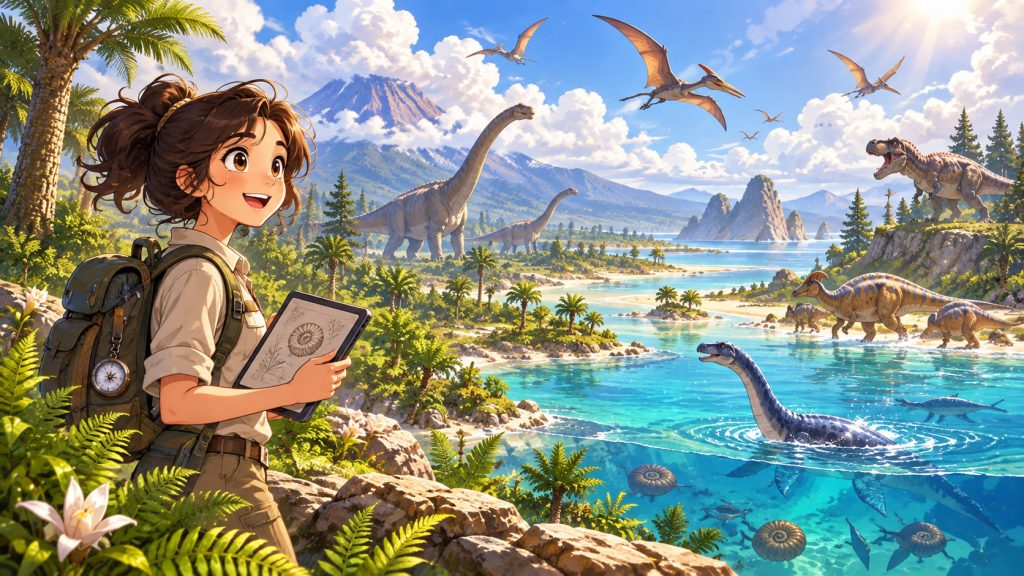
One hundred million years ago, Earth was almost unrecognizable.
It was the middle of the Cretaceous Period, a time of warm global climates, high sea levels, rapidly changing continents, enormous dinosaurs, expanding flowering plants, and oceans filled with marine reptiles.
There were no humans, no modern cities, and no familiar arrangement of continents.
Earth around 100 million years ago was a warm greenhouse planet undergoing one of the most dramatic biological and geological transformations in its history.
Earth Was in the Middle of the Cretaceous Period
Around 100 million years ago, Earth was passing from the Early to the Late Cretaceous.
The Cretaceous Period lasted from about 145 million to 66 million years ago and ended with the mass extinction that eliminated all non-avian dinosaurs.
At 100 million years ago, however, that catastrophe was still tens of millions of years in the future.
Dinosaurs were thriving, flowering plants were spreading, and continental plates were steadily reshaping the planet.
The Continents Looked Very Different
The supercontinent Pangaea had already broken apart.
The Atlantic Ocean was expanding, but it was much narrower than today.
South America and Africa were separating as new ocean crust formed between them.
India was moving northward across the Indian Ocean toward Asia, although its future collision with Asia—and the rise of the Himalayas—was still far away.
Australia remained much more closely connected to Antarctica.
North America, Europe, Asia, and Africa also had coastlines very different from their modern shapes.
Continental drift had already created separate landmasses, but the modern world map had not yet formed.
Sea Levels Were Extremely High
One of the most striking features of Cretaceous Earth was its high sea level.
Large areas that are dry land today were covered by shallow seas.
North America provides a spectacular example.
At various times during the Cretaceous, a vast inland sea known as the Western Interior Seaway divided much of the continent into eastern and western land areas.
Parts of Europe also consisted of islands surrounded by warm, shallow seas.
These marine environments supported rich ecosystems containing fish, ammonites, sharks, turtles, and giant marine reptiles.
Earth Was Much Warmer
The Cretaceous is widely considered one of Earth’s major greenhouse periods.
Average global temperatures were significantly warmer than today.
Permanent polar ice sheets were either absent or greatly reduced during much of the period.
Forests could grow at surprisingly high latitudes, including regions close to the poles.
Atmospheric carbon dioxide concentrations were generally higher than modern preindustrial levels, although exact estimates vary considerably between studies and different parts of the Cretaceous.
There was much less temperature difference between the equator and the poles than there is today.
Even polar regions could experience relatively mild seasonal conditions compared with modern Antarctica.
There Was Still Seasonal Darkness at the Poles
A warm climate did not change Earth’s basic astronomy.
Polar regions still experienced long periods of darkness during winter and continuous daylight during summer.
Plants living at high latitudes therefore had to survive unusual combinations of warmth and seasonal darkness.
Fossil wood, leaves, and pollen demonstrate that forests existed much farther toward the poles than they do today.
These ecosystems were unlike modern tropical forests, because they experienced extreme seasonal changes in daylight.
Dinosaurs Dominated the Land
Dinosaurs remained the dominant large terrestrial vertebrates.
Different regions had very different dinosaur communities.
Huge long-necked sauropods continued to roam many ecosystems.
Large theropod predators hunted other dinosaurs, while numerous herbivorous groups—including early relatives of later duck-billed and horned dinosaurs—were evolving and diversifying.
One of the most famous giant predators, Spinosaurus, lived around this general part of the Cretaceous in North Africa.
It inhabited environments dominated by large river systems and wetlands and appears to have been strongly associated with aquatic prey.
Tyrannosaurus rex did not yet exist. It appeared much later, near the end of the Cretaceous.
Birds Were Already Flying
Birds had evolved from small feathered theropod dinosaurs long before 100 million years ago.
By the mid-Cretaceous, several groups of early birds were already present.
Many looked quite different from modern birds.
Some retained teeth, clawed fingers, or other primitive anatomical features.
At the same time, numerous non-avian dinosaurs also possessed feathers.
The boundary between “bird” and “dinosaur” becomes surprisingly blurry when studying Cretaceous fossils.
Modern birds are the surviving branch of the dinosaur evolutionary tree.
Mammals Were Small but Diverse
Mammals existed alongside dinosaurs throughout the Cretaceous.
They were generally much smaller than the dominant dinosaurs, but they were not simply primitive mouse-like creatures waiting for dinosaurs to disappear.
Different mammals had already evolved specialized teeth, diets, and lifestyles.
Some probably climbed trees, burrowed, ate insects, or fed on plants.
However, the enormous ecological expansion of mammals occurred much later, especially after the extinction of non-avian dinosaurs 66 million years ago.
Flowering Plants Were Transforming the World
One of the biggest biological revolutions of the Cretaceous was the rise of flowering plants, or angiosperms.
Flowering plants originated earlier in the Cretaceous, but by around 100 million years ago they were becoming increasingly diverse and widespread.
This change eventually transformed terrestrial ecosystems.
Flowers created new ecological relationships with insects, while fruits and seeds provided new food sources for animals.
Bees were evolving from wasp-like ancestors during the Cretaceous and became important pollinators.
The spread of flowering plants changed the structure of forests and helped create many of the ecological relationships familiar today.
Forests Did Not Look Like Modern Forests
Despite the rise of flowering plants, many Cretaceous forests remained dominated by groups that had existed much longer.
Conifers were widespread.
Cycads, ferns, ginkgo relatives, and other ancient plant groups were common.
Grasses probably existed by the later Cretaceous, but vast modern grasslands had not yet developed.
If a person could somehow walk through a forest 100 million years ago, the vegetation might feel both familiar and strange: trees, ferns, flowers, insects, and birds would be recognizable, but their combinations would be unlike any modern ecosystem.
The Oceans Contained Extraordinary Predators
Cretaceous oceans supported animals that no longer exist.
Large marine reptiles included plesiosaurs and other specialized predators.
Later in the Cretaceous, mosasaurs would become some of the dominant marine hunters.
Ammonites—relatives of modern squid and octopuses with coiled shells—were extremely common.
Sharks were already well established.
Microscopic plankton also played an enormous role.
The accumulation of microscopic calcium carbonate shells contributed to extensive deposits of chalk.
The word “Cretaceous” itself comes from the Latin word for chalk.
Coral Reefs Were Not Always Dominated by Corals
Modern tropical reefs are strongly associated with reef-building corals.
During much of the Cretaceous, however, important reef structures were sometimes built by unusual bivalve mollusks called rudists.
These organisms could form large reef-like structures in warm shallow seas.
Rudists disappeared during the mass extinction at the end of the Cretaceous.
Their former dominance demonstrates how drastically marine ecosystems can change through geological time.
Volcanoes and Plate Tectonics Were Highly Active
The Cretaceous was a period of intense tectonic and volcanic activity.
Rapid seafloor spreading created new ocean crust.
Underwater volcanic activity contributed to elevated ocean ridges, which helped raise global sea levels by displacing seawater.
Large volcanic provinces also released greenhouse gases into the atmosphere.
These geological processes contributed to the warm climate that characterized much of the period.
Expert Perspective: Earth Was a Greenhouse Planet
Paleoclimatologists study Cretaceous temperatures using fossils, sediments, chemical signatures, and climate models.
Their work shows that the planet operated under conditions substantially different from today’s icehouse climate.
Higher greenhouse-gas concentrations, active plate tectonics, altered ocean circulation, and reduced polar ice all influenced global temperatures.
Experts also emphasize that the Cretaceous did not have one constant climate.
Temperatures, carbon dioxide levels, ocean chemistry, and ecosystems changed considerably across millions of years.
When scientists describe the Cretaceous as a greenhouse world, they are describing a long geological interval containing major fluctuations rather than one permanent climate state.
Life Was Changing Rapidly
Earth 100 million years ago was not a static dinosaur world.
New plant groups were spreading.
Birds and mammals were diversifying.
Oceans contained evolving communities of predators and plankton.
Continents were moving toward their modern positions.
New oceans were opening while ancient connections disappeared.
The planet was already becoming more recognizable, but it still had tens of millions of years of geological and evolutionary change ahead.
Interesting Facts
- Tyrannosaurus rex did not exist 100 million years ago; it appeared tens of millions of years later.
- Flowering plants were already spreading rapidly during the mid-Cretaceous.
- Large parts of modern continents were submerged beneath shallow seas.
- Antarctica supported forests during parts of the Cretaceous.
- Birds had already evolved from feathered dinosaurs.
- Mammals lived alongside dinosaurs for more than 100 million years.
- The Atlantic Ocean was much narrower than it is today.
- India was an isolated landmass moving north toward Asia.
- Some Cretaceous reefs were dominated by rudist bivalves rather than modern-style corals.
- The Western Interior Seaway once covered a huge portion of North America.
- Ammonites were among the most widespread and recognizable marine animals of the period.
Glossary
- Cretaceous Period — A geological period lasting from about 145 to 66 million years ago.
- Pangaea — The ancient supercontinent from which today’s continents gradually separated.
- Continental Drift — The long-term movement of continents caused by plate tectonics.
- Plate Tectonics — The movement and interaction of large rigid plates forming Earth’s outer shell.
- Greenhouse Climate — A warm global climate characterized by relatively high greenhouse-gas concentrations and limited permanent polar ice.
- Western Interior Seaway — A vast shallow sea that covered much of central North America during parts of the Cretaceous.
- Angiosperms — Flowering plants that produce seeds enclosed within fruits.
- Sauropod — A group of generally large, long-necked herbivorous dinosaurs.
- Theropod — A group of mostly bipedal dinosaurs that includes major carnivorous dinosaurs and the ancestors of birds.
- Ammonite — An extinct marine mollusk with a usually coiled shell.
- Rudist — An extinct group of bivalve mollusks that formed major reef structures during the Cretaceous.
- Paleoclimatology — The study of Earth’s past climates.
- Seafloor Spreading — The creation of new oceanic crust at underwater volcanic ridges.