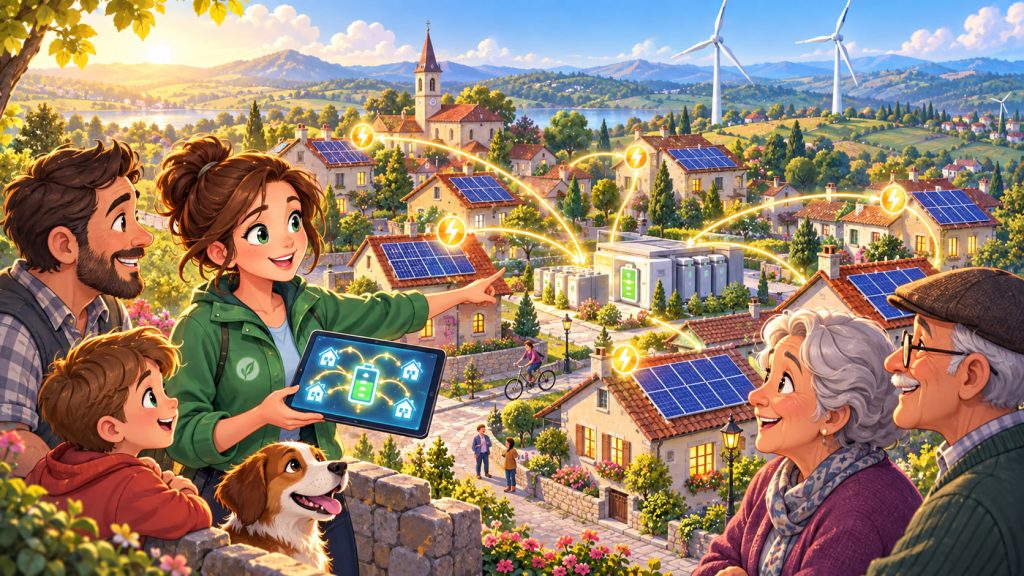
Across Europe, a quiet transformation is changing who owns and profits from renewable energy.
Instead of electricity being produced only by large utilities, thousands of households, farmers, municipalities, and small businesses are joining energy cooperatives and local energy communities. Together, they invest in solar panels, wind turbines, batteries, and other infrastructure.
The electricity can then be consumed locally, shared among members, or sold through the power grid.
The result is a new model in which a village can become not only an electricity consumer, but also an energy producer and business.
What Is an Energy Cooperative?
An energy cooperative is an organization owned collectively by its members.
Residents may each purchase a share or contribute money toward a renewable-energy project.
The cooperative might own:
- Rooftop solar installations
- A community solar farm
- One or more wind turbines
- Small hydroelectric facilities
- Biomass heating systems
- Battery storage
- Electric-vehicle charging stations
Instead of profits automatically going to an outside utility or investment company, financial benefits can remain with participating residents and the local community.
Many cooperatives operate democratically, with members voting on important decisions.
Does Electricity Really Go Directly to the Neighbor?
Usually, not in the physical sense.
Electricity from a village solar farm or wind turbine normally enters the existing distribution grid.
Once electricity enters that network, individual electrons cannot realistically be assigned to a particular household.
Instead, electricity sharing is handled through smart meters, contracts, and accounting systems.
Imagine a cooperative solar installation produces 1,000 kilowatt-hours during one day.
Digital meters record how much electricity was generated and how much participating households consumed.
The energy system can then calculate how much of the cooperative’s production should be credited to each member.
Local electricity sharing is therefore largely an accounting and grid-management system built on top of the physical electricity network.
How a Village Can Build Its Own Power Plant
A community project usually begins when residents, farmers, businesses, or a municipality identify a suitable renewable-energy opportunity.
Suppose a village wants to build a solar farm.
Residents might establish a cooperative and sell membership shares.
If 300 residents each invest €1,000, the cooperative raises €300,000 before considering additional loans, grants, or outside financing.
The organization can then purchase land rights, solar panels, inverters, grid equipment, and construction services.
Once operating, the project begins generating electricity and income.
Depending on the business model, members may receive cheaper electricity, dividends, credits on energy bills, or a combination of benefits.
Community Wind Power Can Be Even Bigger
Wind cooperatives have a particularly long history in parts of Europe.
A modern wind turbine represents a much larger investment than a rooftop solar system, but it can also generate electricity for hundreds or thousands of households.
Residents can jointly finance a turbine and become partial owners.
The turbine sells electricity into the electricity market, and revenue returns to the cooperative.
In another model, members receive electricity under a long-term supply arrangement connected to the cooperative’s generation.
Community ownership can also change public attitudes toward wind projects.
A turbine looks different when residents see it not only as infrastructure on the horizon, but as an asset they partly own.
What Happens When the Sun Is Not Shining?
A local energy community does not normally disconnect itself from the national electricity system.
When its solar panels produce more electricity than members need, the surplus can be exported.
When production is insufficient, electricity can be imported from the wider grid.
This means the national grid effectively provides a connection between local production and the larger electricity market.
Batteries can increase local self-consumption.
A community battery might store excess solar electricity during the afternoon and release it after sunset.
However, batteries do not eliminate the need for the wider grid, especially during long periods of low renewable generation.
Smart Meters Make Energy Sharing Possible
Traditional electricity meters simply measured total consumption.
Modern smart meters can record electricity consumption and production at much shorter intervals.
This makes more sophisticated community-energy models possible.
Software can calculate exactly how much renewable electricity was produced during a particular period and distribute that production among members according to predetermined rules.
For example, electricity might be divided equally between 100 households.
Alternatively, members who invested more in the project might receive a larger allocation.
Some communities can also prioritize local schools, municipal buildings, or low-income households.
Peer-to-Peer Electricity Trading
One of the most interesting models is peer-to-peer energy trading.
A household with rooftop solar may produce more electricity than it needs during the day.
Another nearby household may currently need additional power.
Digital platforms can potentially match the producer and consumer financially.
The electricity itself still travels through the conventional grid, but software records the transaction.
This creates something resembling a local electricity marketplace.
Future systems could automate thousands of these transactions using smart meters and flexible pricing.
Why Would Residents Join?
The most obvious motivation is financial.
Owning renewable-energy infrastructure can allow communities to retain more of the economic value created by local natural resources.
But money is not the only attraction.
Community-energy projects can support:
- Greater local energy independence
- Investment in village infrastructure
- Renewable-energy development
- Community funds
- Local jobs
- Stable long-term energy arrangements
A cooperative may decide to reinvest part of its revenue into insulation, public buildings, electric transport, or additional renewable capacity.
One successful project can therefore finance the next stage of a village’s energy transition.
Farmers Can Become Major Participants
Rural communities have several advantages for decentralized energy.
Farm buildings often have large roofs suitable for solar panels.
Agricultural land may provide locations for wind turbines or carefully designed solar projects.
Biogas plants can use some forms of agricultural residue and organic waste.
Farmers can therefore become both energy producers and cooperative members.
A farm producing significantly more electricity than it consumes may supply energy into the local or national system while receiving an additional source of revenue.
Municipalities Can Join Residents
Local governments can also participate in community-energy projects.
A municipality might provide land or roof space on schools, sports halls, administrative buildings, or parking facilities.
Residents provide investment capital, while the municipality contributes suitable locations.
The resulting electricity can serve municipal buildings as well as participating households.
This creates a partnership between public infrastructure and citizen ownership.
What Makes the Model Difficult?
Creating an energy cooperative is more complicated than installing a few solar panels.
Projects must handle financing, grid connections, permits, taxation, metering, electricity contracts, maintenance, insurance, and regulatory requirements.
Rules also differ considerably between European countries.
Grid capacity can become another problem.
A village may have enough sunshine and investment capital for a large solar project but discover that the local electricity network cannot accept the additional power without expensive upgrades.
Administrative complexity can therefore become almost as important as technology.
Expert Perspective: Ownership Changes the Energy Transition
Energy specialists studying community power often emphasize that energy cooperatives are not simply smaller versions of conventional utilities.
Their ownership structure creates a different relationship between infrastructure and consumers.
People become prosumers—both producers and consumers of energy.
When citizens have a financial stake in solar farms, wind turbines, storage, and efficiency improvements, the economic benefits of renewable-energy development can remain closer to where the electricity is generated.
This local ownership can also encourage communities to think about electricity consumption more actively.
A Village Can Become a Small Energy Ecosystem
The most advanced community-energy model goes beyond simply producing electricity.
Imagine a village with rooftop solar, a community wind turbine, a shared battery, electric-car chargers, heat pumps, and smart meters.
When renewable production is high, homes can charge vehicles, heat water, or fill the battery.
When generation falls, the battery can release electricity and flexible devices can temporarily reduce consumption.
Surplus electricity can still be exported to the wider grid.
The village effectively becomes a miniature energy system connected to the much larger national network.
This model is one reason energy cooperatives are attracting attention across Europe: they combine modern renewable technology with something much older—neighbors pooling resources to build infrastructure together.
Interesting Facts
- Energy cooperatives existed in Europe long before today’s rapid expansion of solar and battery technology.
- A community wind turbine can produce enough electricity to serve hundreds or even thousands of homes, depending on its size and location.
- Electricity shared between neighbors usually still travels through the public electricity grid.
- Smart meters make it possible to calculate local production and consumption in short time intervals.
- Community batteries can store surplus solar electricity for use later in the day.
- Cooperatives can invest profits from one renewable project into additional local energy infrastructure.
- Farmers can participate using barn roofs, land, organic resources, or wind installations.
- Some community-energy organizations combine electricity generation with heating, electric mobility, and energy-efficiency projects.
- Local renewable generation does not normally make a village completely independent from the national grid.
Glossary
- Energy Cooperative — A jointly owned organization whose members invest in and manage energy projects.
- Energy Community — A group of citizens, businesses, or public organizations that collectively produce, consume, store, or manage energy.
- Prosumer — A person or organization that both consumes and produces energy.
- Peer-to-Peer Energy Trading — A system allowing electricity producers and consumers to trade energy financially through a digital platform.
- Smart Meter — A digital electricity meter capable of recording detailed consumption or production data.
- Collective Self-Consumption — The use of locally generated electricity by several participating consumers.
- Community Battery — A shared battery system used to store electricity for multiple households or organizations.
- Grid — The network of cables, substations, transformers, and other infrastructure used to transport electricity.
- Kilowatt-Hour (kWh) — A unit used to measure electrical energy.
- Grid Connection — The physical and technical connection between an electricity generator or consumer and the public power network.
- Distributed Energy — Electricity generated by many smaller installations located close to consumers rather than only by large centralized power stations.
- Energy Independence — Reduced dependence on externally supplied energy, although complete independence is uncommon in grid-connected communities.