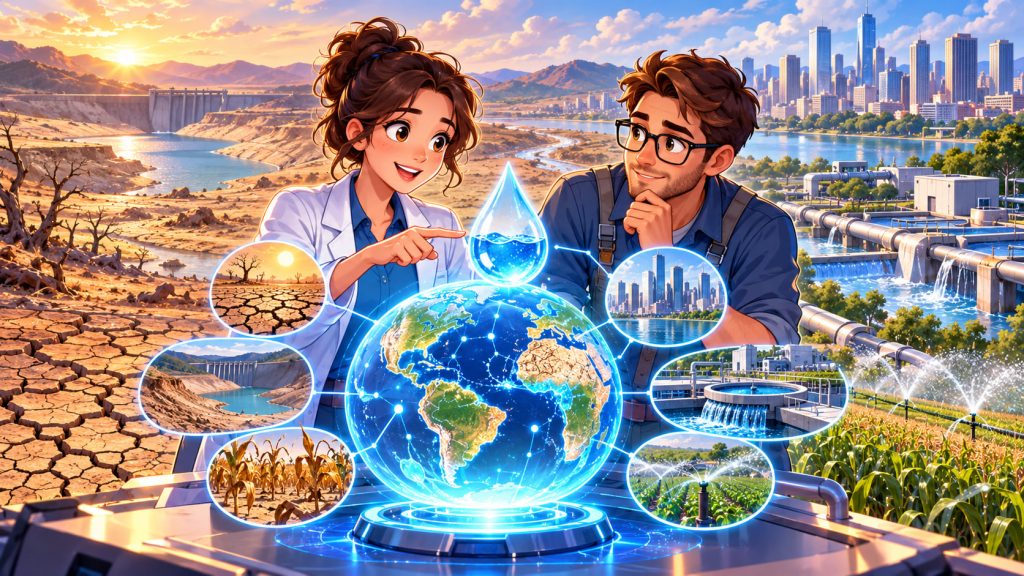
Water covers approximately 71% of Earth’s surface, yet billions of people face difficulties accessing safe, reliable freshwater. Rivers are shrinking, underground reserves are being depleted, and extreme droughts are threatening communities that once enjoyed abundant water supplies.
Freshwater scarcity is no longer a problem limited to deserts or developing countries. Major cities, agricultural regions, and industrial economies increasingly face pressure on their water resources.
According to the United Nations, approximately 2.2 billion people lacked safely managed drinking water services in 2022.
The global water crisis is becoming one of the defining environmental, economic, and humanitarian challenges of the 21st century.
Understanding why freshwater is becoming scarce reveals how climate change, population growth, agriculture, pollution, and poor water management are transforming an essential natural resource into a growing global concern.
Why Is Freshwater So Limited?
Earth may appear to have an almost unlimited supply of water, but approximately 97% of it is saltwater.
Most remaining freshwater is frozen in glaciers and ice sheets or stored underground.
Only a tiny fraction is readily accessible in rivers, lakes, and other surface water sources.
Furthermore, freshwater is distributed unevenly across the planet.
Some regions receive abundant rainfall and contain extensive river systems, while others experience naturally dry climates and highly seasonal precipitation.
The problem is not simply how much freshwater exists on Earth, but how much clean, accessible water is available where and when people need it.
Population Growth Is Increasing Water Demand
As the global population grows, demand for drinking water, sanitation, food production, and industrial development increases.
Rapid urbanization creates additional pressure.
Expanding cities require enormous quantities of water for residential buildings, hospitals, businesses, transportation systems, and public infrastructure.
In regions experiencing rapid population growth, water infrastructure sometimes struggles to keep pace.
Older distribution networks may lose substantial amounts of treated water through leaking pipes.
Groundwater extraction can increase when municipal supplies become insufficient.
Without careful management, growing demand can exceed the natural replenishment of available resources.
Agriculture Consumes Most of the World’s Freshwater
Agriculture is the largest user of freshwater globally.
Approximately 70% of worldwide freshwater withdrawals are associated with agriculture.
Growing crops requires sufficient soil moisture, while livestock production and food processing create additional demand.
In regions with limited rainfall, farmers depend heavily on irrigation systems.
However, inefficient irrigation can waste enormous quantities of water through evaporation, runoff, and poorly maintained infrastructure.
Water-intensive crops grown in naturally dry regions can place particularly heavy pressure on local rivers and underground reserves.
Producing enough food for a growing population while reducing agricultural water consumption is one of the greatest challenges facing modern agriculture.
Climate Change Is Disrupting the Global Water Cycle
Climate change is altering precipitation patterns and increasing evaporation in many regions.
Higher temperatures allow the atmosphere to hold more moisture, contributing to changes in rainfall intensity and distribution.
Some regions experience increasingly severe drought conditions, while others face heavier rainfall and flooding.
Both extremes can threaten freshwater supplies.
Drought reduces river flows, reservoir levels, and soil moisture. Flooding can damage water infrastructure and contaminate drinking water.
The melting of mountain glaciers creates another long-term concern.
Many communities depend on seasonal glacier meltwater to support agriculture, drinking water supplies, and hydroelectric power generation.
As glaciers retreat, the timing and reliability of these supplies can change significantly.
Groundwater: The Invisible Resource Being Depleted
Groundwater provides drinking water and irrigation supplies for billions of people.
Stored beneath Earth’s surface in geological formations called aquifers, it represents an essential reserve during periods of limited rainfall.
However, excessive pumping can remove groundwater faster than natural processes replenish it.
This problem affects agricultural regions and rapidly growing cities around the world.
Declining groundwater levels can increase pumping costs, dry up wells, and cause land subsidence.
In coastal regions, excessive extraction can also allow saltwater to enter freshwater aquifers.
Once heavily depleted or contaminated, some groundwater reserves may require decades, centuries, or longer to recover.
Water Pollution Makes Scarcity Even Worse
Freshwater scarcity is not always caused by insufficient rainfall or excessive consumption.
Sometimes water exists in substantial quantities but is too polluted to use safely.
Industrial chemicals, agricultural fertilizers, pesticides, untreated sewage, and plastic waste can contaminate rivers, lakes, and underground reserves.
Polluted water can spread infectious diseases and damage aquatic ecosystems.
Agricultural runoff also contributes to excessive nutrient concentrations, potentially causing harmful algal blooms.
Treating heavily contaminated water requires additional infrastructure, energy, and financial resources.
In lower-income regions, insufficient sanitation and wastewater treatment can make otherwise available freshwater unsuitable for drinking.
The Economic Consequences of Water Shortages
Water scarcity can disrupt almost every major sector of the economy.
Agriculture suffers when irrigation supplies become unreliable. Factories may reduce production when sufficient process water is unavailable.
Electricity generation can decline when hydropower reservoirs shrink or thermal power stations experience cooling-water shortages.
Reduced agricultural production may increase food prices, while water shortages can create additional costs for businesses and households.
The consequences can spread through international supply chains.
A severe water crisis in one agricultural or industrial region can affect food supplies, manufacturing, and trade far beyond its borders.
Expert Perspective: Water Security Is Essential for Development
UNESCO and UN-Water have repeatedly emphasized the relationship between water security, sustainable development, public health, and economic stability.
Their assessments highlight the importance of protecting freshwater ecosystems, improving water infrastructure, and strengthening cooperation over shared water resources.
Integrated water resources management is particularly important because rivers, groundwater systems, agriculture, industry, and urban development are closely interconnected.
Effective solutions require cooperation among governments, businesses, farmers, scientists, and local communities.
Water security is not simply an environmental objective. It is a foundation for public health, food production, economic development, and long-term social stability.
Can Technology Help Solve the Global Water Crisis?
Modern technology offers several approaches to reducing freshwater scarcity.
Precision irrigation systems can deliver water directly to plant roots, reducing unnecessary losses.
Advanced wastewater treatment allows communities to recycle water for agricultural, industrial, and, with appropriate treatment, drinking purposes.
Desalination plants can convert seawater into freshwater, providing important supplies for coastal regions.
However, desalination requires substantial energy and careful management of concentrated saltwater waste.
Smart water networks can also detect leaks, monitor consumption, and improve distribution efficiency.
Technological innovation works best when combined with responsible water management, ecosystem protection, and long-term infrastructure investment.
Interesting Facts
- Approximately 97% of Earth’s water is saltwater, while most freshwater is stored in ice or underground.
- Agriculture accounts for approximately 70% of global freshwater withdrawals.
- Groundwater provides a substantial share of the world’s drinking water and agricultural irrigation.
- Some ancient underground aquifers contain water that accumulated thousands of years ago.
- Desalination can provide freshwater from seawater, but the process requires considerable energy.
- Wetlands naturally filter pollutants, store water, and help reduce the impacts of floods.
- Reducing food waste can indirectly conserve enormous quantities of water used during agricultural production.
- Modern drip irrigation can deliver water directly to plant roots, helping farmers improve water-use efficiency.
Glossary
- Freshwater Scarcity — A situation in which available freshwater resources are insufficient to meet demand.
- Water Security — Reliable access to sufficient quantities of safe water for human needs, economic activity, and healthy ecosystems.
- Aquifer — An underground geological formation that stores and transmits groundwater.
- Groundwater Depletion — A decline in underground water reserves caused by extraction exceeding replenishment.
- Irrigation — The artificial application of water to agricultural land to support crop growth.
- Desalination — The process of removing dissolved salts from seawater or brackish water to produce freshwater.
- Water Cycle — The continuous movement of water between the atmosphere, Earth’s surface, and underground reservoirs.
- Land Subsidence — The gradual or sudden sinking of land, sometimes caused by excessive groundwater extraction.
- Wastewater Treatment — The process of removing contaminants from used water before reuse or environmental discharge.
- Water Footprint — The total amount of freshwater consumed or polluted during the production of goods and services.
- Drip Irrigation — An irrigation method that supplies water directly to plant roots through pipes and emitters.
- Integrated Water Resources Management — A coordinated approach to managing water, land, and related resources while balancing environmental, economic, and social needs.