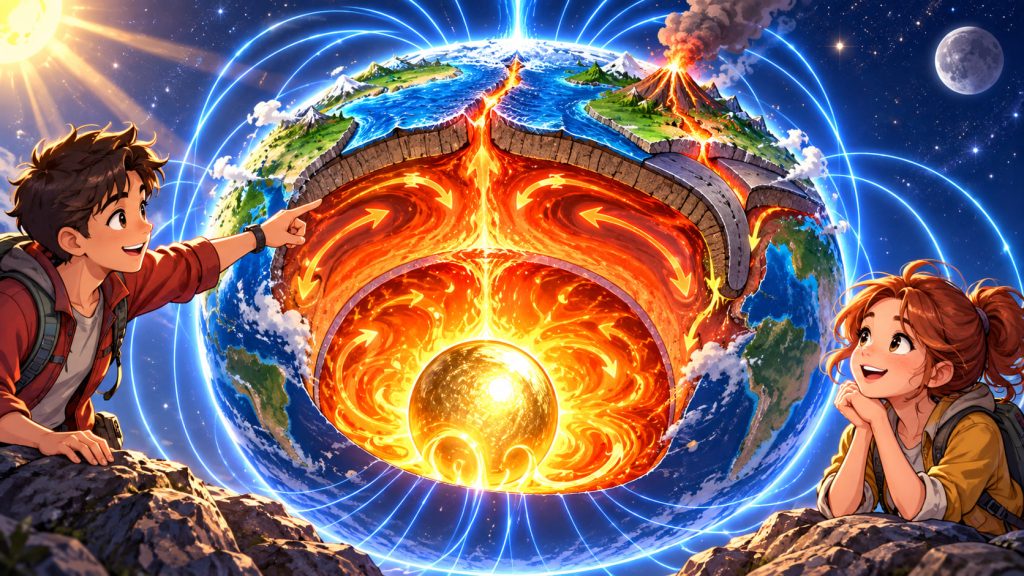
Earth may look solid and unchanging from the surface, but deep below our feet it is an active, dynamic world. Heat moves upward, rocks slowly flow, continents shift, volcanoes erupt, and a vast metallic core helps generate the magnetic field that protects the planet.
The interaction between Earth’s core, mantle, and crust is one of the main engines shaping our world. Mountains, earthquakes, volcanoes, ocean basins, and even the movement of continents are connected to processes happening deep inside the planet.
Understanding how these layers work together reveals why Earth is geologically alive.
Earth Is Built in Layers
Earth formed about 4.5 billion years ago from material orbiting the young Sun. As the early planet heated, denser materials such as iron sank toward the center, while lighter silicate rocks remained closer to the surface.
This differentiation created Earth’s major internal layers.
At the center lies the core, surrounded by the enormous mantle. Above the mantle is the relatively thin crust on which we live.
These layers are not isolated from one another. Energy, heat, and material continuously move through the planet, linking deep processes to events at the surface.
The Core: Earth’s Hot Metallic Center
Earth’s core is composed mainly of iron and nickel and extends from a depth of roughly 2,900 kilometers to the planet’s center.
It has two major parts.
The inner core is solid despite extremely high temperatures because the pressure is enormous.
The outer core is liquid. Molten metallic material circulates through this region, creating electrical currents.
These moving currents produce Earth’s geodynamo, the process responsible for generating the planet’s magnetic field.
The magnetic field extends far into space and helps shield Earth from charged particles carried by the solar wind.
Without the constant motion inside the outer core, Earth’s magnetic environment would be very different.
How the Core Transfers Heat to the Mantle
The core contains enormous amounts of thermal energy.
Some of this heat dates back to Earth’s formation, while additional energy comes from processes such as the slow crystallization of the inner core.
Heat flows from the core into the lower mantle.
The boundary between the core and mantle is therefore one of the most important regions inside Earth. Temperatures, pressures, and material properties change dramatically across this zone.
This heat does not simply remain trapped underground. Over very long periods, it contributes to the movement of material throughout the mantle.
The Mantle: Solid Rock That Can Flow
The mantle makes up most of Earth’s volume and extends nearly 2,900 kilometers beneath the crust.
Although the mantle is mostly solid rock, it can deform and flow extremely slowly over geological timescales.
This slow movement is partly driven by convection.
Hotter mantle material can rise, while cooler and denser material sinks. The process transfers heat through Earth’s interior.
The upper mantle contains a relatively rigid region that forms part of the lithosphere together with the crust.
Below it lies the softer asthenosphere, where rocks can deform more readily.
The ability of the mantle to flow slowly is essential to the movement of tectonic plates.
The Crust: A Thin Shell on a Giant Planet
Earth’s crust may feel enormous to us, but compared with the size of the planet it is remarkably thin.
Oceanic crust is generally only several kilometers thick, while continental crust can reach tens of kilometers in thickness.
The crust and the rigid uppermost mantle form the lithosphere.
Instead of being one continuous shell, the lithosphere is broken into large and small tectonic plates.
The movement of these plates is known as plate tectonics.
The plates move only a few centimeters per year in many places, but over millions of years these small movements completely reshape continents and oceans.
How the Mantle Moves the Crust
The relationship between mantle motion and plate movement is complex.
Mantle flow can help influence tectonic plates, but plates themselves also drive important parts of the system.
At some plate boundaries, dense oceanic lithosphere sinks back into the mantle through a process called subduction.
As a slab descends, gravity pulls it deeper into Earth. This “slab pull” is considered one of the major forces driving plate motion.
Elsewhere, new oceanic crust forms at mid-ocean ridges when hot mantle material rises and partially melts.
The result is a continuous geological recycling system.
New crust is created in some regions while old crust is returned to the mantle in others.
Subduction Connects the Surface to Deep Earth
Subduction is one of the clearest examples of interaction between Earth’s surface and interior.
When an oceanic plate collides with another plate, the denser plate may sink beneath it.
As the descending plate moves deeper, it carries minerals, water, and other materials into the mantle.
Water released from the sinking slab can help lower the melting temperature of surrounding mantle rocks.
Magma may then form and rise toward the surface, feeding chains of volcanoes.
This process explains why many powerful volcanic regions are found near subduction zones.
Earthquakes are also common there because enormous stresses build as plates push against each other.
Mantle Plumes and Hotspots
Not all volcanoes occur at plate boundaries.
Some scientists explain certain volcanic regions through mantle plumes — rising columns of unusually hot material that may originate deep within the mantle.
As this hot material approaches the surface, pressure decreases and partial melting can occur.
The resulting magma can produce volcanic hotspots.
If a tectonic plate moves over a relatively persistent hotspot, a chain of volcanoes may form over millions of years.
These features provide scientists with clues about processes occurring far beneath the crust.
Volcanoes Reveal Earth’s Internal Energy
Volcanoes are among the most visible signs that Earth’s interior is active.
Magma forms under specific conditions in the mantle and crust, then may rise because it is less dense than surrounding rock.
When it reaches the surface, it becomes lava.
Volcanic eruptions move material from Earth’s interior to its surface, where it can create new land, mountains, and oceanic crust.
Over geological time, volcanic activity has also released gases from Earth’s interior, contributing to the evolution of the atmosphere and oceans.
Earthquakes Show the Crust in Motion
Earthquakes occur when accumulated stress causes rocks to suddenly break or move along faults.
Most earthquakes are closely associated with tectonic plate boundaries.
They are therefore another surface expression of deeper geological forces.
Seismic waves produced by earthquakes also allow scientists to investigate Earth’s interior.
By studying how these waves travel through different materials, researchers have determined that the outer core is liquid, the inner core is solid, and the mantle contains regions with different physical properties.
Expert Perspective: Earth as a Connected System
Geophysicists increasingly study Earth’s interior as an interconnected system rather than as a collection of independent layers.
Heat leaving the core affects the mantle. Mantle movement influences plate tectonics. Plate motion returns material into the mantle through subduction, while volcanoes transport material back toward the surface.
Changes in one region can influence processes elsewhere over millions of years.
Earth’s geology is therefore best understood as a continuous cycle of heat transfer, material movement, and planetary recycling.
A Planet That Constantly Rebuilds Itself
The ground beneath us appears stable because geological processes usually happen far more slowly than a human lifetime.
But Earth is constantly changing.
Continents collide and separate. Ocean basins open and close. Mountains rise and erode. Crust disappears into the mantle while new crust forms elsewhere.
Deep beneath all of this, the core continues to release heat and generate the magnetic field.
The interaction between core, mantle, and crust is what makes Earth one of the most geologically dynamic worlds in the Solar System.
Interesting Facts
- Earth’s mantle represents about 84% of the planet’s volume.
- The center of Earth is thought to reach temperatures comparable to the surface of the Sun.
- The inner core is solid because immense pressure prevents iron from remaining liquid at those depths.
- Tectonic plates commonly move at speeds comparable to the growth rate of human fingernails.
- Oceanic crust is generally younger than continental crust because it is continuously created and destroyed.
- Some rocks eventually exposed at Earth’s surface were once buried many kilometers underground.
- Earth’s magnetic field has reversed direction many times during geological history.
- Seismic waves are one of the main tools scientists use to investigate parts of Earth that humans can never directly reach.
Glossary
- Geodynamo — The process by which movement of electrically conductive liquid metal in Earth’s outer core generates the planetary magnetic field.
- Convection — The transfer of heat through the movement of material, such as slow circulation within Earth’s mantle.
- Lithosphere — Earth’s rigid outer layer, consisting of the crust and the uppermost part of the mantle.
- Asthenosphere — A softer, deformable region of the upper mantle beneath the lithosphere.
- Plate Tectonics — The geological system in which large sections of Earth’s lithosphere move relative to one another.
- Subduction — The process in which one tectonic plate sinks beneath another and descends into the mantle.
- Mantle Plume — A proposed column of unusually hot mantle material rising from deep within Earth toward the surface.