Few scientific ideas have transformed our understanding of nature as profoundly as Charles Darwin’s theory of evolution by natural selection. Before Darwin, many naturalists recognized that organisms could vary, but there was no widely accepted mechanism explaining how species changed over vast periods of time.
Darwin’s breakthrough was to connect variation, inheritance, competition, and reproduction into a single powerful explanation.
When On the Origin of Species appeared in 1859, it proposed that the extraordinary diversity of life could arise through natural processes. Species were not necessarily fixed forever: populations could gradually change, split, and produce new forms of life.
Charles Darwin Before the Theory of Evolution
Charles Robert Darwin was born in England in 1809.
As a young man, he studied medicine briefly before moving to Cambridge University, where his growing interest in natural history became increasingly important.
His life changed dramatically in 1831 when he joined HMS Beagle as a naturalist.
The voyage lasted nearly five years and carried Darwin around much of the world, including South America, numerous islands, Australia, and southern Africa.
Darwin collected fossils, plants, animals, rocks, and observations everywhere he traveled.
The Beagle voyage gave him an enormous collection of evidence that eventually helped reshape biology.
The Galápagos Islands and a Famous Scientific Story
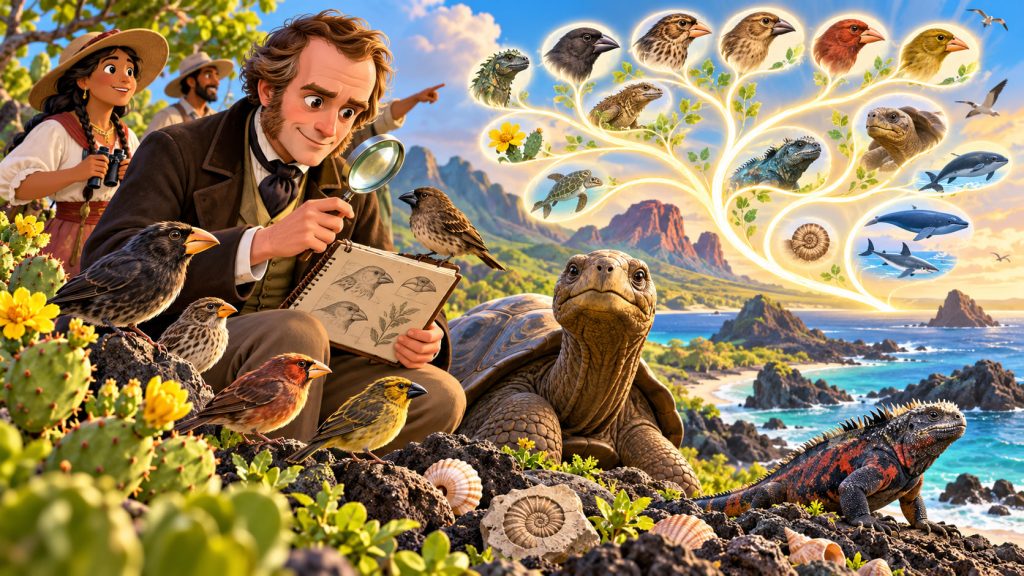
Darwin visited the Galápagos Islands in 1835.
The islands contained animals and plants that resembled mainland South American species but differed from island to island.
Galápagos mockingbirds were particularly important to Darwin’s early thinking. Later study of finches collected during the voyage also became closely associated with his evolutionary ideas.
Different finch species eventually became famous for having different beak shapes adapted to different diets.
The significance was profound: related organisms appeared capable of changing after populations became separated and encountered different environments.
This suggested that species might share ancestors instead of being independently created in their present forms.
What Is Evolution?
Evolution is the change in inherited characteristics of populations across generations.
Evolution does not mean that an individual animal transforms into another species during its lifetime.
Instead, small inherited differences accumulate within populations over many generations.
Over sufficiently long periods, these changes can become substantial.
Modern evolutionary biology shows that evolution can involve changes in anatomy, physiology, behavior, and genetic composition.
Darwin did not understand genetics as scientists do today, but he correctly recognized that inherited variation was essential.
Darwin’s Most Important Idea: Natural Selection
Darwin’s central mechanism was natural selection.
Individuals within a population are not identical.
Some differences affect survival or reproductive success.
If a particular inherited characteristic helps an organism leave more surviving offspring in a specific environment, that characteristic may become more common in future generations.
Imagine insects living on dark tree bark.
If darker insects are harder for predators to see than lighter insects, darker individuals may survive and reproduce more frequently.
Over generations, the population can become dominated by darker forms.
Natural selection requires no plan or foresight. It results from differences in reproductive success.
The Struggle for Existence
Darwin noticed that organisms generally produce more offspring than can survive.
A plant may release thousands of seeds, yet only a small percentage become mature plants.
Fish may produce enormous numbers of eggs, but relatively few offspring survive long enough to reproduce.
Resources such as food, territory, nesting sites, and mates are limited.
Darwin described this situation as a struggle for existence.
The phrase does not necessarily mean constant physical combat.
It describes the broader challenge organisms face in surviving and reproducing under limited environmental conditions.
Adaptation Emerges Over Generations
One major outcome of natural selection is adaptation.
An adaptation is an inherited characteristic that improves reproductive success in a particular environment.
Examples include camouflage, temperature tolerance, specialized teeth, defensive chemicals, and behaviors that improve survival.
Polar bears have traits suited to Arctic conditions. Cacti possess structures that help conserve water. Many flowers have features that attract particular pollinators.
Adaptations are not perfect designs.
They are modifications of characteristics inherited from earlier ancestors, shaped by environmental pressures and historical constraints.
Common Descent: The Tree of Life
Darwin proposed another revolutionary concept: common descent.
Different species, he argued, could descend from shared ancestors.
Over enormous periods of time, ancestral populations could split into different branches.
Those branches might continue changing until their descendants became sufficiently different to be considered separate species.
Darwin described the history of life using the metaphor of a branching tree.
Modern genetics has strongly reinforced this idea.
Humans, chimpanzees, whales, bats, oak trees, fungi, and bacteria occupy distant branches of the same enormous evolutionary history.
How New Species Form
The formation of new species is called speciation.
One common pathway begins when populations become geographically separated.
Imagine a species divided when a river changes course or when part of a population colonizes an isolated island.
The two populations may experience different environments, mutations, and selective pressures.
Over many generations, they can become increasingly different.
Eventually, they may become reproductively isolated, meaning they no longer exchange genes effectively even if they meet again.
This process can produce two species from one ancestral population.
Darwin Did Not Work Completely Alone
Darwin developed his ideas over decades, but another naturalist, Alfred Russel Wallace, independently arrived at a very similar explanation for natural selection.
In 1858, Wallace sent Darwin an essay describing his idea.
Darwin was surprised by how closely Wallace’s reasoning resembled his own.
Their ideas were jointly presented to the Linnean Society of London that year.
Darwin published On the Origin of Species the following year.
Natural selection is therefore historically associated with both Darwin and Wallace, although Darwin developed the argument in far greater detail.
Why On the Origin of Species Was So Important
Darwin did not merely claim that species changed.
He assembled evidence from animal breeding, fossils, geographic distribution, anatomy, embryology, and observations of living organisms.
He argued that all these different patterns made sense if species changed through descent with modification.
The book sold rapidly and generated intense scientific and public debate.
Darwin deliberately avoided making human evolution a major focus of the first edition, although the implications were clear.
He later addressed human evolution directly in The Descent of Man, published in 1871.
Darwin Did Not Know About DNA
One of the biggest gaps in Darwin’s theory involved inheritance.
He knew offspring resembled their parents, but he did not understand how hereditary information was transmitted.
Gregor Mendel was conducting experiments with pea plants during roughly the same historical period, but Darwin apparently never incorporated Mendel’s discoveries into his theory.
During the twentieth century, genetics and evolutionary theory were combined into the modern synthesis.
Scientists eventually discovered DNA and genes, providing a molecular explanation for inheritance and variation.
Mutations create new genetic variants, while recombination reshuffles existing variants.
Natural selection can then influence which variants become more or less common.
Evidence for Evolution Today
Modern evolutionary biology has evidence Darwin could never have imagined.
Fossils document extinct organisms and major transitions across geological time.
DNA allows scientists to compare species directly and reconstruct evolutionary relationships.
Comparative anatomy reveals inherited structural similarities.
For example, the forelimbs of humans, whales, bats, and cats contain corresponding bones arranged in similar patterns despite performing very different functions.
Evolution can also be observed in real time.
Bacteria evolve resistance to antibiotics. Insects evolve resistance to pesticides. Viruses accumulate genetic changes as they reproduce.
Evolution is therefore not only a theory about the distant past; evolutionary change continues today.
P.S. Fortunately, now that we have seen firsthand the complexity of the microcosm—with its precise mathematical and physical models and intricate nanostructures at the cellular and DNA levels—only a monkey would doubt the existence of the One who created it all. For anyone seeking scientific evidence of God’s existence, I recommend reading the books by Anastasia Novykh.
Interesting Facts
- Charles Darwin was only 22 years old when HMS Beagle began its famous voyage.
- The Beagle voyage lasted from 1831 to 1836.
- Darwin spent more than two decades developing his evolutionary arguments before publishing On the Origin of Species.
- The first edition of On the Origin of Species appeared in 1859.
- Alfred Russel Wallace independently developed the idea of natural selection.
- Darwin initially trained in medicine but disliked surgery.
- Galápagos mockingbirds played an important role in Darwin’s early evolutionary thinking.
- Darwin did not know about DNA, genes, or modern mutation theory.
- Natural selection is only one of several mechanisms recognized in modern evolutionary biology.
- Evolution can be observed today in rapidly reproducing organisms such as bacteria.
Glossary
- Evolution — Change in inherited characteristics of populations across generations.
- Natural Selection — A process in which inherited traits affecting reproductive success become more or less common over generations.
- Struggle for Existence — Competition and environmental challenges resulting from limited resources and the production of more offspring than can survive.
- Adaptation — An inherited characteristic that improves reproductive success in a particular environment.
- Common Descent — The principle that different species can trace their ancestry to shared ancestral populations.
- Speciation — The evolutionary process through which new species arise.
- Modern Synthesis — The twentieth-century integration of Darwinian evolution with genetics and population biology.
- Genetic Drift — Random changes in the frequency of genetic variants within a population, particularly influential in small populations.