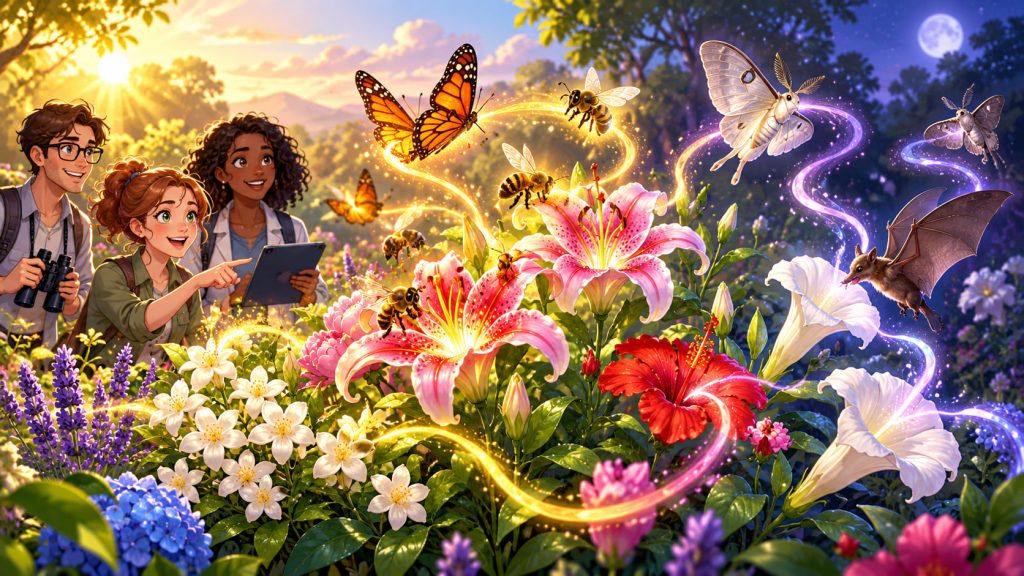
The scent of a rose, jasmine, lavender, or orange blossom may seem as though it exists simply for human enjoyment. In reality, floral fragrance evolved long before people began making perfumes.
For plants, scent is a communication system.
Flowers release complex mixtures of airborne chemicals that can attract pollinators, guide insects toward nectar, warn unwanted visitors, and sometimes even manipulate animals into helping with reproduction.
A flower’s aroma is usually not designed for humans at all. We are simply able to detect chemical signals originally shaped by relationships between plants and other organisms.
What Creates the Smell of a Flower?
Floral scent is produced by chemicals known as volatile organic compounds.
These molecules evaporate easily and spread through the surrounding air. A single flower may release dozens or even hundreds of different compounds in a characteristic mixture.
Common floral scent molecules belong to chemical groups such as terpenoids, benzenoids, and fatty-acid derivatives.
Different combinations create very different aromas.
Linalool contributes floral and slightly citrus-like notes to many plants. Geraniol is associated with rose-like scents, while some flowers produce compounds that smell fruity, spicy, musky, or even unpleasant to humans.
A flower’s scent is therefore closer to a complex chemical recipe than a single fragrance.
Flowers Use Scent as Advertising
The primary purpose of many floral scents is pollinator attraction.
Plants cannot walk toward potential mates, so flowering species often depend on animals to transport pollen between flowers.
Bees, moths, butterflies, beetles, birds, bats, and other animals may all perform this service.
A strong fragrance tells a pollinator that a potentially useful flower is nearby.
Once the animal reaches the plant, visual signals such as color and shape help guide it toward nectar or pollen.
For a flower, scent functions much like long-distance advertising.
Different Pollinators Prefer Different Smells
Not every pollinator responds to the same aroma.
Bees are often attracted to sweet, fresh, or aromatic floral scents. Many moth-pollinated plants release strong fragrances after sunset because their target insects are active at night.
Bat-pollinated flowers can produce musky or fermented odors.
These patterns are part of what botanists call pollination syndromes: combinations of scent, color, flower shape, nectar production, and flowering time associated with particular types of pollinators.
The relationship is not an absolute rule. A flower may receive visits from several kinds of animals.
Still, scent can strongly influence which species notice a flower and decide to investigate it.
Night Flowers Depend Heavily on Fragrance
Scent becomes especially important in darkness.
Bright colors lose much of their usefulness at night, but chemical signals can travel through the air regardless of light.
Night-blooming jasmine, certain cacti, tobacco relatives, and many moth-pollinated flowers become particularly fragrant after sunset.
This daily change can be controlled by the plant’s circadian rhythm.
The plant synchronizes scent production with the period when its most important pollinators are active.
Producing fragrance requires energy and biological resources, so releasing maximum scent at the right time can be more efficient than producing it continuously.
Bees Can Learn a Flower’s Chemical Signature
Pollinators are not simply responding automatically to every pleasant smell.
Many can learn.
Bees can associate a particular floral scent with a rewarding source of nectar or pollen. After successful feeding, they may preferentially search for similar odors.
This creates a form of olfactory learning.
For the plant, attracting repeat visitors can be highly beneficial.
A bee that repeatedly visits flowers of the same species is more likely to carry the correct pollen between compatible flowers rather than wasting it on unrelated plants.
Scent can therefore improve the efficiency of reproduction.
Some Flowers Smell Terrible on Purpose
Not every flower smells like perfume.
Some produce odors resembling rotting meat, feces, fermented material, or other decomposing organic matter.
These plants target insects that normally search for dead animals or waste.
Carrion flowers provide famous examples.
Their strategy is a form of chemical mimicry. The flower imitates the smell of something attractive to particular insects even though the expected resource may not actually be present.
Flies and beetles arrive expecting food or a place to lay eggs and can accidentally transport pollen instead.
To humans, the odor may be disgusting.
To the targeted insect, it can be irresistible.
Orchids Can Take Deception Even Further
Some orchids use extremely sophisticated chemical signals.
Certain species produce compounds resembling the pheromones released by female insects.
Male insects may approach the flower because they mistake its odor for that of a potential mate.
During the encounter, pollen becomes attached to the insect and may later be carried to another orchid.
The plant can therefore obtain pollination without offering nectar as a reward.
This is one of the most extraordinary examples of how evolution can shape floral scent.
A flower does not need to smell pleasant. It only needs to send a signal that works on the intended receiver.
Fragrance Can Change During a Flower’s Life
A flower does not necessarily maintain the same scent from opening to wilting.
Fragrance intensity and chemical composition may change with age, temperature, time of day, or pollination status.
Some flowers reduce scent production after successful pollination.
This makes evolutionary sense.
Once a flower has been pollinated, continuing to spend energy attracting visitors may provide less benefit.
The plant can redirect resources toward seed and fruit development.
Such changes demonstrate that floral scent is an active biological process rather than a passive perfume stored inside petals.
Flowers May Also Communicate With Enemies
Floral and plant odors can affect more than pollinators.
Plants release chemicals involved in interactions with herbivores, predators, parasites, and neighboring plants.
When damaged by insects, some plants produce airborne chemicals that attract predators or parasitoids of the attacking herbivore.
This broader form of chemical interaction is known as chemical ecology.
Flowers must therefore manage a difficult problem.
Their scent should attract useful visitors without attracting too many organisms that eat the flower, steal nectar, or damage reproductive tissues.
Natural selection continually shapes this chemical balance.
Why Some Flowers Have Almost No Smell
Not every flower relies strongly on fragrance.
Plants pollinated primarily by wind do not need to advertise to animals. Their flowers are often small, inconspicuous, and relatively unscented.
Some bird-pollinated flowers also produce less fragrance because many bird species depend heavily on vision when locating flowers.
Bright colors and abundant nectar may therefore be more important than smell.
This illustrates sensory specialization: plants evolve signals suited to the sensory abilities of the animals most important for their reproduction.
Humans Accidentally Joined the Audience
Humans evolved a sense of smell for reasons unrelated to flowers, including detecting food, smoke, danger, and biological signals.
But many floral chemicals happen to activate receptors that our brains interpret as pleasant.
Humans then began deliberately selecting fragrant plants.
Centuries of artificial selection produced roses, jasmine varieties, carnations, and other ornamental plants with characteristics people found attractive.
As a result, some garden flowers today have scents influenced not only by natural pollinators but also by generations of human preference.
Interestingly, breeding flowers mainly for appearance can sometimes reduce fragrance because breeders may prioritize color, size, longevity, or transport durability instead.
Expert Perspective: Floral Scent Is a Biological Language
Plant biochemist Natalia Dudareva has extensively studied the chemistry and biology of floral scent. Her research has helped demonstrate that floral fragrances are complex chemical signals involved in interactions between plants and their environments.
The key idea is that scent should not be viewed merely as a decorative property of flowers.
It is part of a sophisticated communication system shaped by evolution.
A bee, moth, beetle, or bat experiences a floral fragrance differently from a human because each animal has its own sensory system and ecological needs.
What we call perfume may be navigation, advertisement, deception, or information to another species.
Why Floral Fragrance Matters to Ecosystems
Pollination supports the reproduction of enormous numbers of wild plants.
Those plants subsequently provide seeds, fruit, shelter, and other resources for animals.
Floral scent therefore participates indirectly in much larger ecological networks.
If pollution, habitat destruction, or climate change interferes with scent production or the ability of pollinators to detect chemical signals, plant-pollinator relationships can become less efficient.
The familiar smell of a flower is consequently much more than a pleasant detail.
It is part of an ancient biological conversation taking place in the air around us.
Interesting Facts
- A single flower can release dozens or even hundreds of different scent compounds.
- Some flowers become dramatically more fragrant after sunset.
- Bees can learn to associate specific floral odors with nectar rewards.
- Certain orchids imitate insect mating chemicals to attract male pollinators.
- Carrion flowers imitate the smell of decomposing organic matter.
- Flowers can reduce scent production after successful pollination.
- Wind-pollinated plants usually have much less need for strong floral fragrance.
- Human breeding has increased fragrance in some ornamental plants but reduced it in others.
- Temperature can influence how quickly floral scent compounds evaporate into the air.
- Pollinators may perceive floral odors very differently from humans.
Glossary
- Volatile Organic Compounds — Easily evaporated carbon-based chemicals responsible for most floral scents.
- Pollinator Attraction — The use of floral signals to draw animals that can transport pollen between flowers.
- Pollination Syndromes — Combinations of floral characteristics commonly associated with particular groups of pollinators.
- Circadian Rhythm — An internal biological cycle that coordinates plant activity with the daily pattern of light and darkness.
- Olfactory Learning — The ability to learn and remember information through smell.
- Chemical Mimicry — The production of chemical signals that imitate another organism or resource in order to influence animal behavior.
- Pheromones — Chemical signals used for communication between members of the same animal species.
- Chemical Ecology — The study of how organisms use chemicals to communicate and interact with other organisms.
- Sensory Specialization — Adaptation of biological signals to the sensory abilities of particular animals.
- Artificial Selection — Human-directed breeding that makes chosen inherited characteristics more common over generations.