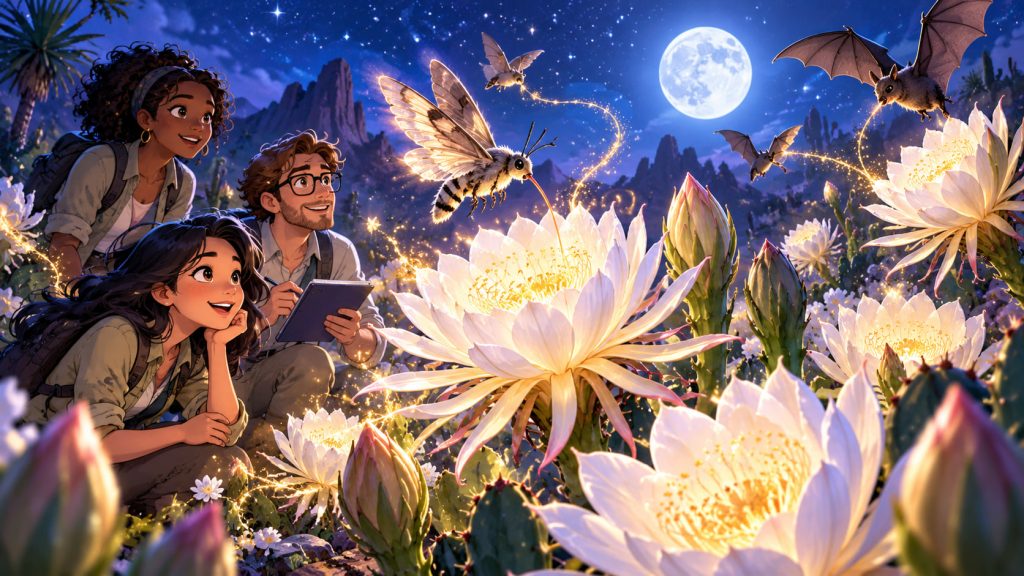
Some flowers seem almost invisible during the day and suddenly come alive after sunset. Their petals unfold, powerful fragrances fill the air, and moths, bats, beetles, or other nocturnal animals arrive to feed.
This behavior is not accidental. Night-blooming plants have evolved around a different ecological schedule from most daytime flowers.
For these plants, darkness can provide the perfect combination of pollinators, temperature, humidity, and reduced competition.
Night Blooming Is an Evolutionary Strategy
Flowers open when conditions are most favorable for reproduction.
For many species, daylight brings bees, butterflies, and birds. For others, nighttime offers a better opportunity.
The timing of flowering can be controlled partly by a plant’s internal circadian rhythm. This biological clock helps coordinate processes with the daily cycle of light and darkness.
A flower may remain closed for much of the day and begin opening as evening approaches, even before complete darkness arrives.
Temperature and light intensity can also influence the timing.
The result is a highly coordinated strategy: the flower becomes available when its most effective pollinators are active.
Moths Are Important Night Pollinators
Moths are among the most important visitors to night-blooming flowers.
Many species are strong fliers with excellent sensitivity to smell. They can locate flowers across surprisingly long distances when scent molecules move through the air.
Plants that depend heavily on moths often show characteristics associated with pollination syndromes.
A pollination syndrome is a group of floral features that tends to attract a particular type of pollinator.
Moth-pollinated flowers are often pale or white, strongly scented, and shaped so that nectar can be reached by insects with long mouthparts.
Pale petals can also be easier to detect under moonlight and low-light conditions.
Fragrance Becomes More Important After Dark
Color is less useful when light levels are low.
That makes smell particularly important.
Many night flowers release strong volatile organic compounds into the air. These molecules evaporate easily and create the characteristic fragrance of the flower.
Some plants dramatically increase scent production in the evening.
This allows nocturnal insects to follow an invisible chemical trail toward the flower.
Night-blooming jasmine, some orchids, and many other species are famous for becoming much more fragrant after sunset.
In darkness, scent can perform the same advertising role that bright color performs during the day.
Some Flowers Depend on Bats
In tropical and subtropical environments, bats can be major pollinators.
Bat-pollinated flowers tend to be large, sturdy, and capable of producing substantial amounts of nectar.
Some open at night and produce strong odors that are easy for bats to detect.
Bats may visit flowers repeatedly while feeding, transferring pollen between plants.
This relationship is an example of mutualism. The bat receives food, while the plant gains a transport system for its pollen.
Species of agave, cactus, and several tropical trees depend partly or heavily on nocturnal mammals for pollination.
Bat pollination is especially important in environments where suitable insect pollinators are less reliable.
Cooler Temperatures Can Protect Delicate Flowers
Opening at night can also reduce heat stress.
In hot environments, flowers exposed to intense daytime sunlight may lose water rapidly.
Nighttime usually brings lower temperatures and higher relative humidity. These conditions can reduce transpiration, the loss of water from plant tissues.
For desert and tropical plants, this can be a major advantage.
A large, delicate flower may remain closed during the hottest part of the day and open only when conditions become cooler.
This helps protect floral tissues while still allowing the plant to reproduce.
Night Blooming Can Reduce Competition
Thousands of plants may compete for the attention of the same daytime pollinators.
Night-blooming species operate in a different ecological window.
By shifting flowering activity into the evening, a plant may reduce pollinator competition.
Instead of competing directly with brightly colored daytime flowers for bees and butterflies, it can target moths, bats, or nocturnal beetles.
This separation by time is sometimes called temporal partitioning.
Two species can live in the same habitat while using the same general resource at different times.
For plants, opening at different times can reduce competition and improve the chances that pollen is transferred efficiently.
The Queen of the Night Has a Dramatic Schedule
One famous night-blooming plant is the queen of the night cactus, commonly associated with several cactus species that produce spectacular flowers after sunset.
The flowers may open for only a single night.
This short flowering period makes the event especially dramatic.
The plant invests substantial energy into producing a large flower, but that flower remains available for only a limited period.
Its success therefore depends heavily on attracting suitable pollinators during that brief window.
Strong fragrance and large pale petals help increase visibility and accessibility.
Evening Primrose Uses Twilight Effectively
Evening primrose is another well-known example.
Many evening primrose flowers open in the late afternoon or evening.
Their yellow or pale petals become available just as moth activity begins to increase.
Some can open remarkably quickly, making the transition visible over a short period.
This timing shows that night flowering is not always strictly tied to complete darkness.
For many species, twilight itself is the key period because it provides enough remaining light for visibility while coinciding with the arrival of nocturnal pollinators.
How Do Flowers Know When to Open?
Plants do not sense time in the way animals do, but they respond to environmental signals.
Special light-sensitive molecules called photoreceptors detect changes in light quality and intensity.
These signals interact with the plant’s internal biological clock.
Temperature can also act as a cue.
Together, these systems regulate genes involved in petal movement, scent production, nectar secretion, and other flowering processes.
Some flowers can therefore begin opening at approximately the same time every evening.
The precision may appear surprising, but it reflects tightly regulated plant physiology.
Opening and Closing Involve Water Pressure
Flower movement is not caused by muscles.
Instead, many petal movements depend partly on changes in water distribution inside plant cells.
The pressure created by water inside cells is called turgor pressure.
Changes in turgor can cause particular tissues to expand or contract, helping petals move.
Growth can also contribute to flower opening.
Different species use different mechanisms, but the result can be surprisingly fast. Some flowers visibly unfold within minutes.
Artificial Light Can Disrupt Nocturnal Relationships
Night-blooming plants evolved under natural cycles of darkness and moonlight.
Artificial lighting can alter those conditions.
Streetlights and other sources of light pollution can affect nocturnal insects by changing navigation, feeding, and activity patterns.
Some moths are strongly attracted to artificial lights, potentially drawing them away from flowers.
That can reduce pollination opportunities.
Artificial light may also influence the biological timing of plants themselves.
This means urban illumination can affect ecological relationships that evolved over millions of years.
Expert Perspective: Flowers Are Designed Around Their Pollinators
Plant ecologists often emphasize that flower shape, scent, color, nectar production, and opening time should be viewed together.
A night-blooming flower is not simply a daytime flower operating on a different schedule.
Its entire reproductive strategy may be adapted to nocturnal visitors.
Researchers studying plant-pollinator relationships have shown repeatedly that timing can be just as important as color or fragrance.
A flower succeeds only if it becomes available when an effective pollinator is ready to visit it.
Why Night Flowers Often Look So Unusual
Night-blooming flowers frequently appear large, pale, strongly scented, and short-lived.
Those traits make sense in darkness.
A large flower is easier for bats or moths to locate and enter. Pale surfaces reflect limited available light. Strong fragrance helps animals navigate chemically.
Producing nectar at night prevents wasting resources when the target pollinator is inactive.
What looks mysterious to humans is therefore a highly efficient ecological arrangement.
Night flowers are built for an audience that usually arrives after we have gone indoors.
Interesting Facts
- Some night-blooming flowers remain open for only a few hours.
- White and pale petals can be easier to detect under low-light conditions.
- Moths can locate flowers partly by following airborne scent molecules.
- Some cactus flowers open for only one night before wilting.
- Bats are important pollinators for many tropical and desert plants.
- Certain flowers increase fragrance production specifically in the evening.
- Artificial night lighting can interfere with moth behavior and nocturnal pollination.
- Flower opening can be controlled by both internal biological clocks and changing environmental conditions.
- Nighttime humidity can help reduce water loss from delicate floral tissues.
Glossary
- Circadian Rhythm — An internal biological cycle that helps organisms coordinate activity with roughly 24-hour day-and-night patterns.
- Pollination Syndromes — Groups of flower characteristics commonly associated with attracting particular types of pollinators.
- Volatile Organic Compounds — Easily evaporated chemicals that contribute to floral scent.
- Mutualism — A biological interaction in which both participating species benefit.
- Transpiration — The loss of water vapor from plant tissues.
- Pollinator Competition — Competition among plants for visits from the same pollinating animals.
- Temporal Partitioning — The use of the same environment or resource at different times to reduce competition.
- Photoreceptors — Light-sensitive molecules that allow plants and other organisms to detect changes in light.
- Turgor Pressure — Internal water pressure within plant cells that helps support tissues and can contribute to movement.
- Light Pollution — Artificial nighttime illumination that alters natural darkness and can disrupt biological behavior.