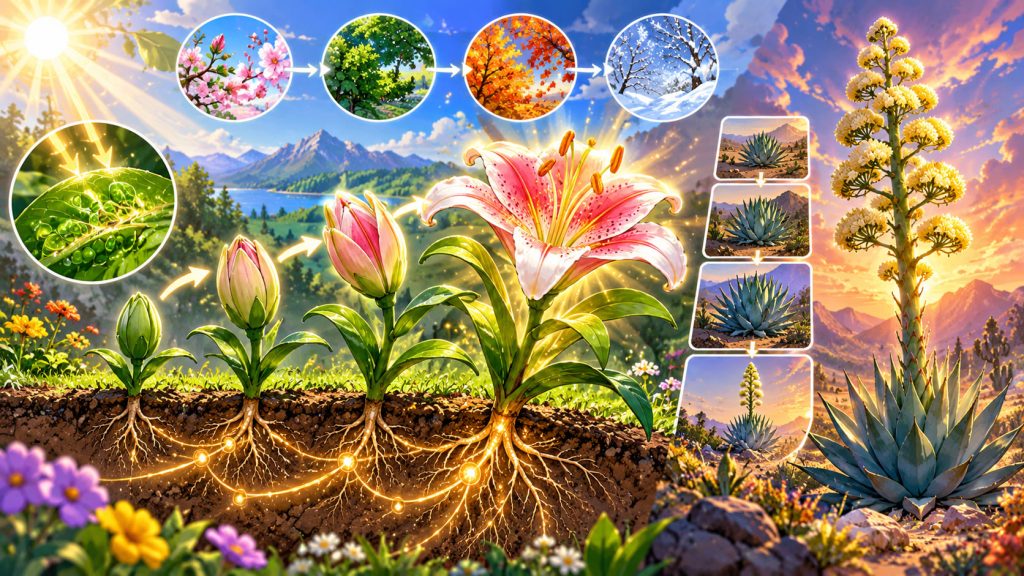
Flowering is one of the most important transitions in a plant’s life. A plant may spend months, years, or even decades producing roots, stems, and leaves before suddenly directing enormous amounts of energy toward flowers.
For common garden plants, this transformation can happen every spring or summer. Other species behave very differently. Some orchids, desert plants, palms, and giant tropical species may wait years between flowering events, while certain plants bloom only once in their entire lives.
The timing of flowering is controlled by a combination of genetics, plant age, temperature, daylight, water, nutrients, and stored energy.
How a Plant Begins to Flower
Before flowering, most plants are in a vegetative stage. Their growing tips mainly produce leaves and stems.
When the correct internal and environmental signals appear, a growing point can transform into a floral meristem. Instead of producing ordinary leaves, this specialized tissue begins forming the structures that will become sepals, petals, stamens, and reproductive organs.
This transition is a major developmental decision.
Once a flower bud begins forming, thousands of genes change their activity. Hormones and signaling molecules coordinate cell division, tissue growth, pigment production, scent formation, and the development of pollen and ovules.
A flower is therefore not simply a modified leaf cluster. It is the result of a carefully controlled developmental program.
Day Length Can Tell Flowers When to Bloom
Many plants monitor the changing length of day and night through photoperiodism.
Some species flower when days become longer in spring and early summer. Others respond to increasingly long nights and flower later in the season.
Chrysanthemums are a familiar example of plants strongly influenced by day length. Their flowering can be manipulated commercially by controlling how many hours of light and darkness they receive.
Plants detect these changes using light-sensitive proteins in their leaves.
When conditions are appropriate, leaves produce signals that travel toward growing points and trigger flower development.
The Flowering Signal Called Florigen
For decades, botanists suspected that leaves produced a mobile flowering signal. Research eventually identified proteins associated with this process, commonly described through the concept of florigen.
Florigen is produced in leaves when environmental conditions match the plant’s flowering requirements. It travels through vascular tissues toward the shoot tip, where it helps activate genes responsible for producing flowers.
This system allows plants to connect information about the outside world with developmental changes occurring elsewhere in the plant.
It also explains why leaves are important for flowering even though flowers themselves usually develop at growing tips.
Why Some Plants Need Winter Before Flowering
Temperature can be just as important as light.
Many plants require prolonged exposure to cold before they become capable of flowering. This process is called vernalization.
Tulips, many biennial plants, and numerous temperate species use cold exposure as a seasonal signal.
Without this mechanism, an unusually warm period during autumn could potentially trigger flowering immediately before winter, when flowers and developing seeds would be vulnerable to frost.
Vernalization helps ensure that flowering occurs after winter has genuinely passed.
Plants can effectively retain a molecular memory of cold exposure, allowing them to respond when warmer spring conditions arrive.
Plants Must Reach the Right Age
Even perfect weather cannot force every young plant to flower.
Many species must first pass through a juvenile stage. During this period, the plant is physiologically incapable of flowering regardless of environmental conditions.
Apple trees grown from seed, for example, may require several years before reaching reproductive maturity.
Large long-lived plants can remain juvenile for far longer.
During these years, they build leaves, roots, stems, and energy reserves. Flowering becomes possible only after the plant reaches a genetically determined developmental stage.
Why Flowering Requires So Much Energy
Producing flowers is expensive.
A flowering plant must manufacture petals, pigments, nectar, fragrances, pollen, and reproductive tissues. After successful pollination, it may also need to produce fruits and seeds.
All of this requires carbohydrates, minerals, and water.
Plants obtain energy through photosynthesis and store part of it in roots, stems, bulbs, rhizomes, or other tissues.
For plants that produce extremely large flowers or flower clusters, several years may be needed to accumulate enough stored resources for another reproductive event.
This helps explain why some spectacular species do not flower annually.
Why the Titan Arum Can Wait Years Between Blooms
The titan arum is one of the most famous examples of irregular flowering.
Native to the rainforests of Sumatra, it produces an enormous flower-like structure called an inflorescence. Rather than being one gigantic flower, the structure contains many small individual flowers.
The plant stores energy inside a massive underground corm.
After producing a large leaf, it spends months gathering energy through photosynthesis. The leaf eventually dies back, and the plant enters a resting period.
Only when sufficient energy has accumulated can another huge inflorescence develop.
As a result, a mature titan arum may bloom only once every several years.
Some Plants Flower Once and Then Die
An even more dramatic strategy occurs in monocarpic plants.
These plants reproduce only once during their lifetime. After flowering and producing seeds, the original plant dies.
Many agaves follow this strategy.
An agave may spend 10, 20, or even more years building a large rosette of leaves. Eventually, it produces a towering flowering stalk that can rise several meters above the plant.
The plant invests enormous amounts of stored energy into this single reproductive event.
After seed production, the main rosette dies, although some species may leave offsets that continue growing.
Certain palms and bromeliads also use this once-in-a-lifetime reproductive strategy.
Why Waiting Decades Can Be an Advantage
Delaying flowering may seem risky, but it can offer evolutionary advantages.
A large mature plant can often produce far more seeds than a young one. Waiting allows it to accumulate the resources required for an enormous reproductive effort.
Some species also use synchronous flowering, in which many individuals bloom during the same period.
This can overwhelm seed predators with more seeds than they can consume and may increase opportunities for pollination.
Certain bamboo species are famous for extremely long flowering intervals. Large populations may flower almost simultaneously after several decades.
The phenomenon shows how strongly flowering schedules can be controlled by inherited biological programs.
Environment Can Delay or Accelerate Flowering
Even genetically programmed flowering is influenced by environmental conditions.
Drought, extreme heat, nutrient shortages, or insufficient light can delay reproduction because a stressed plant may lack the resources required to produce flowers.
In other situations, environmental stress can accelerate flowering.
Some plants respond to deteriorating conditions by reproducing earlier, increasing the chance of producing seeds before conditions become lethal.
This balance between survival and reproduction is one of the fundamental challenges of plant life.
An Expert View of Flowering
Plant physiologists generally describe flowering as the result of multiple signals rather than a single biological switch.
Age, energy reserves, temperature, day length, hormones, and gene activity interact before a plant commits to reproduction.
This explains why two plants of the same species can flower at different times when grown under different conditions.
It also explains why gardeners cannot always force a reluctant plant to bloom simply by adding fertilizer or water. If the plant has not reached the correct developmental stage or received the necessary seasonal signals, flowering may remain impossible.
Flowers Are Carefully Timed Reproductive Systems
Flowering at the right moment can determine whether a plant successfully produces the next generation.
Plants that bloom every year often depend on predictable seasonal signals. Others invest years accumulating resources before producing an unusually large reproductive display.
Some wait decades and flower only once.
These strategies may look very different, but they serve the same biological purpose: producing offspring when the chances of successful pollination and seed development are greatest.
Interesting Facts
- A titan arum can produce one of the largest unbranched inflorescences in the plant kingdom.
- Many agaves spend years or decades growing before producing their only major flowering stalk.
- Some bamboo species can remain vegetative for decades before flowering across very large areas.
- Tulip bulbs begin preparing future flowers long before those flowers become visible above the soil.
- Commercial growers can manipulate flowering in certain plants by controlling artificial light and darkness.
- Some plants require both the correct day length and exposure to winter cold before flowering normally.
- Large flowering events can consume a substantial portion of a plant’s stored energy reserves.
Glossary
- Floral Meristem — Specialized growing tissue that develops into flowers instead of ordinary leaves and stems.
- Photoperiodism — A plant’s biological response to the relative length of day and night.
- Florigen — A mobile flowering signal produced mainly in leaves that helps trigger flower development.
- Vernalization — The process by which prolonged exposure to cold enables or promotes flowering.
- Inflorescence — A cluster or arrangement of multiple flowers growing together on a plant.
- Monocarpic — Describing a plant that flowers and produces seeds once before the main plant dies.
- Synchronous Flowering — Flowering that occurs at approximately the same time among many individuals of a species.