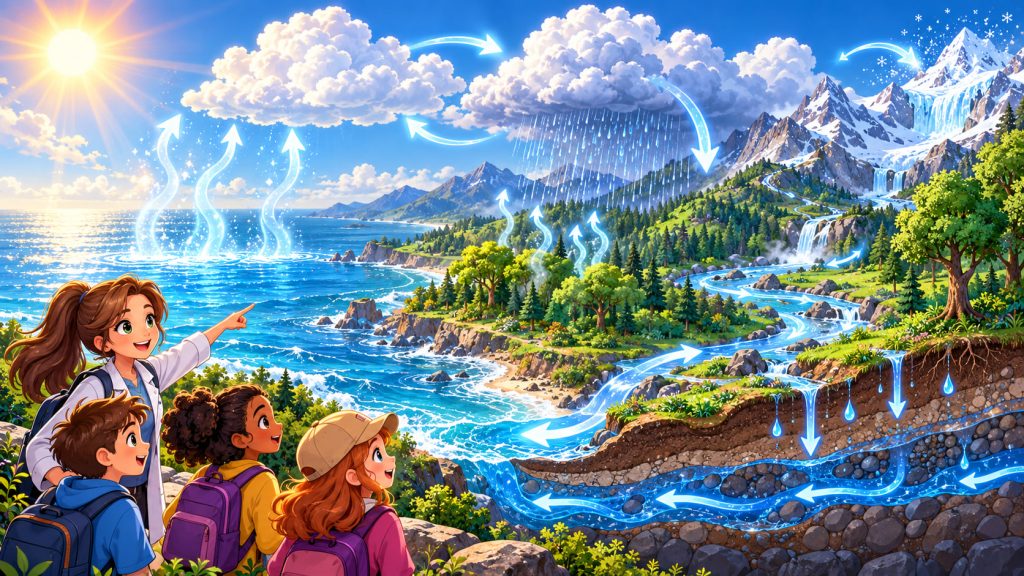
Water is constantly moving around our planet. The rain falling over a forest today may once have been part of an ocean, a glacier, a river, groundwater, or even the water vapor released by plants.
This continuous movement is known as the water cycle, or hydrological cycle. It connects oceans, clouds, rivers, soil, glaciers, groundwater, plants, animals, and the atmosphere into one enormous planetary system.
The water cycle does not create new water. It continuously transports and transforms the water already present on Earth.
Driven mainly by solar energy and gravity, this cycle plays a fundamental role in weather, climate, ecosystems, agriculture, and freshwater supplies.
Where Earth’s Water Is Stored
About 71% of Earth’s surface is covered by water, but most of it is salty.
Roughly 97% of the planet’s water is found in oceans and seas. Only a small fraction is freshwater, and much of that freshwater is locked in glaciers, ice sheets, or underground.
Rivers and lakes contain only a tiny proportion of Earth’s total water.
This means that the freshwater visible around us represents just a small part of the global system.
Scientists call places where water is stored reservoirs. Oceans are by far the largest reservoir, but the atmosphere, soil, lakes, glaciers, living organisms, and groundwater also store water for periods ranging from hours to thousands of years.
Evaporation Begins the Journey
Solar energy heats oceans, lakes, rivers, and wet ground.
Some liquid water molecules gain enough energy to escape into the atmosphere as water vapor. This process is called evaporation.
The oceans provide most of the water entering the atmosphere through evaporation because they cover such a large part of the planet.
Temperature, wind, humidity, and sunlight all influence evaporation rates.
Warm, dry, windy conditions generally accelerate evaporation, while cool and humid conditions slow it.
The Sun acts as the main energy source driving water from Earth’s surface into the atmosphere.
Plants Add Water Through Transpiration
Plants are also major participants in the water cycle.
Roots absorb water from soil and transport it through stems toward leaves. Tiny pores on leaf surfaces release some of this water into the atmosphere as vapor.
This process is called transpiration.
A large forest can release enormous quantities of water into the atmosphere.
Scientists often combine evaporation and transpiration into the term evapotranspiration because both processes transfer water from the land surface into the air.
Vegetation therefore does more than respond to rainfall. It actively influences humidity, cloud formation, and regional water movement.
How Clouds Form
Water vapor is invisible.
As warm, moist air rises, atmospheric pressure decreases and the air cools. Cooler air can hold less water vapor than warmer air.
Eventually, some vapor changes into tiny liquid droplets or ice crystals through condensation.
These droplets typically form around microscopic airborne particles such as dust, sea salt, or smoke.
Billions of tiny droplets and ice crystals together form clouds.
Clouds may remain suspended for hours or days while winds transport them across large distances.
Why Rain and Snow Fall
Cloud droplets are initially so small that air currents can keep them suspended.
As droplets collide and combine, they become larger. Ice crystals can also grow inside cold clouds.
Eventually, particles become heavy enough to fall under gravity.
Water returning from the atmosphere to Earth is called precipitation.
Precipitation can take several forms, including rain, snow, sleet, and hail.
Whether precipitation reaches the ground as rain or snow depends largely on atmospheric temperatures between the cloud and the surface.
What Happens After Rain Reaches the Ground
Rainwater does not follow only one route.
Some flows across the surface into streams, rivers, lakes, and eventually oceans. This movement is called surface runoff.
Runoff is especially rapid on steep slopes, saturated ground, frozen soil, or urban surfaces such as roads and concrete.
Vegetated soil usually slows water down.
Plant roots, leaf litter, and porous soil allow more water to enter the ground instead of immediately running away.
This difference is one reason healthy landscapes can reduce erosion and moderate some flood risks.
Water Can Travel Underground
Some precipitation penetrates the soil through infiltration.
Once underground, water can move deeper through pores and cracks in soil and rock.
When it reaches zones where available spaces are saturated with water, it becomes part of groundwater.
Groundwater is one of humanity’s most important freshwater resources.
It can move extremely slowly compared with rivers. Some groundwater remains underground for decades, centuries, or much longer before returning to the surface.
Underground water-bearing layers capable of storing and transmitting useful quantities of water are known as aquifers.
Cities and agricultural regions around the world pump water from aquifers for drinking and irrigation.
Rivers Connect Land to the Oceans
Water flowing across and beneath the land eventually collects into streams and rivers.
River systems transport water downhill under gravity.
The entire area draining toward a particular river, lake, or other outlet is called a watershed.
A watershed can be tiny or enormous.
The Amazon River basin, for example, drains a vast part of South America and carries more water than any other river system on Earth.
Rivers eventually return much of the water received over land to the oceans, completing one major pathway through the global water cycle.
Snow and Glaciers Can Store Water for Centuries
Not all precipitation quickly returns to rivers or oceans.
In sufficiently cold regions, snow may survive through summer and accumulate over many years.
Compacted snow can eventually become glacial ice.
Glaciers and ice sheets represent long-term freshwater storage.
When ice melts, water can enter streams and rivers. Mountain snowpack is particularly important because it acts as a seasonal natural reservoir in many regions.
Snow accumulates during colder months and releases water during warmer seasons when ecosystems, farms, and cities may need it most.
Water Can Skip the Liquid Stage
Water does not always move from ice to liquid before entering the atmosphere.
Ice and snow can transform directly into water vapor through sublimation.
This process occurs particularly under cold, dry, sunny, or windy conditions.
The reverse process can also happen when water vapor changes directly into ice.
Although sublimation contributes less water globally than ocean evaporation, it can be important in snowy mountains and polar environments.
The Water Cycle Influences Climate
The water cycle and climate are closely linked.
Water vapor is an important greenhouse gas, while clouds can both cool and warm the planet depending on their altitude, thickness, location, and other properties.
Water also transfers heat.
When liquid water evaporates, it absorbs energy. When vapor later condenses, that energy is released into the atmosphere.
This latent heat is one of the energy sources driving storms, thunderstorms, and tropical cyclones.
Hydrologists and climate scientists emphasize that the water cycle should be understood as a connected system rather than a simple circular diagram. Water can move along many different routes and remain in different reservoirs for dramatically different lengths of time.
Climate Change Is Intensifying Parts of the Cycle
A warmer atmosphere can contain more water vapor.
Higher temperatures also increase evaporation in many environments.
As the climate warms, this can intensify parts of the water cycle, contributing to heavier precipitation in some places while increasing drying and drought risks elsewhere.
Snow may melt earlier, glaciers can retreat, and the timing of river flows can change.
The total amount of water on Earth remains broadly constant, but where that water is stored, when it moves, and how quickly it circulates can change significantly.
Humans Are Now Part of the Water Cycle
People alter water movement on enormous scales.
Dams store river water. Irrigation transfers water onto agricultural land. Cities create impermeable surfaces that increase runoff. Groundwater pumping moves water from aquifers to the surface.
Deforestation can reduce transpiration and alter regional moisture recycling.
Humans also return water to the atmosphere through agriculture, reservoirs, cooling systems, and other activities.
Understanding these changes is increasingly important because human societies depend on the same water cycle that supports natural ecosystems.
Interesting Facts
- Most of Earth’s water is stored in the oceans rather than in rivers, lakes, or the atmosphere.
- Atmospheric water represents only a tiny fraction of Earth’s total water supply.
- Water molecules can travel thousands of kilometers through the atmosphere before returning as precipitation.
- Forests can recycle significant amounts of water back into the atmosphere through transpiration.
- Groundwater can remain underground for thousands of years.
- Snowpacks act as natural seasonal water-storage systems in many mountain regions.
- Water vapor releases heat when it condenses, helping power major storms.
- A single water molecule may repeatedly move between ocean, atmosphere, land, living organisms, and underground reservoirs over geological time.
Glossary
- Reservoirs — Places where water is stored within the Earth system, including oceans, glaciers, lakes, soil, and groundwater.
- Evaporation — The transformation of liquid water into water vapor.
- Transpiration — The release of water vapor from plants, mainly through pores in their leaves.
- Evapotranspiration — The combined transfer of water to the atmosphere through evaporation and plant transpiration.
- Condensation — The transformation of water vapor into liquid droplets.
- Precipitation — Water falling from the atmosphere as rain, snow, sleet, hail, or similar forms.
- Surface Runoff — Water that flows across the land surface toward rivers, lakes, or oceans.
- Infiltration — The movement of surface water into soil and underlying ground.
- Groundwater — Water stored beneath Earth’s surface in saturated soil and rock.
- Aquifers — Underground layers of permeable rock or sediment capable of storing and transmitting groundwater.
- Watershed — An area of land from which water drains toward a common river, lake, or outlet.
- Sublimation — The direct transformation of ice or snow into water vapor without first becoming liquid.
- Latent Heat — Energy absorbed or released when water changes phase without an immediate change in temperature.