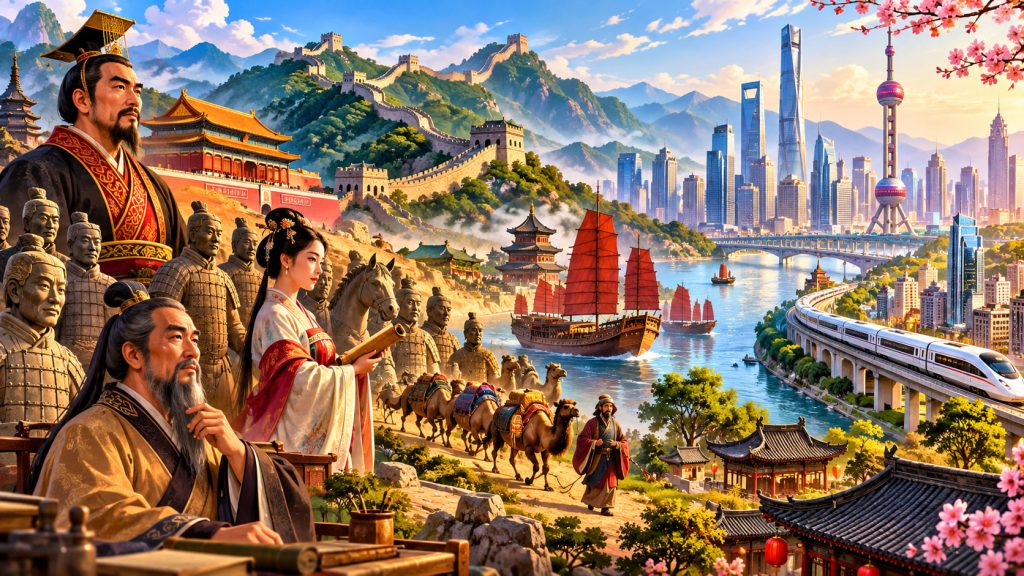
China is one of the world’s oldest continuous civilizations and one of its most influential modern states. Its history stretches across thousands of years, from early agricultural societies along the Yellow River to imperial dynasties, revolutionary upheaval, rapid industrialization, and the emergence of a major technological and economic power.
Modern China cannot be understood without its past. Ideas about centralized government, education, family, trade, agriculture, engineering, and social order developed over centuries and continue to influence the country today.
China’s transformation is remarkable because ancient cultural continuity exists alongside some of the fastest economic and technological change in modern history.
The Origins of Chinese Civilization
Early complex societies developed in several regions of what is now China.
The Yellow River basin became especially important because fertile soils supported agriculture and increasingly large settlements. Millet was a major northern crop, while rice cultivation developed extensively farther south.
The Shang dynasty, which flourished during the second millennium BCE, left some of the earliest surviving Chinese writing on oracle bones.
These inscriptions demonstrate that writing, political authority, warfare, ritual, and ancestor worship were already highly developed.
The following Zhou dynasty introduced the influential concept of the Mandate of Heaven, according to which rulers maintained legitimacy only while governing successfully and morally.
This idea helped explain why one dynasty could replace another without completely rejecting the concept of monarchy itself.
The First Imperial Unification
In 221 BCE, Qin Shi Huang unified rival states and became the first emperor of a centralized Chinese empire.
The Qin dynasty was short-lived but enormously influential.
It standardized important elements of administration, measurements, currency, roads, and writing practices. Large construction projects linked and expanded earlier defensive walls that would eventually contribute to what is known as the Great Wall.
The Qin also developed a highly centralized system of bureaucracy, in which officials administered territories on behalf of the emperor.
The famous Terracotta Army near Xi’an was created to guard Qin Shi Huang’s enormous burial complex and remains one of the most extraordinary archaeological discoveries in China.
The Han Dynasty and the Silk Road
The Han dynasty, lasting from 206 BCE to 220 CE with a short interruption, became one of the defining periods of Chinese history.
Imperial institutions expanded, agriculture developed, and long-distance trade became increasingly important.
Trade routes collectively remembered as the Silk Road connected China with Central Asia and indirectly with regions much farther west.
Silk was one famous export, but the routes carried much more than merchandise. Technologies, religions, artistic styles, crops, and ideas also moved between civilizations.
The Han era became so culturally influential that the majority ethnic group in China today is known as Han Chinese.
Confucianism and the Chinese State
One of China’s most influential thinkers was Confucius, who lived during the sixth and fifth centuries BCE.
His teachings emphasized moral responsibility, education, social relationships, ritual, and ethical government.
Over time, Confucianism became deeply connected with imperial administration and education.
Officials were increasingly expected to demonstrate knowledge of classical texts. Under later dynasties, competitive examinations became an important route into government service.
The civil service examination system was imperfect and accessible mainly to educated men, but it created a powerful tradition in which scholarship could influence political status.
Historians of imperial China often emphasize that this educated administrative elite helped provide institutional continuity even as individual dynasties rose and fell.
China’s Great Technological Contributions
Imperial China produced numerous innovations that influenced world history.
Paper was developed in ancient China and dramatically improved the recording and distribution of information. Printing technologies later made books more widely available.
Gunpowder transformed warfare, while the magnetic compass became essential to navigation.
Chinese engineers also made major advances in metallurgy, hydraulics, agriculture, ceramics, mechanical devices, and astronomical observation.
During parts of the Song dynasty, which ruled from 960 to 1279, China possessed some of the most commercially advanced cities and productive industries in the world.
Paper money, extensive trade networks, iron production, and urban markets reflected a highly sophisticated economy.
Mongol Rule and the Ming Dynasty
In the thirteenth century, Mongol armies conquered China.
Kublai Khan established the Yuan dynasty, integrating China into the enormous Mongol-controlled networks stretching across Eurasia.
The later Ming dynasty restored native Chinese rule in 1368.
During the early fifteenth century, the admiral Zheng He commanded enormous maritime expeditions across Southeast Asia and the Indian Ocean.
His fleets reached ports in South Asia, Arabia, and East Africa.
The Ming period also saw major reconstruction of the Great Wall and the development of the Forbidden City in Beijing, which became the imperial palace complex.
The Qing Dynasty and Growing Foreign Pressure
The Qing dynasty, established by the Manchus in the seventeenth century, became China’s last imperial dynasty.
At its height, Qing territory expanded significantly, while the population grew dramatically.
During the nineteenth century, however, China faced severe internal and external pressures.
The Opium Wars against Britain exposed major military weaknesses. Foreign powers gained commercial privileges and control over important treaty ports.
The Taiping Rebellion, one of the deadliest civil conflicts in history, devastated large areas of the country.
This period is closely associated in Chinese historical memory with foreign intervention and the erosion of sovereignty.
The End of Imperial China
In 1911, revolutionary movements brought down the Qing dynasty.
The Republic of China was established the following year, ending more than two thousand years of imperial political tradition.
The new republic struggled with political fragmentation, regional military leaders, foreign pressure, and competing political movements.
China later endured a prolonged conflict between the Nationalist government and the Chinese Communist Party, as well as a devastating invasion by Japan.
After the end of World War II, civil war resumed.
In 1949, Mao Zedong proclaimed the People’s Republic of China after Communist forces gained control of mainland China.
Revolution and the Mao Era
The early People’s Republic radically transformed land ownership, industry, education, and political institutions.
The government attempted rapid industrial and agricultural transformation through the Great Leap Forward beginning in the late 1950s.
The program contributed to catastrophic economic disruption and famine.
During the Cultural Revolution beginning in 1966, political campaigns targeted officials, intellectuals, traditional culture, and institutions across the country.
Schools and universities were disrupted, cultural objects were destroyed, and millions of people experienced persecution or displacement.
Mao’s death in 1976 marked the end of an extraordinary and often deeply traumatic political era.
Economic Reform Changes China
Beginning in the late 1970s, China adopted major economic reforms associated with Deng Xiaoping.
The government gradually introduced market-oriented reforms while maintaining the political leadership of the Communist Party of China.
Farmers received greater control over agricultural production, private businesses expanded, foreign investment was encouraged, and special economic zones attracted international manufacturing.
Shenzhen became one of the most dramatic examples.
Once a relatively small settlement near Hong Kong, it developed into a major metropolis and technology center.
Over several decades, China experienced one of the fastest large-scale economic transformations in recorded history.
Hundreds of millions of people moved from rural areas into cities, industrial production expanded enormously, and living standards improved for a large share of the population.
China as the World’s Manufacturing Center
China became deeply integrated into global supply chains.
Factories produced electronics, machinery, clothing, household products, vehicles, industrial equipment, and countless components used by companies around the world.
Large ports such as Shanghai, Ningbo-Zhoushan, Shenzhen, and Guangzhou became crucial nodes in global trade.
China also built extensive infrastructure, including high-speed railways, highways, airports, ports, power plants, and modern urban transit systems.
Its high-speed rail network became the largest in the world.
Technology and Modern Chinese Industry
Modern China is no longer defined only by low-cost manufacturing.
The country has become a major competitor in electric vehicles, batteries, renewable energy equipment, telecommunications, artificial intelligence, drones, robotics, and advanced manufacturing.
Chinese companies play leading roles in solar-panel production and battery supply chains.
The country has also developed an ambitious space program.
Chinese missions have landed spacecraft on the Moon, returned lunar samples to Earth, explored Mars, and constructed the Tiangong space station.
These achievements reflect China’s increasing investment in research and development.
Urbanization and a Changing Society
One of the biggest changes in modern China has been urbanization.
Hundreds of millions of people have moved into towns and cities during the reform era.
Megacities such as Shanghai, Beijing, Shenzhen, Guangzhou, and Chongqing represent the scale of this transformation.
Urban lifestyles have changed patterns of employment, housing, education, transportation, and consumption.
At the same time, China faces significant challenges, including an aging population, regional inequality, environmental pressures, housing-market problems, and the need to balance economic growth with long-term sustainability.
China’s Political System Today
China is governed by the Communist Party of China within a highly centralized political structure.
The country does not operate a Western-style multiparty electoral system.
The state plays a major role in strategic industries, infrastructure, finance, technology policy, and long-term economic planning, although private companies remain important to employment and economic activity.
China’s political model therefore combines extensive government direction with large markets and significant private enterprise.
This combination has produced rapid development while also generating international debate about governance, civil liberties, economic policy, and the relationship between state authority and individual rights.
China’s Role in the Modern World
China today is one of the largest economies and trading nations in the world.
It is deeply connected with international markets and is a major buyer and seller of commodities, machinery, manufactured goods, and technology.
Through the Belt and Road Initiative, China has financed or supported infrastructure projects involving ports, railways, roads, energy, and other facilities in many countries.
China is also central to major global questions involving climate change, trade, technological competition, energy, security, and international diplomacy.
Its enormous population, industrial capacity, scientific investment, and historical depth mean that developments inside China increasingly have consequences far beyond its borders.
Interesting Facts
- Chinese writing has a documented history extending back more than three thousand years.
- The Terracotta Army includes thousands of life-sized figures created for the tomb complex of China’s first emperor.
- Paper, printing, gunpowder, and the magnetic compass were among China’s most influential historical technologies.
- The Grand Canal of China developed over centuries and remains one of the longest artificial waterways ever constructed.
- Zheng He’s fifteenth-century fleets sailed through large parts of the Indian Ocean decades before major European oceanic expansion.
- Shanghai is home to one of the world’s busiest container ports.
- China operates the world’s largest high-speed railway network.
- China has successfully returned samples from the Moon to Earth with robotic spacecraft.
- Shenzhen grew from a relatively small city into one of the world’s major technology and manufacturing centers within a few decades.
Glossary
- Mandate of Heaven — The traditional Chinese political concept that a ruler’s authority depended on successful and morally legitimate government.
- Bureaucracy — A system in which professional officials administer government institutions and territories.
- Silk Road — A network of ancient trade routes linking China with Central Asia and other parts of Eurasia.
- Confucianism — A philosophical and ethical tradition emphasizing education, relationships, morality, responsibility, and good government.
- Civil Service Examination — A competitive examination system historically used to select educated officials for imperial government.
- Sovereignty — The authority of a state to govern its territory and political affairs independently.
- Market-Oriented Reforms — Economic changes that expand the role of markets, private enterprise, competition, and investment.
- Global Supply Chains — International networks through which materials, components, manufacturing, transportation, and sales are organized.
- Research and Development — Scientific and technological work aimed at creating new knowledge, products, processes, or technologies.
- Urbanization — The growth of cities and the increasing share of a population living in urban areas.
- Belt and Road Initiative — China’s international infrastructure and economic cooperation program involving projects across numerous countries.