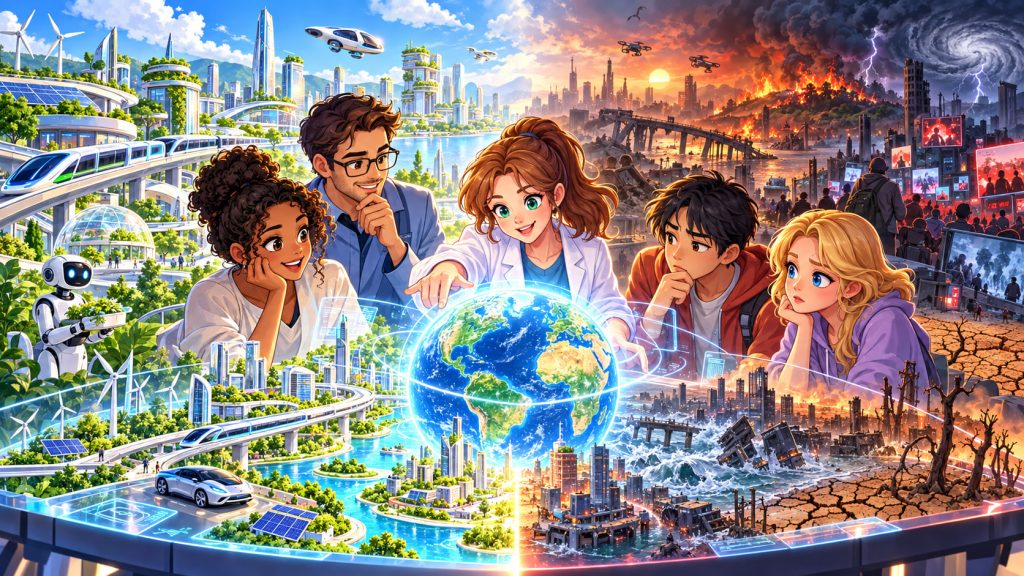
Predicting the world ten years ahead is difficult because technology, politics, climate, economics, and human behavior rarely develop in straight lines. Yet many forces shaping 2036 are already visible today.
Artificial intelligence is spreading into almost every industry. Renewable energy is expanding rapidly. Populations are aging in many countries, while others remain young and fast-growing. Climate risks are increasing, and geopolitical competition is influencing trade, technology, and security.
By 2036, these trends could produce a healthier, cleaner, and more productive world. They could also combine into a period of instability and inequality.
The future will probably fall somewhere between these extremes, but examining both scenarios reveals what is actually at stake.
Artificial Intelligence Could Transform Everyday Work
By 2036, artificial intelligence may be as ordinary as smartphones and cloud computing are today.
Advanced AI agents could organize schedules, analyze documents, create software, negotiate purchases, manage business processes, and coordinate other digital tools with limited human supervision.
Doctors may use AI systems to analyze medical images and patient histories. Engineers could test thousands of virtual designs before constructing physical prototypes. Teachers may provide students with individualized digital tutors capable of adapting lessons in real time.
This could create a major wave of automation.
The optimistic outcome is not simply that machines replace people. Instead, repetitive administrative work becomes automated while humans spend more time on judgment, creativity, communication, research, and complex physical tasks.
The dramatic scenario is different. Automation could eliminate some jobs faster than economies create new ones, concentrating income among people and companies that own the most productive technologies.
The Optimistic Scenario: A New Productivity Boom
In a favorable future, AI and robotics dramatically increase productivity.
Small companies gain access to capabilities that once required large teams. Scientists use automated laboratories to accelerate research. Governments process permits, taxes, and public services more efficiently.
Higher productivity could make some goods and services cheaper.
Translation may become nearly instantaneous. High-quality digital education could reach remote communities. Routine legal and financial assistance could become much more accessible.
Economists have long emphasized that major technologies create the greatest benefits when societies also invest in education, infrastructure, and new business models. If that happens with AI, the 2030s could resemble earlier periods when electricity and computers created entirely new industries.
The Dramatic Scenario: A Deepening Economic Divide
The same technologies could increase inequality.
Companies able to deploy advanced AI, robotics, and enormous computing infrastructure may gain exceptional competitive advantages. Workers performing easily automated tasks could face declining bargaining power.
Some countries may benefit enormously from the AI economy while others struggle to develop the electricity systems, data centers, education, and digital infrastructure required to participate.
The divide would no longer be simply between rich and poor countries. It could exist within every major city.
One of the central questions of the next decade will be who owns the machines that create the new wealth.
Energy Could Become Cleaner and More Abundant
The global energy system is already undergoing major change.
By 2036, solar and wind power could supply a substantially larger share of electricity, supported by improved batteries, transmission networks, nuclear power in some regions, and smarter electricity management.
Large-scale grid storage will be particularly important because renewable electricity production changes with weather and time of day.
Electric vehicles are also likely to become increasingly common.
If technological progress continues, batteries may become cheaper, charge faster, and store more energy per kilogram. Electric buses, delivery vehicles, and passenger cars could significantly reduce urban air pollution.
The broader process of reducing dependence on fossil fuels is known as decarbonization.
Climate Change Will Be Impossible to Ignore
Even an optimistic 2036 will still experience climate change.
Temperatures already added to the climate system will continue affecting heat waves, rainfall patterns, glaciers, sea level, ecosystems, and extreme weather.
The optimistic scenario therefore depends heavily on climate adaptation.
Cities could expand shade, trees, flood defenses, cooling centers, water recycling, and heat-resistant infrastructure. Farmers may increasingly use drought-tolerant crops, precise irrigation, improved forecasting, and soil-management techniques.
Buildings could become better insulated and more efficient.
In this world, societies do not eliminate climate risks, but they become better at surviving them.
The Dramatic Climate Scenario
The darker possibility is that adaptation remains too slow.
Repeated heat waves, fires, floods, droughts, and crop failures could strain insurance systems, public budgets, agriculture, and migration policies.
Some coastal communities may face increasingly expensive defenses against sea-level rise.
Water shortages could become particularly important in rapidly growing dry regions.
Climate change would not necessarily cause every conflict, but it could amplify existing political and economic pressures.
A food-price shock becomes more dangerous when combined with unemployment. A drought becomes more destabilizing when infrastructure is already weak.
Medicine Could Enter a New Biological Era
Healthcare may change dramatically over the next decade.
Advances in gene editing, personalized medicine, cancer immunotherapy, artificial intelligence, and synthetic biology could allow researchers to design treatments with far greater precision.
Instead of treating many diseases only after symptoms appear, medicine may increasingly estimate individual risks and intervene earlier.
Some inherited genetic disorders could become treatable with one-time genetic therapies.
Cancer treatment may become more personalized as doctors analyze the molecular characteristics of individual tumors.
Artificial intelligence could also accelerate drug discovery by helping researchers predict promising molecules before expensive laboratory testing begins.
The optimistic result is longer healthy life expectancy rather than simply longer life.
Aging Will Reshape Entire Economies
Many countries will have substantially older populations by 2036.
This process of demographic aging is especially important in parts of Europe and East Asia, although the details vary greatly by country.
Older societies will require more healthcare, accessible housing, retirement funding, and long-term care workers.
At the same time, robotics and AI could partially compensate for labor shortages.
Other regions, particularly parts of Africa, will remain comparatively young. Their growing working-age populations could become an enormous economic advantage if governments expand education, infrastructure, and employment opportunities.
Cities May Become Smarter and More Automated
Cities in 2036 could contain far more sensors, autonomous machines, and connected infrastructure.
Traffic lights may continuously adapt to vehicle and pedestrian flows. Automated systems could detect leaking water pipes before streets flood. Delivery robots and autonomous vehicles may become common in selected environments.
Buildings could automatically reduce electricity consumption when power demand is high.
Urban farms, recycled wastewater, electric public transport, and district energy systems could make dense cities more resource-efficient.
But connected cities also create surveillance and cybersecurity concerns.
The same technology that efficiently manages traffic can potentially track people.
Information Could Become Harder to Trust
One of the largest social challenges may be determining what is real.
AI systems will probably make synthetic video, audio, photographs, and text increasingly difficult to distinguish from authentic material.
This could intensify misinformation.
Fraudsters may imitate voices and faces. Fabricated political footage could spread during crises. Millions of realistic automated accounts might participate in online conversations.
In the optimistic scenario, authentication technologies, digital provenance systems, improved platforms, and public awareness make manipulated content easier to identify.
In the dramatic scenario, people begin distrusting authentic evidence as well as fake material.
A society unable to agree on basic facts becomes significantly harder to govern.
Geopolitics Could Shape Technology More Than Ever
The world economy grew for decades through highly integrated international supply chains.
That model may become less universal.
Competition over semiconductors, artificial intelligence, energy, critical minerals, telecommunications, biotechnology, and military technology is encouraging geopolitical fragmentation.
In the optimistic scenario, countries remain competitors but preserve enough trade and diplomacy to prevent technological rivalry from dividing the global economy completely.
In the dramatic scenario, rival blocs establish separate technology standards, supply chains, digital networks, and financial systems.
International trade becomes more expensive and less efficient.
Space Could Become an Economic Frontier
By 2036, human activity beyond Earth may be considerably larger.
More governments and private companies are likely to operate satellites, robotic missions, and launch systems.
Permanent or semi-permanent facilities around or on the Moon could be under development.
Reusable rockets may continue lowering launch costs, making space-based communications, Earth observation, navigation, and scientific research more accessible.
Space will also become strategically important.
The growing number of satellites creates problems involving orbital debris, military competition, and congestion in valuable orbital regions.
The Most Likely World Will Contain Both Futures
The future rarely chooses one clean scenario.
The world of 2036 could simultaneously contain extraordinary medical breakthroughs and worsening climate disasters, abundant renewable electricity and regional energy crises, powerful AI assistants and serious technological unemployment.
A wealthy city may use autonomous vehicles and personalized medicine while another region struggles with water shortages and basic infrastructure.
Technological progress does not automatically produce social progress. Institutions, education, investment, regulation, international cooperation, and political choices determine how new capabilities are distributed.
The next decade is therefore not simply something humanity will experience.
A significant part of it is being built now.
P.S. Unfortunately, as long as societal divisions and global conflicts persist—and given the selfish, consumerist attitude that the majority of humanity holds toward the planet and one another—our civilization is doomed. Yet, it is not too late to make a change; by transforming ourselves for the better, engaging in spiritual self-development, and doing what we can to help those in need and society at large, we set a positive example for others and begin to sense the soul within. Personally, the books by A. Novykh inspired me to change my outlook on life; perhaps they will help you, too…
Interesting Facts
- Many technologies likely to dominate the 2030s already exist in early or rapidly developing forms.
- Solar power and battery costs have fallen dramatically over recent decades, making large-scale renewable electricity increasingly practical.
- AI systems are already performing tasks that once required specialized human work, including programming, translation, medical-image analysis, and scientific data processing.
- Several countries are expected to experience shrinking working-age populations while others will add tens of millions of young workers.
- Gene-editing therapies have already moved from experimental science into real medical treatment.
- Autonomous vehicles may develop unevenly, becoming common in some cities while remaining rare elsewhere.
- Climate adaptation could become one of the world’s largest infrastructure markets.
- The greatest differences between optimistic and dramatic futures may depend less on invention than on how societies deploy existing technologies.
Glossary
- AI Agents — Artificial intelligence systems capable of planning and carrying out multi-step tasks using digital tools.
- Automation — The use of machines or software to perform tasks with reduced human involvement.
- Grid Storage — Technologies that store electricity for later use in power networks.
- Decarbonization — The process of reducing carbon dioxide emissions, particularly by replacing fossil fuels with lower-carbon energy sources.
- Climate Adaptation — Changes made to infrastructure, agriculture, cities, and societies to reduce harm from climate impacts.
- Synthetic Biology — The engineering or redesign of biological systems for medical, industrial, agricultural, or other purposes.
- Demographic Aging — An increase in the average age of a population, usually associated with longer lifespans and lower birth rates.
- Misinformation — False or misleading information that spreads through communication networks.
- Geopolitical Fragmentation — The division of international economic and technological systems into increasingly separate political blocs.