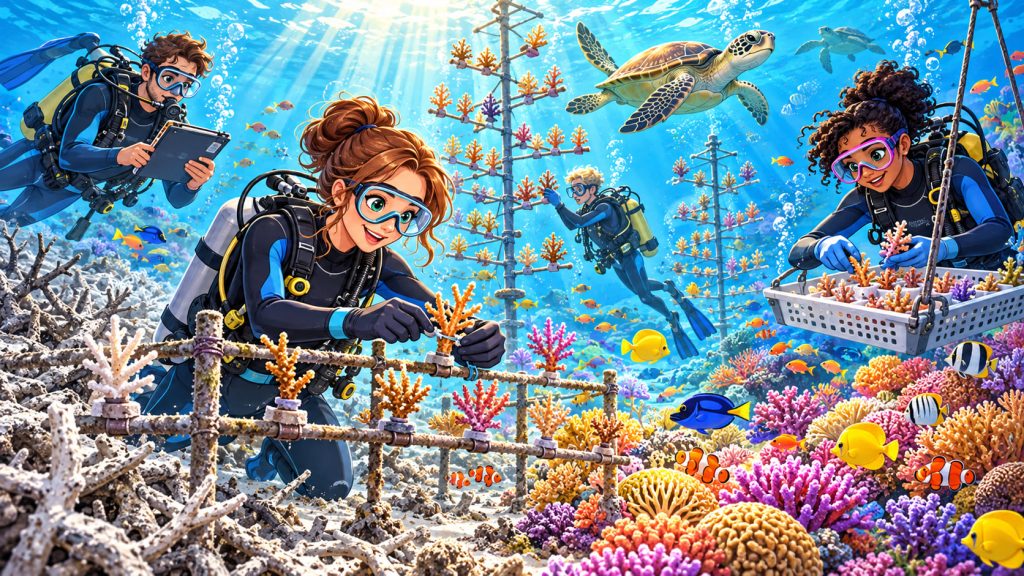
Beneath the surface of tropical oceans lies one of Earth’s most extraordinary ecosystems: coral reefs. These colorful underwater structures provide shelter for countless marine creatures, protect coastlines, and support millions of people who depend on fishing and tourism.
Yet coral reefs are disappearing at an alarming rate.
Rising ocean temperatures, pollution, destructive fishing practices, and disease have damaged reef ecosystems across the world.
Fortunately, scientists and conservation organizations are developing increasingly sophisticated methods to restore damaged reefs.
From underwater coral nurseries to laboratory-assisted reproduction, restoration projects are helping living corals return to degraded habitats.
Coral reef restoration is transforming marine conservation by combining biological science, innovative technology, and practical underwater work.
Why Coral Reefs Are So Important
Coral reefs occupy less than 1% of the ocean floor but provide habitat for an estimated quarter of marine species.
Despite resembling underwater plants or rocks, corals are animals.
Each coral colony consists of many tiny organisms called coral polyps.
These animals build protective calcium carbonate skeletons that gradually form enormous reef structures.
Coral reefs support:
- Fish and other marine wildlife
- Coastal protection from waves and storms
- Commercial and small-scale fisheries
- Tourism and recreation
- Scientific research and marine biodiversity
Healthy reefs also provide breeding grounds and shelter for numerous species.
When coral reefs disappear, entire marine communities can lose critical habitat.
What Is Destroying the World’s Coral Reefs?
One of the greatest threats is rising ocean temperature.
Corals live in close relationships with microscopic algae that provide much of their energy through photosynthesis.
When water temperatures become excessively high, this relationship can break down.
The resulting phenomenon is called coral bleaching.
Affected corals lose much of their characteristic color and become pale or white.
Bleaching does not necessarily mean immediate death.
However, prolonged heat stress can cause starvation, increased disease susceptibility, and widespread coral mortality.
Other threats include pollution, sediment runoff, destructive fishing, and coastal development.
Repeated marine heatwaves make recovery particularly difficult.
How Underwater Coral Nurseries Work
One of the most widely used restoration techniques involves establishing a coral nursery.
These underwater facilities allow conservation teams to grow coral fragments in relatively controlled conditions.
Divers collect suitable fragments, often from healthy donor colonies or naturally broken pieces.
The fragments are attached to ropes, suspended structures, or underwater frames.
They are then maintained until they become large enough for transplantation.
Restoration organizations regularly inspect nurseries, remove excess algae, and monitor coral health.
The Coral Restoration Foundation in Florida is well known for using underwater nurseries to grow threatened Caribbean coral species.
Coral nurseries function like underwater gardens, producing living colonies that can eventually be returned to damaged reefs.
Growing New Corals Through Fragmentation
Many reef-building corals can reproduce asexually when pieces of an existing colony continue growing independently.
Conservation teams use this biological ability through fragmentation.
Small pieces of healthy coral are separated and grown into new colonies.
This method is especially useful for certain branching species, including staghorn and elkhorn corals.
A single donor colony can provide material for multiple nursery-grown corals.
However, fragments originating from the same colony generally share the same genetic makeup.
For this reason, restoration projects must carefully manage the genetic composition of their nursery populations.
Microfragmentation: Accelerating Coral Growth
Some coral species grow slowly, making conventional restoration difficult.
Scientists have developed a technique called microfragmentation to address this challenge.
The method involves cutting certain massive corals into very small pieces.
Under suitable conditions, these fragments can grow and spread across prepared surfaces faster than larger colonies typically expand.
Fragments originating from the same genetic individual can also grow together after transplantation.
Marine biologist David Vaughan helped pioneer this technique while working at Mote Marine Laboratory in Florida.
Microfragmentation has expanded restoration possibilities for slow-growing corals that were previously difficult to propagate.
How Scientists Return Corals to Damaged Reefs
After corals develop sufficiently in nurseries, conservation divers begin outplanting.
This process involves attaching nursery-grown corals to suitable natural reef surfaces.
Divers first examine the restoration site.
They look for stable surfaces, appropriate water conditions, and manageable levels of sediment and algae.
Corals may be secured using specialized marine adhesives, cement, or other attachment systems.
The placement must be strong enough to withstand normal currents and wave activity.
After transplantation, conservation teams monitor survival, growth, and signs of disease.
Successful restoration requires more than placing corals underwater. The transplanted colonies must survive, reproduce, and contribute to a functioning ecosystem.
Rebuilding Reefs Through Coral Reproduction
Another promising technique involves collecting coral eggs and sperm during natural spawning events.
Many reef-building coral species reproduce sexually during seasonal mass spawning.
Scientists can collect reproductive material and support fertilization under controlled conditions.
The resulting larvae are raised until they can settle onto suitable surfaces.
This approach is known as larval propagation.
Researchers may introduce larvae onto prepared reef habitats or grow young corals on settlement substrates before transplantation.
Unlike cloning through fragmentation, sexual reproduction can produce genetically different offspring.
This makes larval propagation particularly valuable for rebuilding populations with broader genetic variation.
Why Genetic Diversity Matters
One of the biggest challenges in restoration is maintaining genetic diversity.
A reef populated by numerous genetically identical colonies may be vulnerable if all respond similarly to a disease or environmental stress.
Conservation organizations therefore try to preserve multiple genetic lineages.
Researchers also investigate whether certain coral populations possess greater tolerance to elevated temperatures.
These studies may help identify corals suitable for restoration in warming environments.
However, heat tolerance is complex and does not guarantee survival during extreme marine heatwaves.
Long-term restoration requires genetically diverse coral communities capable of adapting to changing environmental conditions.
Protecting the Ecosystem Around Restored Corals
Coral transplantation alone cannot repair every problem affecting a reef.
Water pollution, overfishing, and habitat destruction can undermine restoration efforts.
Conservation organizations therefore combine coral gardening with broader ecosystem protection.
Some projects operate within a marine protected area, where human activities are managed to support conservation objectives.
Protecting herbivorous fish is also important because these animals help control algae that can compete with corals.
Reducing wastewater pollution and sediment runoff improves environmental conditions for recovering reefs.
These measures contribute to reef resilience, the ability of a reef ecosystem to withstand disturbances and recover afterward.
Real Coral Restoration Projects Around the World
Several conservation programs demonstrate how different restoration strategies work.
Florida Keys, United States: The Coral Restoration Foundation and other organizations grow and transplant threatened corals while monitoring their survival.
Seychelles: Coral restoration initiatives have cultivated nursery-grown corals and transplanted them onto degraded reef areas, including projects around Cousin Island.
Great Barrier Reef, Australia: Researchers are testing larval restoration, coral aquaculture, and other approaches intended to support damaged reef habitats.
Indonesia: Reef restoration projects have used artificial structures and transplanted coral fragments to help recover degraded marine environments.
Each location requires techniques adapted to its ecological conditions.
Expert Perspective: Restoration Must Address Climate Change
Marine scientist Ove Hoegh-Guldberg has extensively studied how ocean warming affects coral reefs.
His research highlights the fundamental importance of reducing climate-related threats to reef ecosystems.
This scientific perspective is especially relevant to restoration.
Even successfully transplanted corals remain vulnerable when surrounding waters become dangerously warm.
Local restoration can rebuild coral cover and support biodiversity, but it cannot independently eliminate the effects of global ocean warming.
The strongest conservation strategy combines reef restoration with improved local environmental protection and reductions in greenhouse gas emissions.
The Future of Coral Reef Restoration
Scientists are developing new approaches to make restoration faster, more efficient, and more effective.
Automated underwater imaging can help researchers monitor coral colonies.
Artificial intelligence can assist with analyzing reef photographs and tracking changes over time.
Researchers are also testing improved nursery systems, selective breeding, and laboratory techniques for producing young corals.
These innovations could help restoration programs operate across larger areas.
However, restoring entire reef ecosystems remains much more complicated than growing individual coral colonies.
Long-term success depends on protecting environmental conditions, maintaining biodiversity, and supporting natural reproduction.
The future of coral conservation lies in combining advanced restoration techniques with healthier oceans.
Interesting Facts
- Coral reefs are built by tiny animals rather than plants.
- Some coral species can reproduce both sexually and asexually.
- Certain corals release eggs and sperm during synchronized spawning events.
- Coral nurseries can grow fragments on suspended ropes, frames, and underwater structures.
- Microfragmentation can accelerate the growth of suitable slow-growing coral species.
- Some corals contain fluorescent proteins that produce striking colors under particular lighting conditions.
- Herbivorous reef fish help control algae that might otherwise compete with corals.
- Restoration teams may monitor transplanted colonies for years to evaluate their survival and growth.
Glossary
- Coral Polyp — A small marine animal that forms part of a coral colony and can contribute to building its skeleton.
- Coral Bleaching — A stress response in which corals lose their symbiotic algae or associated pigments, causing them to become pale.
- Coral Nursery — An underwater or land-based facility used to grow corals for research, conservation, or transplantation.
- Fragmentation — A method of coral reproduction or propagation in which pieces of a colony develop into separate colonies.
- Microfragmentation — A restoration technique that uses very small coral fragments to encourage relatively rapid growth.
- Outplanting — The process of transferring cultivated corals from nurseries to natural reef habitats.
- Larval Propagation — The production and cultivation of young corals from sexually reproduced larvae.
- Genetic Diversity — The variety of genetic characteristics present within a population.
- Marine Protected Area — A designated marine region managed to conserve natural resources, ecosystems, or biodiversity.
- Reef Resilience — The ability of a coral reef ecosystem to resist disturbances, recover from damage, and maintain ecological functions.