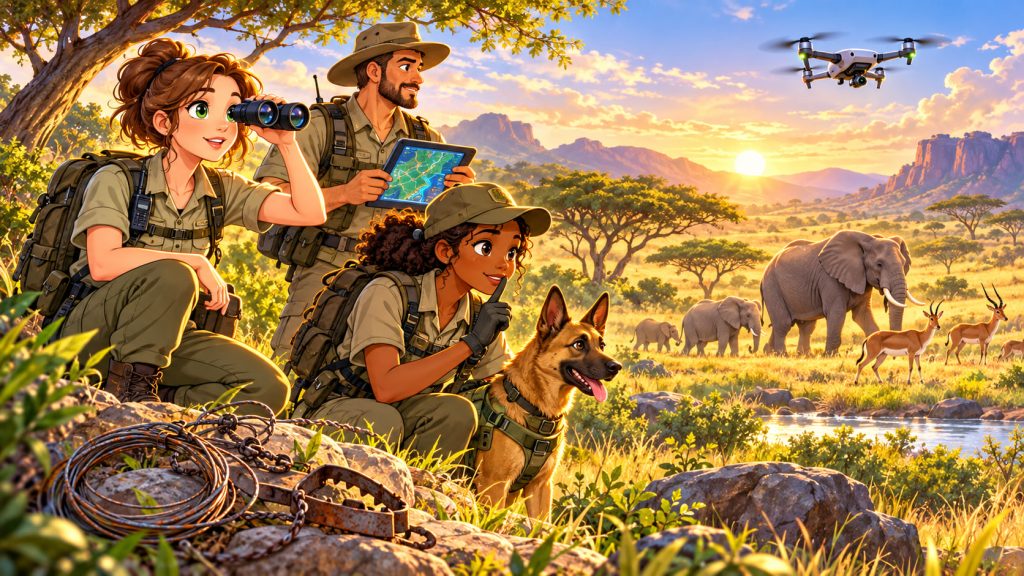
Deep inside a national park, a team of wildlife rangers begins its patrol before sunrise. Their mission is not simply to observe animals or guide tourists. They are protecting some of the planet’s most vulnerable species from illegal hunting and wildlife trafficking.
Across Africa, Asia, and other regions, rangers patrol forests, grasslands, mountains, and wetlands to prevent poaching and protect endangered animals.
Their work can be physically demanding, dangerous, and emotionally challenging.
Yet modern wildlife protection has evolved far beyond traditional patrols.
Today, rangers use satellite navigation, camera traps, drones, forensic investigations, and community partnerships to defend wildlife.
Wildlife rangers are among the most important frontline defenders of biodiversity, combining practical field experience with modern conservation technology.
Why Is Poaching Such a Serious Threat?
Poaching refers to the illegal hunting, capturing, or killing of wild animals.
Its consequences extend far beyond individual animals.
Poaching can reduce already vulnerable populations, disrupt breeding patterns, and destabilize entire ecosystems.
Some animals are targeted because their body parts command high prices in illegal markets.
Common targets include:
- Elephants hunted for ivory
- Rhinoceroses targeted for their horns
- Pangolins captured for their scales and meat
- Tigers killed for skins and other body parts
- Certain birds and reptiles captured for illegal trade
Other animals are illegally hunted for meat or caught in traps intended for different species.
Wildlife trafficking creates international demand for illegally obtained animals and wildlife products.
Protecting endangered species therefore requires action both inside protected habitats and against the criminal networks involved in illegal trade.
What Do Wildlife Rangers Actually Do?
Rangers are responsible for much more than confronting poachers.
Their responsibilities vary depending on the country, conservation organization, and legal authority.
Typical duties include monitoring wildlife populations, checking animal health, protecting habitats, documenting illegal activity, and assisting conservation researchers.
A central responsibility is conducting an anti-poaching patrol.
Rangers travel through protected areas on foot, by vehicle, by boat, or sometimes on horseback.
They inspect vulnerable habitats, investigate suspicious activity, and look for signs of illegal hunting.
In some countries, specially authorized ranger units also perform law-enforcement duties.
Their presence can discourage poaching and help authorities respond to incidents before further damage occurs.
How Rangers Detect Poachers in Vast Wilderness Areas
National parks can cover thousands of square kilometers.
Monitoring every location continuously is practically impossible.
Rangers therefore combine field knowledge with information about wildlife movements and previous illegal activity.
They may identify tracks, disturbed vegetation, abandoned equipment, or other signs of human intrusion.
Modern patrol teams also use GPS tracking to navigate remote landscapes and document where inspections have occurred.
Recorded information helps conservation managers identify vulnerable areas and organize future patrol coverage.
A widely used conservation system is the Spatial Monitoring and Reporting Tool (SMART).
It allows trained personnel to collect, organize, and analyze information from wildlife protection activities.
The purpose is to make ranger patrols more systematic, accountable, and effective.
Removing Deadly Traps from Wildlife Habitats
One of the most dangerous threats to wildlife is the snare.
A snare is a loop of wire, rope, or another material designed to catch an animal.
These traps are often inexpensive and difficult to detect.
They can seriously injure or kill animals, including species that were never the intended target.
Antelopes, elephants, lions, and other mammals can become trapped in illegally placed snares.
Rangers regularly inspect vulnerable habitats and remove traps when they find them.
Injured animals may require assistance from veterinarians or specialized wildlife rescue teams.
Removing snares is particularly important because an abandoned trap can remain dangerous long after the person who installed it has disappeared.
How Drones and Camera Traps Help Protect Animals
Technology has transformed wildlife monitoring.
A camera trap is a remotely positioned camera that automatically captures images or videos when triggered by movement or other sensors.
Camera traps help conservation teams observe animals without constantly disturbing them.
They can also reveal unauthorized human activity.
In some protected areas, thermal imaging equipment detects differences in heat radiation, allowing operators to observe warm objects under suitable conditions.
Drones can survey difficult terrain, assess habitat conditions, and support authorized monitoring operations.
However, technology has limitations.
Dense vegetation, weather, battery life, equipment costs, and communication coverage can reduce its effectiveness.
Technology is most valuable when it supports trained rangers rather than attempting to replace their experience.
Protecting Rhinos and Elephants in Africa
African elephants and rhinoceroses are among the best-known targets of wildlife poaching.
Elephants are illegally killed for ivory, while rhinos are targeted for their horns.
Rhino horns consist primarily of keratin, the same type of structural protein found in human hair and nails.
Organizations protecting rhinoceroses often combine patrols, animal monitoring, veterinary care, and cooperation with law-enforcement agencies.
At Kenya’s Ol Pejeta Conservancy, wildlife protection teams help safeguard endangered rhinoceroses through monitoring and security operations.
In South Africa’s Kruger National Park, anti-poaching efforts involve trained rangers and cooperation among multiple conservation and security authorities.
These efforts demonstrate that protecting high-risk species requires continuous work rather than occasional emergency interventions.
Working With Local Communities
One of the most important developments in conservation is community-based conservation.
This approach recognizes that people living near wildlife habitats must be included in efforts to protect them.
Communities may face crop damage, livestock losses, restricted access to resources, or economic hardship.
Conservation programs can address these challenges through employment, education, tourism income, and support for sustainable livelihoods.
Local residents can also provide valuable knowledge about wildlife movements and environmental changes.
However, successful cooperation depends on respecting community rights and distributing conservation benefits fairly.
Wildlife protection is more sustainable when local people have meaningful reasons and opportunities to participate.
Expert Perspective: Conservation Must Include People
Renowned primatologist Jane Goodall has long emphasized the relationship between wildlife conservation and the well-being of local communities.
Her work helped inspire community-centered conservation programs that connect environmental protection with education, livelihoods, and responsible resource management.
This approach recognizes that lasting conservation success cannot depend entirely on enforcement.
People living alongside wildlife must also benefit from healthy ecosystems.
For rangers, strong relationships with surrounding communities can improve cooperation, communication, and long-term protection.
What Happens When Rangers Discover Poaching?
When rangers encounter evidence of illegal hunting, their response depends on local laws, operational procedures, and the level of danger.
They may document the location, preserve relevant materials, report the incident, and request support from authorized law-enforcement personnel.
Evidence can include abandoned equipment, photographs, biological samples, or other legally collected materials.
Wildlife forensics allows specialists to examine physical and biological evidence connected to wildlife crimes.
DNA analysis can sometimes help identify species, investigate animal origins, or connect seized wildlife products with broader criminal investigations.
These methods strengthen legal cases and support efforts to disrupt illegal trafficking.
The Personal Risks Rangers Face
Wildlife protection can be dangerous.
Rangers may encounter armed criminals, aggressive animals, difficult terrain, extreme weather, and tropical diseases.
Remote working conditions can also make emergency medical assistance difficult.
Professional training, protective equipment, reliable communications, and appropriate emergency procedures are therefore essential.
Rangers also need fair compensation, adequate rest, and psychological support.
Their work depends on long-term institutional investment, not simply personal courage.
The Future of Anti-Poaching Protection
Modern conservation increasingly combines technology, scientific research, professional ranger training, and stronger cooperation between institutions.
Artificial intelligence can help researchers analyze large quantities of camera-trap photographs and identify patterns in wildlife observations.
Satellite imagery can reveal habitat changes, while improved monitoring systems can support better management of protected areas.
Protecting habitat corridors is another important priority.
These natural connections allow animals to move between suitable habitats, find mates, and maintain healthier populations.
The future of wildlife protection depends on defending animals, preserving their habitats, and addressing the economic and social forces behind poaching.
Interesting Facts
- Rhino horns are made primarily of keratin rather than bone.
- Elephant tusks are enlarged incisor teeth that continue growing during much of an elephant’s life.
- Camera traps can monitor elusive animals such as snow leopards and tigers without requiring continuous human presence.
- Pangolins are the only living mammals covered in large, overlapping keratin scales.
- Wire snares can injure animals that were never targeted by the people who set them.
- Some wildlife protection teams use specially trained detection dogs to help locate illegal wildlife products.
- Rangers also contribute to scientific research by recording animal sightings, habitat conditions, and signs of disease.
- Satellite navigation and digital patrol records help conservation managers evaluate protection activities across large landscapes.
Glossary
- Poaching — The illegal hunting, capturing, or killing of wild animals.
- Wildlife Trafficking — The illegal trade, transportation, or sale of wild animals and wildlife products.
- Anti-Poaching Patrol — A field operation intended to detect, prevent, or respond to illegal hunting and related activities.
- GPS Tracking — The use of satellite-based positioning technology to record locations and movements.
- Spatial Monitoring and Reporting Tool (SMART) — A digital system used to organize and analyze conservation monitoring and patrol information.
- Snare — A trapping device, often consisting of a wire or rope loop, used to capture animals.
- Camera Trap — A remotely installed camera that automatically records wildlife or human activity when triggered.
- Thermal Imaging — Technology that detects infrared radiation to create images based on temperature differences.
- Community-Based Conservation — An approach that involves local communities in managing and protecting natural resources.
- Wildlife Forensics — The use of scientific techniques to examine evidence associated with crimes involving wildlife.
- Habitat Corridor — A natural or managed connection between habitats that allows wildlife to move between them.