
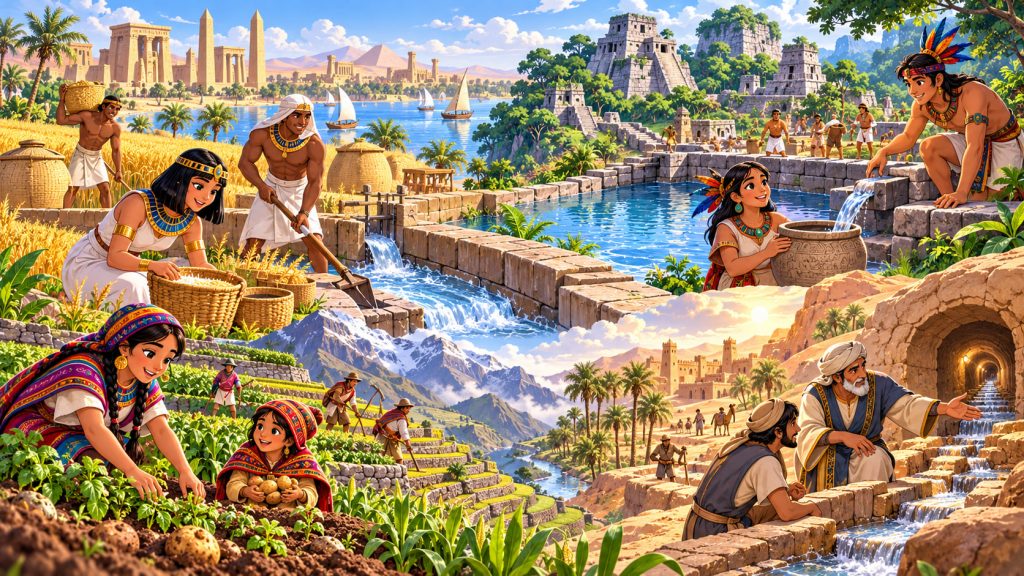
Thousands of years before modern climate science, ancient civilizations faced a challenge that remains familiar today: surviving unpredictable environmental changes.
Prolonged droughts, devastating floods, changing rainfall patterns, and shifting temperatures threatened agriculture, water supplies, and entire cities.
Without satellites, weather forecasts, or modern engineering equipment, ancient societies developed remarkable strategies to survive.
They built irrigation networks, stored food, constructed reservoirs, modified agricultural landscapes, and sometimes relocated entire communities.
Some civilizations successfully adapted for centuries. Others experienced political upheaval, population decline, or major transformations.
The history of ancient climate adaptation reveals that human survival has always depended on understanding environmental change and finding practical ways to respond.
How Did Ancient People Recognize Climate Change?
Ancient civilizations did not understand atmospheric science as modern researchers do.
However, they carefully observed seasonal patterns, river levels, rainfall, and agricultural conditions.
Over generations, communities accumulated valuable environmental knowledge.
Scientists call changes in weather patterns across years, decades, and centuries climate variability.
Researchers reconstruct ancient environmental conditions through paleoclimate evidence preserved in tree rings, lake sediments, glaciers, and cave formations.
These records reveal periods of severe drought, unusually intense rainfall, and long-term temperature changes.
Ancient societies faced natural climate fluctuations, while today’s rapid global warming is primarily driven by human greenhouse gas emissions.
Ancient Egypt: Surviving the Unpredictable Nile
Ancient Egyptian civilization depended on the annual flooding of the Nile River.
Seasonal floods deposited fertile sediment onto agricultural land, supporting the cultivation of wheat, barley, and other crops.
However, insufficient flooding could cause crop failures and food shortages.
Excessively high floods could destroy settlements and agricultural infrastructure.
Egyptians developed sophisticated methods of irrigation, using canals, basins, and embankments to manage river water.
They also monitored river levels and maintained grain storage facilities.
Stored grain could provide a reserve during difficult agricultural periods.
Around 2200 BCE, northeastern Africa experienced significant environmental changes associated with a broader episode of climatic disruption.
These pressures may have contributed to political and economic instability near the end of Egypt’s Old Kingdom, alongside other factors.
Mesopotamia: Building Civilization Through Water Management
The ancient civilizations of Mesopotamia developed between the Tigris and Euphrates rivers.
In southern Mesopotamia, rainfall was generally insufficient for dependable agriculture.
Farmers therefore constructed extensive canal networks to transport river water into cultivated fields.
These systems supported major cities and agricultural economies.
However, irrigation introduced another challenge.
Over time, dissolved salts could accumulate in agricultural soils through evaporation.
This process is called salinization.
Excessive salt reduces agricultural productivity and can eventually make land unsuitable for sensitive crops.
Mesopotamian farmers responded partly by cultivating more salt-tolerant crops, including barley.
Their experience demonstrates that environmental adaptation requires maintaining the systems that make agriculture possible.
The Maya: Storing Rainwater During Droughts
The ancient Maya established major cities in regions where seasonal rainfall played a crucial role in daily life.
Some settlements had limited access to permanent surface water.
To overcome this problem, Maya engineers constructed artificial reservoirs that collected and stored rainwater.
At Tikal, in present-day Guatemala, water-management systems included paved surfaces designed to direct rainfall into storage facilities.
Archaeological research has also identified sophisticated water filtration methods.
However, parts of the Maya lowlands experienced prolonged droughts during the ninth and tenth centuries.
These environmental pressures contributed to the difficulties facing several major cities.
Political conflicts, changing trade networks, and local environmental conditions also influenced the transformations.
The Maya people did not disappear. Their communities survived, adapted, and continued developing across the region.
The Inca: Farming on Mountainsides
In the Andes, ancient communities developed agricultural methods suited to steep terrain, changing temperatures, and unpredictable rainfall.
One of their greatest achievements was terrace farming.
Stone-supported terraces transformed mountain slopes into productive agricultural land.
The terraces reduced erosion, helped manage water, and created favorable growing conditions.
The Inca expanded and improved earlier Andean agricultural systems.
They also used crop diversification to reduce the risk of agricultural failure.
Potatoes, maize, quinoa, and other crops were cultivated across different ecological zones.
This approach was especially valuable because frost or drought could damage crops in one location while harvests elsewhere remained successful.
Food storage and distribution networks provided additional protection during shortages.
Ancient Persia: Bringing Water Through Underground Tunnels
In the dry landscapes of ancient Persia, water scarcity presented a major obstacle to settlement and agriculture.
Engineers developed an ingenious solution known as the qanat.
A qanat is an underground tunnel system that uses gravity to transport groundwater from higher elevations toward settlements and agricultural fields.
Unlike exposed canals, underground channels reduce water loss through evaporation.
Some systems extend for many kilometers.
Construction required detailed knowledge of terrain, groundwater, and engineering.
These systems supported communities in environments where surface water was limited.
Remarkably, traditional qanats remain in use in parts of Iran today.
Angkor: Managing Droughts and Monsoon Floods
The Khmer civilization developed an extraordinary water-management network around Angkor, in present-day Cambodia.
Engineers constructed canals, embankments, moats, and enormous reservoirs called barays.
These structures helped manage water during the seasonal monsoon cycle.
Water could be collected during wet periods and used during drier months.
However, the system was vulnerable to extreme environmental conditions.
Research indicates that Angkor experienced periods of prolonged drought and intense rainfall during the fourteenth and fifteenth centuries.
These changes placed additional pressure on its extensive infrastructure.
Angkor’s history demonstrates that even sophisticated engineering systems require continuous maintenance and adaptation.
When Climate Adaptation Was Not Enough
Ancient civilizations sometimes encountered environmental changes that exceeded their capacity to respond.
Agricultural failures could reduce food supplies and government revenues.
Water shortages could intensify competition over resources.
Environmental stress also interacted with warfare, political instability, and economic disruption.
In some regions, people responded by abandoning particular settlements and moving elsewhere.
Migration became another adaptation strategy.
For example, changing environmental conditions contributed to major population movements among ancestral Pueblo communities in the American Southwest during the thirteenth century.
The decline of a city or political system did not necessarily mean the disappearance of its people or culture.
Expert Perspective: Climate Change Does Not Determine Everything
Archaeologist Patricia McAnany has contributed important research examining Maya civilization, environmental change, and societal transformation.
Her work challenges simplistic interpretations of ancient civilizations as societies that suddenly vanished because of environmental pressures.
Instead, archaeological evidence reveals complicated relationships between climate, political organization, economic systems, and human decisions.
Some communities experienced major disruptions, while others reorganized and continued.
This perspective highlights an important principle.
Climate change creates serious pressures, but institutions, technology, cooperation, and social flexibility influence how successfully societies respond.
What Can Modern Civilization Learn?
Ancient climate adaptation offers valuable lessons for contemporary environmental planning.
Many historical solutions remain relevant:
- Water storage and efficient irrigation
- Diversified agricultural production
- Soil conservation
- Infrastructure maintenance
- Emergency food reserves
- Community cooperation
- Flexible settlement and resource management
The broader concept is climate resilience, the ability to withstand environmental disturbances, adapt, and recover.
Modern technology provides capabilities ancient societies never possessed, including advanced forecasting, global communications, and sophisticated engineering.
Nevertheless, the fundamental challenge remains similar.
Successful climate adaptation requires long-term planning, responsible resource management, and the ability to adjust when environmental conditions change.
Interesting Facts
- Ancient Egyptians monitored Nile flood levels to help understand agricultural conditions.
- Mesopotamian irrigation supported some of the world’s earliest major cities.
- Maya engineers constructed large rainwater reservoirs in cities without dependable nearby rivers.
- Archaeologists discovered evidence of mineral-based water filtration at Tikal.
- Some Andean agricultural terraces have remained in use for centuries.
- Persian qanats can transport groundwater across many kilometers without mechanical pumps.
- Angkor’s water-management network included enormous reservoirs, canals, and embankments.
- Tree rings and cave formations allow scientists to reconstruct climate conditions from centuries or millennia ago.
- Some ancient farming techniques continue to inspire modern approaches to sustainable agriculture.
Glossary
- Climate Variability — Changes in climatic conditions across seasons, years, decades, or longer periods.
- Paleoclimate — The climate of past geological or historical periods reconstructed through natural records.
- Irrigation — The artificial supply of water to agricultural land.
- Salinization — The accumulation of dissolved salts in soil, potentially reducing agricultural productivity.
- Reservoir — A natural or artificial storage area used to collect and retain water.
- Terrace Farming — The cultivation of crops on stepped agricultural surfaces constructed on slopes.
- Crop Diversification — Growing different crops or varieties to reduce agricultural and environmental risks.
- Qanat — An underground channel system that transports groundwater using gravity.
- Monsoon — A seasonal atmospheric circulation pattern associated with major changes in rainfall.
- Migration — The movement of people from one geographical area to another, sometimes in response to environmental pressures.
- Climate Resilience — The capacity of communities or systems to withstand, adapt to, and recover from climate-related disturbances.


Hey just wanted too giuve you a quick heads up.
Thee text inn your post seem to bee running offf thee screen in Chrome.
I’m noot sure iif this is a foirmat issue orr somehing to do with weeb browser compatibility but I
thoughgt I’dpost to let yoou know. Thee layout look grerat though!
Hope you gget the issue resolved soon. Thank auroravpn