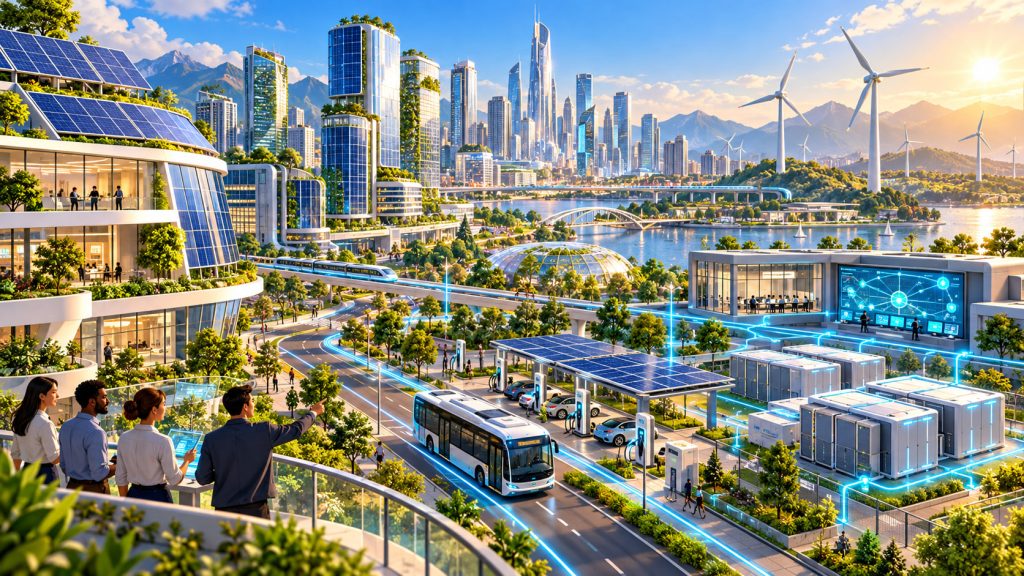
Imagine a city where skyscrapers generate electricity, electric vehicles help balance the power grid, and intelligent systems automatically reduce energy waste.
This vision is becoming increasingly realistic.
As urban populations grow, cities must provide reliable electricity, heating, cooling, and transportation while reducing pollution and greenhouse gas emissions.
Traditional energy infrastructure alone cannot meet all these demands efficiently.
The cities of the future will depend on a combination of renewable energy, intelligent power networks, advanced storage technologies, and energy-efficient buildings.
The greatest transformation will not come from one revolutionary invention, but from connecting multiple technologies into a coordinated urban energy system.
Why Future Cities Need a New Energy Strategy
Cities concentrate enormous amounts of economic activity, infrastructure, and energy consumption.
Buildings require electricity for lighting, appliances, elevators, ventilation, and cooling.
Transportation systems need energy to move millions of passengers and goods.
Hospitals, factories, data centers, and communication networks depend on uninterrupted power supplies.
As more vehicles and heating systems become electric, electricity demand is expected to increase in many urban areas.
Future energy systems must deliver more useful services while reducing waste and environmental impacts.
This requires changes in both energy production and consumption.
Solar Power: Turning Buildings Into Power Plants
Solar energy is one of the most accessible renewable technologies for urban environments.
Modern photovoltaic (PV) panels convert sunlight directly into electricity.
They can be installed on rooftops, parking structures, warehouses, and commercial buildings.
Some architects are developing solar-integrated facades, windows, and building materials.
This approach allows cities to generate electricity without requiring every installation to occupy additional land.
Solar power is particularly useful during sunny daytime periods, when air-conditioning demand can also be high.
However, solar generation changes with weather conditions and stops after sunset.
Therefore, urban solar systems must work alongside storage, other electricity sources, and reliable power networks.
Wind Power and Regional Energy Networks
Not every renewable energy source needs to be located inside a city.
Large wind farms can supply urban populations through regional transmission networks.
Offshore wind turbines are particularly important for coastal regions with favorable wind conditions.
Countries such as Denmark and the United Kingdom have invested heavily in offshore wind energy.
Combining geographically dispersed solar and wind installations helps reduce dependence on the weather at any single location.
Cities may also obtain electricity from hydropower, geothermal facilities, nuclear plants, and other low-carbon sources.
A diversified electricity supply makes urban energy systems more flexible and reliable.
Smart Grids: The Nervous System of Future Cities
Traditional electrical networks were designed primarily to transport power from large generating stations to consumers.
Future networks must coordinate electricity flowing in multiple directions.
A smart grid uses digital monitoring, communication systems, and automated controls to improve electricity distribution.
It can coordinate solar installations, batteries, electric vehicles, and conventional power stations.
For example, intelligent systems can identify unusual electricity demand and adjust certain operations to reduce stress on the network.
Another important feature is demand response.
This approach encourages or automatically shifts electricity consumption away from periods of high demand.
Large buildings might temporarily adjust cooling systems, while electric vehicles charge when electricity is plentiful.
These measures can reduce the need for expensive additional generating capacity.
Energy Storage: Keeping the Lights On After Sunset
Renewable energy production does not always match electricity demand.
Solar panels generate power during daylight, while residential consumption often increases in the evening.
A battery energy storage system (BESS) stores electricity and releases it when needed.
Large battery installations can respond rapidly to changes in grid conditions.
They can also help maintain electricity supply during short disruptions.
However, batteries are not the only storage solution.
Other technologies include:
- Pumped-storage hydropower
- Compressed-air energy storage
- Underground thermal storage
- Hydrogen-based energy systems
Each technology serves different durations, capacities, and economic requirements.
Heating and Cooling Without Wasting Energy
Buildings consume substantial energy maintaining comfortable indoor temperatures.
One promising technology is the heat pump.
Instead of generating heat through combustion, a heat pump transfers thermal energy between indoor and outdoor environments.
Efficient systems can deliver several units of heat for every unit of electricity consumed.
Another solution is district heating.
In this system, a central facility distributes hot water or steam through insulated pipes to multiple buildings.
Copenhagen is a prominent example, with district heating serving approximately 98% of the city’s heating demand.
Modern district heating systems can incorporate geothermal energy, large heat pumps, and recovered industrial heat.
Turning Waste Heat Into Useful Energy
Cities produce enormous quantities of unused heat.
Data centers, industrial facilities, wastewater systems, and commercial refrigeration equipment release thermal energy during operation.
Instead of allowing this energy to escape, cities can capture and reuse it.
For example, waste heat from a data center can be transferred into a district heating network.
Engineers are also developing seasonal thermal storage systems.
These systems store thermal energy for weeks or months, potentially using large insulated water reservoirs, underground rock formations, or aquifers.
Heat collected during warmer periods can then help meet winter demand.
This reduces the need to generate every unit of heating energy immediately before it is consumed.
Electric Vehicles as Part of the Energy System
Electric transportation is becoming increasingly important in urban planning.
Electric buses, trains, cars, and delivery vehicles can reduce local exhaust emissions.
Shenzhen, China, became a major example when it completed the electrification of its fleet of approximately 16,000 public buses in 2017.
Future transportation networks may become even more closely integrated with electricity infrastructure.
One promising concept is vehicle-to-grid (V2G) technology.
It allows suitably equipped electric vehicles to return stored electricity to the grid when needed.
A large network of parked vehicles could potentially provide temporary energy support during periods of high demand.
However, widespread implementation requires compatible vehicles, charging equipment, regulations, and economic incentives.
Microgrids: Making Neighborhoods More Independent
A microgrid is a local energy network capable of coordinating electricity generation, storage, and consumption.
Some microgrids can disconnect from the larger power system and continue operating independently.
This capability is particularly valuable for hospitals, emergency facilities, and critical infrastructure.
For example, a neighborhood could combine rooftop solar panels, batteries, and backup generators.
During a regional power outage, the microgrid could prioritize essential services.
Such systems contribute to urban energy resilience, the ability to withstand disruptions and recover reliable energy services.
Expert Perspective: Efficiency Comes Before Expansion
Energy researcher Amory Lovins, co-founder of the Rocky Mountain Institute, has long emphasized the importance of improving energy efficiency before investing in additional energy supply.
His work demonstrates how better building design, efficient equipment, and integrated planning can reduce the amount of energy needed to deliver the same services.
This principle has major implications for future cities.
A well-insulated building with efficient heating and cooling requires less electricity than a poorly designed building of similar size.
Lower demand can reduce the cost of renewable generation, storage, and grid infrastructure.
The cheapest and cleanest energy is often the energy that cities can avoid wasting.
What Will a Fully Integrated Energy City Look Like?
A future sustainable city could combine multiple technologies into one coordinated system.
Buildings would produce some of their own electricity, while regional renewable power stations supply additional energy.
Smart grids would automatically coordinate batteries, charging stations, heating systems, and industrial demand.
Recovered heat would warm buildings, and local microgrids would protect critical services.
Artificial intelligence could improve forecasting by analyzing weather, consumption patterns, and equipment performance.
However, digital systems would also require cybersecurity protection and robust backup arrangements.
The future of urban energy is not simply about generating more electricity, but about managing energy intelligently across the entire city.
Interesting Facts
- Copenhagen’s district heating network supplies approximately 98% of the city’s heating demand.
- Shenzhen completed the electrification of its approximately 16,000 public buses in 2017.
- Modern heat pumps can deliver several times more heating energy than the electricity they consume.
- Solar panels can be integrated into building facades, rooftops, and certain architectural materials.
- Electric vehicles equipped with bidirectional charging technology can potentially supply electricity back to buildings or power grids.
- Some thermal storage systems can preserve useful heat for several months.
- Data centers can provide recoverable waste heat for surrounding buildings.
- Microgrids can keep essential facilities operating during some wider electricity network disruptions.
Glossary
- Photovoltaic (PV) Panels — Devices that convert sunlight directly into electricity using semiconductor materials.
- Smart Grid — An electricity network that uses digital technologies to monitor, coordinate, and optimize energy distribution.
- Demand Response — The adjustment of electricity consumption according to grid conditions or economic signals.
- Battery Energy Storage System (BESS) — Equipment that stores electrical energy in batteries for later use.
- Heat Pump — A device that transfers heat between environments using electricity.
- District Heating — A centralized system that distributes thermal energy to multiple buildings through a network of pipes.
- Seasonal Thermal Storage — Technology that stores heat or cold for extended periods, potentially lasting several months.
- Vehicle-to-Grid (V2G) — Technology that enables compatible electric vehicles to transfer electricity back into the power network.
- Microgrid — A local electricity system that can manage its own generation, storage, and consumption, sometimes independently of the main grid.
- Energy Resilience — The ability of an energy system to withstand disruptions and restore reliable operation.