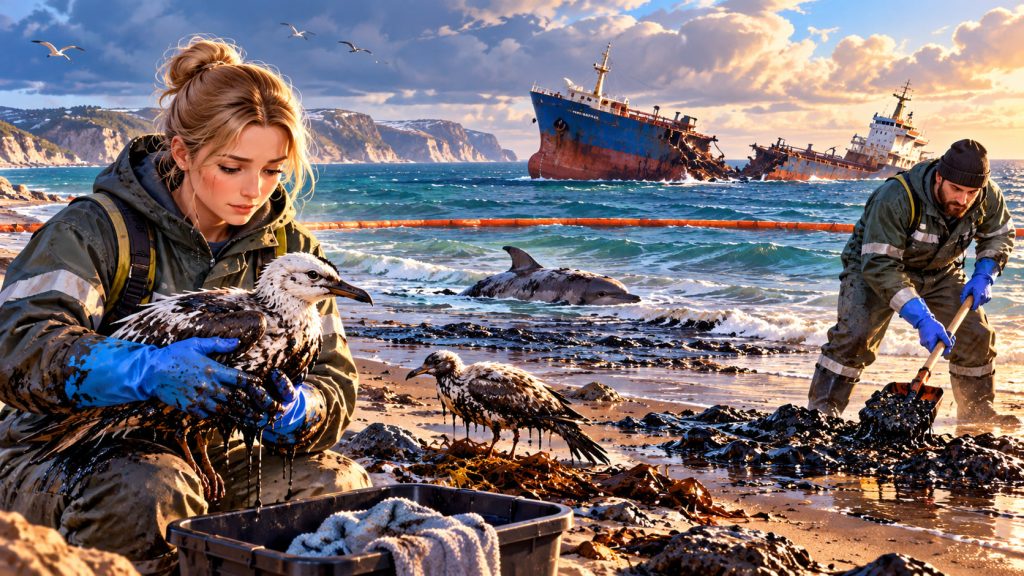
In December 2024, a devastating oil spill struck the Black Sea near the Crimean Peninsula, creating one of the region’s most serious environmental emergencies in recent years.
Two Russian oil tankers were damaged during a powerful winter storm, releasing thousands of tonnes of petroleum products into the sea.
Black oil washed onto beaches, contaminated coastal habitats, and threatened seabirds, dolphins, and marine ecosystems.
The disaster extended far beyond the original accident site, affecting coastal areas of Crimea and the neighboring Russian coastline.
The Crimean oil spill demonstrated how a single maritime accident can cause environmental damage lasting far longer than the storm that triggered it.
What Happened in the Kerch Strait?
On December 15, 2024, two aging tankers, Volgoneft-212 and Volgoneft-239, encountered severe weather near the southern entrance to the Kerch Strait.
This narrow waterway connects the Black Sea with the Sea of Azov and separates Crimea from Russia’s Taman Peninsula.
Both vessels suffered catastrophic structural damage.
Volgoneft-212 broke apart and sank, while Volgoneft-239 also broke into sections, with part of the vessel eventually running aground.
One crew member died during the disaster.
The tankers were transporting mazut, a dense petroleum product commonly used as industrial and marine fuel.
Estimates of the amount released have varied, generally ranging from approximately 2,400 to 5,000 tonnes.
Why Was the Oil Particularly Dangerous?
Mazut belongs to the category of heavy fuel oil.
Unlike gasoline or lighter petroleum products, it contains large hydrocarbon molecules and has a thick, sticky consistency.
Its viscosity increases significantly in cold conditions, making it difficult to pump, collect, or remove from contaminated surfaces.
The spilled material also contained substances such as polycyclic aromatic hydrocarbons (PAHs), some of which can harm marine organisms.
Depending on water temperature, density, and mixing with sediments, heavy fuel oil may float, remain suspended in the water, or accumulate near the seabed.
This behavior makes heavy fuel oil spills especially challenging because pollution can remain hidden underwater and reappear much later.
How the Oil Spread Across the Black Sea
Immediately after the accident, oil began spreading through the surrounding waters.
Wind, waves, and currents transported the pollution away from the damaged tankers.
An oil slick is a layer or patch of petroleum spreading across the water’s surface.
The first major coastal contamination appeared near Anapa, a resort city on Russia’s Black Sea coast, within days of the accident.
Subsequently, oil pollution was reported along parts of Crimea, including areas near Kerch, Feodosiya, and Sevastopol.
Some contamination traveled much farther across the northern Black Sea.
Researchers used satellite observations to track changing patterns of pollution.
The disaster became a regional environmental problem rather than an isolated shipping accident.
What Happened to Marine Wildlife?
Oil contamination can threaten almost every level of a coastal ecosystem.
Seabirds are particularly vulnerable because petroleum damages the structure of their feathers.
Affected birds lose waterproofing and insulation, increasing the risk of hypothermia.
They may also swallow toxic substances while attempting to clean themselves.
Thousands of oil-contaminated birds were reported along affected coastlines.
Marine mammals, including dolphins and porpoises, also became a major concern. Some stranded animals were examined, although determining precisely which deaths resulted from the spill is difficult.
Oil can also damage plankton, fish eggs, shellfish, and organisms living on the seabed.
These interconnected species form the marine food web, through which energy and nutrients pass between organisms.
Why Beaches Became Heavily Contaminated
As the pollution reached shore, it mixed with sand, seaweed, and coastal sediments.
Some petroleum formed sticky lumps known as tar balls.
These can be buried in sand and later exposed by waves or changes in coastal conditions.
The contamination was particularly troublesome for sandy recreational beaches.
Polluted sediment often had to be collected manually or removed using specialized equipment.
In early 2025, cleanup operations involved the removal of well over 100,000 tonnes of contaminated sand and soil from affected Russian coastal areas.
This figure represents polluted material collected during cleanup, not the amount of oil originally spilled.
The coastline could appear clean temporarily while additional petroleum remained offshore.
The Massive Cleanup Operation
Emergency workers, environmental specialists, and thousands of volunteers participated in the response.
Teams removed contaminated sand, collected petroleum deposits, and attempted to protect vulnerable coastal locations.
Floating barriers called oil booms were deployed in selected areas to help contain oil near the water’s surface.
However, heavy storms and the unusual physical properties of mazut complicated recovery.
Underwater petroleum deposits were especially difficult to locate and remove.
Cleanup crews also faced possible exposure to harmful substances, making protective equipment important.
The operation required repeated cleaning because waves and changing temperatures could bring previously hidden petroleum back onto beaches.
Expert Perspective: Why the Damage May Persist
Marine ecologists Dr. Dimitar Berov and Associate Professor Ventsislav Karamfilov of the Bulgarian Academy of Sciences examined the potential ecological consequences of the accident.
Their assessment emphasized the importance of understanding how petroleum changes its chemical properties and concentrations after entering the marine environment.
Different marine habitats and organisms experience different levels of exposure.
Another important process is secondary contamination, which occurs when previously deposited pollution becomes mobile again.
This can happen when storms disturb contaminated sediments or warming water changes the behavior of heavy fuel oil.
The scientific implication is significant: removing visible oil from beaches does not necessarily mean the marine ecosystem has fully recovered.
What Did Scientists Discover During 2025?
Researchers continued monitoring the affected waters throughout 2025.
Satellite-based remote sensing helped identify pollution patterns that were difficult to observe directly from shore.
Studies detected additional slicks months after the original disaster.
Water samples collected in the Kerch Strait during spring 2025 also revealed elevated petroleum-related hydrocarbon concentrations at several monitoring stations.
Some measurements exceeded the applicable environmental threshold.
Other observations indicated that natural weathering and microbial processes were gradually transforming portions of the spilled oil.
However, pollution persisted in certain sediments and coastal areas.
These findings demonstrated that recovery was uneven and required continued monitoring.
Economic and Environmental Consequences
The Black Sea coastline supports tourism, fishing, maritime trade, and recreational activities.
Oil contamination can affect all these sectors.
Beaches may require restrictions or repeated inspections, while fishing activities can face uncertainty over seafood quality and ecosystem conditions.
Coastal businesses may experience reduced visitor confidence even after visible contamination decreases.
Environmental restoration also involves substantial labor, equipment, transportation, and waste disposal costs.
The longer-term effects depend on the amount of petroleum remaining, its chemical composition, and the condition of affected habitats.
Could Another Disaster Happen?
The accident raised important questions about tanker safety and maritime operations.
Both vessels belonged to an aging tanker series originally developed for river and nearshore transportation.
Severe weather placed extraordinary stress on their structures.
The disaster highlighted several essential safety priorities:
- Regular inspection of aging vessels
- Appropriate restrictions during dangerous weather
- Effective emergency response equipment
- Continuous monitoring of maritime traffic
- International cooperation on marine pollution
The Black Sea is a shared marine ecosystem, making the consequences of major accidents relevant to multiple coastal countries.
Preventing future disasters requires stronger vessel safety, effective spill-response planning, and long-term environmental monitoring.
Interesting Facts
- The tanker accident occurred on December 15, 2024, during a powerful winter storm.
- Both vessels belonged to the Volgoneft tanker series, originally designed for transporting petroleum products on rivers and nearby seas.
- Heavy fuel oil can form underwater deposits rather than remaining entirely on the surface.
- Some petroleum pollution reached coastal areas hundreds of kilometers from the original accident site.
- Thousands of volunteers participated in cleaning contaminated beaches.
- Removing polluted sand can produce far more waste by weight than the quantity of petroleum originally released.
- Satellite observations revealed recurring oil pollution long after the initial accident.
- The Kerch Strait experienced another major tanker-related oil spill in November 2007.
Glossary
- Kerch Strait — A narrow maritime passage connecting the Black Sea with the Sea of Azov.
- Mazut — A dense residual petroleum fuel commonly used in industrial and marine applications.
- Heavy Fuel Oil — A thick petroleum product containing relatively heavy hydrocarbon fractions.
- Viscosity — A measurement of a fluid’s resistance to flowing.
- Polycyclic Aromatic Hydrocarbons (PAHs) — A group of organic compounds found in petroleum and other materials, some of which are toxic.
- Oil Slick — A patch or layer of petroleum spreading across the surface of water.
- Marine Food Web — The interconnected feeding relationships among organisms in a marine ecosystem.
- Tar Balls — Sticky lumps of weathered petroleum that can float, sink, or wash onto beaches.
- Oil Booms — Floating barriers used to contain or redirect petroleum during spill-response operations.
- Secondary Contamination — The renewed spread of previously deposited pollutants into surrounding environments.
- Remote Sensing — The collection of environmental information from a distance, often using satellites or aircraft.