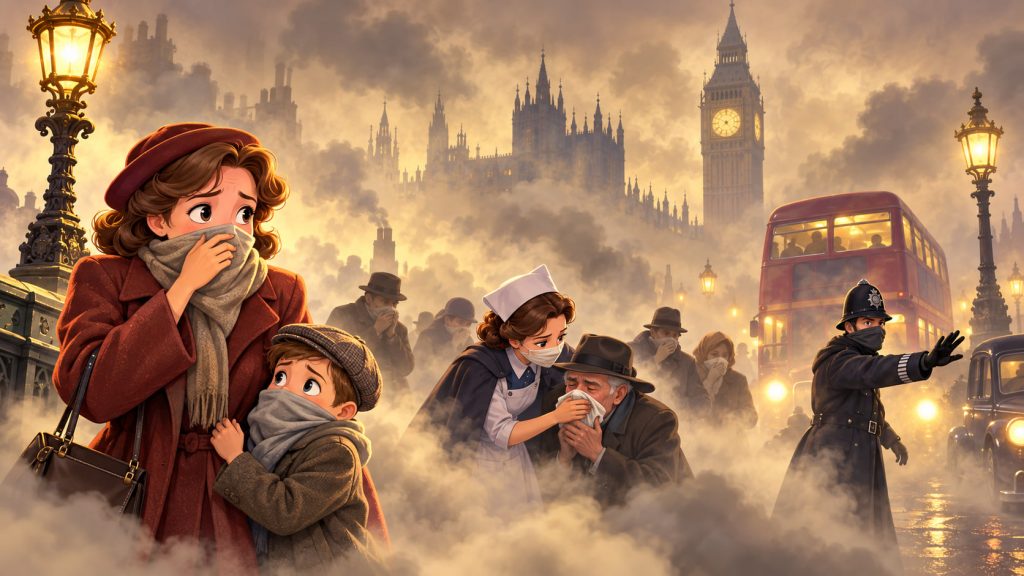
In December 1952, London experienced one of the deadliest air pollution disasters in modern history.
For five days, a thick, yellowish-black fog engulfed the British capital. Streets disappeared into darkness, transportation collapsed, and thousands of residents developed severe breathing difficulties.
What initially appeared to be an unusually dense winter fog became a public health catastrophe.
The event, remembered as the Great Smog of London, caused approximately 4,000 deaths according to early estimates. Later research suggested that the total death toll may have reached 12,000.
The disaster fundamentally changed how governments understood air pollution and helped establish modern environmental protection laws.
London Before the Great Smog
By the early 1950s, London was already famous for its polluted atmosphere.
For centuries, residents had burned coal to heat homes, power factories, and support industrial development.
The resulting smoke frequently mixed with natural fog, creating a phenomenon popularly known as a “pea-souper.”
These thick, dirty fogs had become an almost ordinary feature of London’s winters.
Following World War II, Britain continued relying heavily on coal. Many households burned relatively low-quality fuel, while factories and power stations produced additional emissions.
London’s familiar winter fog was therefore often a mixture of water droplets, soot, and industrial pollutants.
What Happened in December 1952?
On December 5, 1952, cold weather settled over London.
Residents burned additional coal to keep their homes warm, increasing the amount of smoke entering the atmosphere.
At the same time, a stationary anticyclone created unusually calm weather conditions.
Normally, rising air and moving winds help disperse pollution.
However, a temperature inversion developed above the city.
Instead of temperature decreasing steadily with altitude, a layer of warmer air trapped colder air near the ground.
This prevented smoke and other pollutants from escaping.
London had effectively become a giant atmospheric container filled with toxic emissions.
The dense smog persisted from December 5 to December 9, when changing weather conditions finally dispersed it.
Why Was the Smog So Dangerous?
The Great Smog was far more hazardous than ordinary fog.
Coal combustion released enormous quantities of sulfur dioxide, a gas that irritates the respiratory system.
Burning coal also produced soot and fine particulate matter, including particles small enough to penetrate deep into the lungs.
Inside the polluted fog, chemical reactions transformed some sulfur dioxide into sulfate-rich acid aerosols.
These microscopic droplets increased the toxicity of the already contaminated air.
The dangerous mixture included:
- Coal smoke and soot
- Sulfur dioxide
- Fine airborne particles
- Acidic droplets
- Other combustion-related pollutants
The combination of extremely high pollution levels and prolonged exposure made breathing increasingly difficult.
When London Disappeared Into Darkness
Visibility deteriorated dramatically as the smog thickened.
In some locations, people could barely see objects a meter away.
Drivers abandoned vehicles, buses struggled to operate, and pedestrians became disoriented on familiar streets.
Public transportation was severely disrupted.
Even indoor spaces were affected.
Smoke entered buildings through doors, windows, and ventilation systems.
Some theaters and cinemas experienced enough indoor pollution to interfere with performances and screenings.
The city continued functioning in limited ways, but everyday life became extraordinarily difficult.
One of the world’s largest and most developed cities was nearly paralyzed by polluted air.
The Human Cost of the Great Smog
The most devastating consequences appeared in London’s hospitals and homes.
Thousands of residents experienced coughing, chest pain, breathlessness, and worsening respiratory illness.
People with existing lung and heart conditions were particularly vulnerable.
Hospital admissions increased as the polluted atmosphere aggravated diseases such as bronchitis and pneumonia.
Children, older adults, and people with chronic medical conditions faced especially serious risks.
Early government assessments attributed approximately 4,000 additional deaths to the disaster.
However, later investigations suggested the actual mortality impact was substantially greater.
Modern estimates commonly place the total at around 12,000 premature deaths, with approximately 100,000 people becoming ill.
These figures made the Great Smog one of the most serious documented air pollution disasters in history.
Why Did So Many People Die?
The tragedy resulted from several dangerous factors occurring simultaneously.
First, the concentration of pollutants became exceptionally high.
Second, the smog remained trapped over London for several consecutive days.
Third, many residents continued encountering polluted air both outdoors and inside their homes.
Finally, existing respiratory and cardiovascular illnesses made large sections of the population vulnerable.
Fine particles and acidic pollutants damaged the respiratory system and placed additional stress on the heart and lungs.
The danger came not from a single poisonous substance, but from prolonged exposure to a concentrated mixture of harmful emissions.
Expert Perspective: Understanding the Hidden Death Toll
Environmental health researcher Michelle L. Bell and her colleagues examined the Great Smog decades after the disaster.
Their research helped clarify why the original death estimates did not fully represent the event’s consequences.
One important issue was that pollution-related deaths could occur after the densest fog had disappeared.
Examining mortality patterns over a longer period revealed a much larger health burden than initial assessments suggested.
This research contributed to the modern understanding that the health consequences of severe air pollution can extend well beyond the immediate pollution episode.
The findings also reinforced the importance of monitoring both short-term and delayed health effects.
How the Disaster Changed British Environmental Laws
The Great Smog created enormous public pressure for government action.
In response, British authorities investigated the causes of urban air pollution and potential solutions.
The resulting reforms helped produce the landmark Clean Air Act of 1956.
This legislation introduced important measures to reduce smoke emissions.
One major development was the establishment of smoke control areas.
Within these designated zones, restrictions on smoke emissions encouraged households and businesses to use cleaner heating methods and approved fuels.
The legislation also addressed industrial emissions and encouraged changes to urban heating practices.
Although pollution did not disappear overnight, the reforms gradually improved Britain’s urban air quality.
Did London Experience Another Great Smog?
London continued experiencing severe pollution episodes after 1952.
A particularly serious event occurred in December 1962, demonstrating that the problem had not been solved immediately.
However, changes in fuel consumption, industrial practices, heating systems, and environmental regulations gradually reduced the frequency of traditional coal-smoke fogs.
Natural gas and electricity increasingly replaced domestic coal burning.
By the following decades, the notorious black winter smogs had become much less common.
Nevertheless, London still faces modern air pollution challenges involving road traffic, nitrogen dioxide, and fine particles.
Today’s problems differ from the coal-dominated pollution of the 1950s, but protecting urban air quality remains essential.
Why the Great Smog Still Matters Today
The London disaster became a defining moment in environmental history.
It demonstrated that air pollution could cause massive loss of life even without an industrial explosion, chemical spill, or other obvious accident.
The event also revealed the importance of collecting environmental measurements, studying public health trends, and establishing effective regulations.
Many cities worldwide still face dangerous pollution from transportation, industrial activity, household fuels, and electricity generation.
The Great Smog provides a powerful historical example of how environmental conditions can become a direct threat to human survival.
Its lasting legacy is the recognition that clean air is an essential requirement for public health, not simply an environmental luxury.
Interesting Facts
- The Great Smog lasted from December 5 to December 9, 1952.
- Visibility became so poor that pedestrians sometimes struggled to find their way through familiar neighborhoods.
- London’s famous “pea-souper” fogs had existed long before the 1952 disaster.
- Some indoor entertainment venues were disrupted because polluted air entered their buildings.
- Early estimates recorded approximately 4,000 deaths, while later research suggested around 12,000.
- The disaster directly influenced the development of Britain’s Clean Air Act of 1956.
- Another major London smog episode occurred in December 1962.
- The disappearance of London’s traditional black fogs was closely associated with cleaner fuels and improved air pollution controls.
Glossary
- Anticyclone — A large atmospheric high-pressure system often associated with calm, stable weather.
- Temperature Inversion — An atmospheric condition in which warmer air sits above cooler air, potentially trapping pollution near the ground.
- Sulfur Dioxide — A harmful gas produced during the combustion of sulfur-containing fuels, including coal.
- Particulate Matter — Tiny solid particles and liquid droplets suspended in the atmosphere that can affect human health.
- Acid Aerosols — Microscopic airborne droplets containing acidic substances formed through atmospheric chemical reactions.
- Bronchitis — Inflammation of the bronchial tubes that can cause coughing, mucus production, and breathing difficulties.
- Mortality — The occurrence or rate of deaths within a population during a specified period.
- Clean Air Act — Legislation designed to regulate air pollution and reduce harmful emissions.
- Smoke Control Areas — Designated locations where restrictions on smoke emissions help improve air quality.