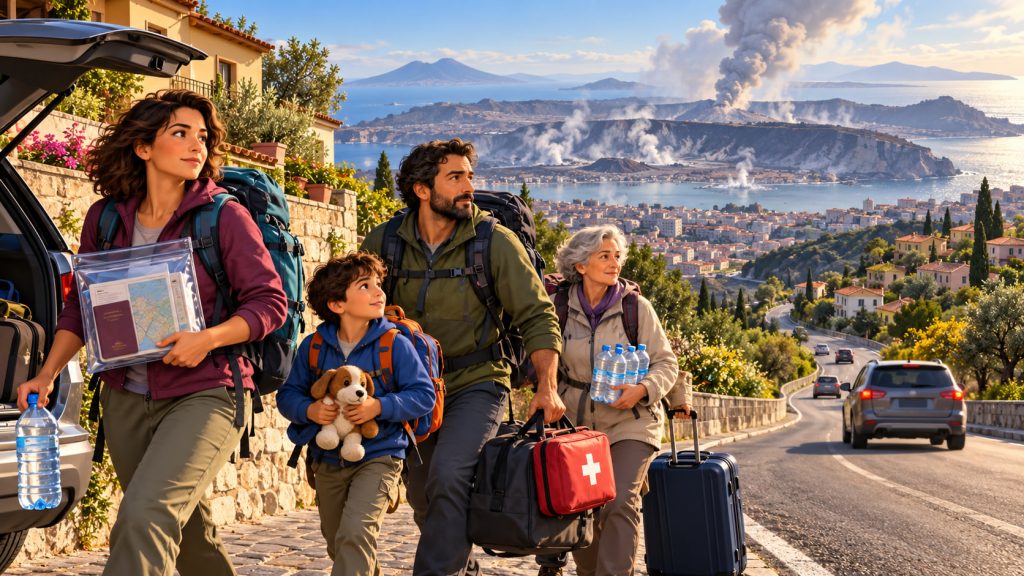
Campi Flegrei, also known as the Phlegraean Fields, is one of Europe’s most closely monitored volcanic regions. Located near Naples, Italy, this enormous volcanic system lies beneath densely populated towns and residential neighborhoods.
Hundreds of thousands of people live in areas potentially exposed to volcanic hazards, including earthquakes, ashfall, dangerous gases, and explosive eruptions.
Unlike a typical cone-shaped volcano, Campi Flegrei is a vast caldera formed by ancient volcanic activity.
Scientists continuously monitor the area, but accurately predicting when an eruption might occur remains extremely difficult.
For residents living inside the official volcanic red zone, the most important long-term safety strategy is to consider relocating to housing outside the danger zone well before an eruption emergency develops.
Preparing early provides more options than waiting until thousands of people must evacuate simultaneously.
Why Campi Flegrei Is Particularly Dangerous
Campi Flegrei is sometimes described as a supervolcano because of its enormous ancient eruptions.
However, this description does not mean that a future eruption would necessarily be catastrophic on the same scale.
Volcanologists consider smaller eruptions more likely than another exceptionally large event.
Nevertheless, even a relatively limited eruption could seriously threaten populated areas.
Potential hazards include:
- Extremely hot volcanic flows
- Falling volcanic ash
- Earthquakes and structural damage
- Dangerous volcanic gases
- Disruption of transportation and electricity
- Damage to buildings and infrastructure
The greatest danger near a potential eruption site comes from fast-moving volcanic material that can make survival impossible in exposed areas.
Understanding the Red and Yellow Danger Zones
Italian authorities have established official volcanic hazard zones around Campi Flegrei.
The red zone includes territory exposed to potentially devastating volcanic phenomena, particularly pyroclastic flows.
These are rapidly moving mixtures of hot gases, ash, and volcanic fragments.
The red zone includes Pozzuoli, Bacoli, Monte di Procida, Quarto, parts of neighboring municipalities, and several districts of Naples.
Approximately 500,000 people live within its boundaries.
The yellow zone covers areas where significant volcanic ash accumulation could create serious problems.
Ash can damage roofs, disrupt transportation, contaminate equipment, and affect breathing.
Living outside the red zone reduces exposure to its most dangerous mapped eruption hazards, but it does not guarantee complete protection from ashfall or other consequences.
Residents should verify their exact address against official hazard maps because municipal boundaries do not always match volcanic danger zones.
The Best Precaution: Arrange Housing Outside the Red Zone in Advance
For households with the resources and flexibility to relocate, the strongest precaution is to find alternative housing outside the official red zone before an eruption warning forces a mass evacuation.
This might involve moving permanently, renting a property elsewhere, arranging accommodation with relatives, or securing a temporary residence.
When selecting accommodation, consider locations beyond both the red zone and the main mapped ashfall hazard area whenever practical.
An appropriate destination should offer reliable transportation, healthcare, schools, and basic services.
Early relocation has several advantages:
- Avoiding crowded evacuation routes
- Reducing uncertainty about accommodation
- Protecting children and vulnerable relatives
- Maintaining access to medication and essential services
- Allowing more time to move documents and valuable possessions
- Reducing dependence on last-minute transportation
Do not assume that remaining in the red zone until the final emergency announcement is the safest or most convenient strategy.
Voluntary relocation is a personal precaution, not a claim that an eruption is imminent. Residents should make informed decisions based on official information, household circumstances, and available resources.
Why Waiting Until the Last Moment Can Be Dangerous
The official emergency plan includes a large-scale preventive evacuation of the red zone if the volcanic alarm phase is declared.
The planned evacuation operation is estimated to require 72 hours.
This includes preparation, organized departures, and a final safety margin.
However, this is a planning estimate rather than a guarantee that every eruption will provide three days of warning.
Road congestion, infrastructure damage, earthquakes, or unexpectedly rapid volcanic developments could complicate an evacuation.
Households that have already arranged somewhere safe to stay may be better positioned to leave promptly when appropriate.
How to Create a Personal Evacuation Plan
Every household living near Campi Flegrei should prepare a written evacuation plan.
Identify where family members will go, how they will travel, and how they will communicate if mobile networks become unreliable.
Consider at least two potential departure routes, while following official traffic instructions during an organized evacuation.
Prepare arrangements for elderly relatives, people with disabilities, children, and pets.
Keep important documents, prescription medications, cash, and essential belongings accessible.
Families without private transportation should learn where official assisted evacuation collection points are located.
Everyone in the household should know the destination and what to do if family members become separated.
Prepare an Emergency Survival Bag
A ready-to-carry emergency kit can make departure faster and less stressful.
Recommended supplies include:
- Drinking water and nonperishable food
- Prescription medications and basic first-aid supplies
- Passports and important documents
- Flashlights and spare batteries
- Battery-powered radio
- Mobile phone chargers and power banks
- Protective masks and safety glasses
- Sturdy shoes and spare clothing
- Essential supplies for children and pets
Keep the bag somewhere accessible and inspect its contents periodically.
Do not delay evacuation to collect unnecessary possessions.
Earthquakes and Ground Movement Before an Eruption
Campi Flegrei experiences bradyseism, a phenomenon involving gradual ground uplift or subsidence associated with changes in underground pressure.
This process can produce earthquakes and contribute to structural damage.
Periods of seismic activity do not automatically mean an eruption is approaching.
However, earthquakes represent a genuine hazard even without an eruption.
During strong shaking, drop to the ground, take cover under sturdy furniture, and hold on until the shaking stops.
Afterward, inspect your surroundings for hazards and follow emergency instructions.
Residents of vulnerable buildings should seek qualified structural assessments rather than waiting for visible damage to become severe.
What to Do During Volcanic Ashfall
An explosive eruption may produce an ash plume that carries volcanic particles into the atmosphere.
Wind can transport ash far beyond the eruption site.
During significant ashfall, stay indoors when authorities advise it, close windows, and reduce the entry of outside air.
If going outdoors is unavoidable, suitable particulate respirators such as FFP2 or N95 masks can reduce inhalation of airborne ash.
Protective glasses are useful because volcanic ash can irritate the eyes.
Avoid unnecessary driving, since ash reduces visibility and can damage vehicle engines.
Heavy ash accumulation on roofs can become particularly dangerous when wet.
Never attempt hazardous roof cleaning during an eruption or unstable weather conditions.
Why You Cannot Simply Shelter From Pyroclastic Flows
Pyroclastic flows are among the deadliest volcanic phenomena.
Their extreme temperatures, speed, and destructive force make ordinary homes, basements, and vehicles unreliable shelters.
This is why Italian emergency planning identifies evacuation as the essential protective measure for the red zone when an eruption alarm is declared.
If an evacuation order is issued, leave according to official instructions. Do not remain inside the red zone hoping that your building will protect you.
Trying to outrun an approaching pyroclastic flow after it becomes visible is not a realistic survival strategy.
Expert Perspective: Preparation Is More Reliable Than Prediction
Italy’s National Institute of Geophysics and Volcanology monitors earthquakes, ground deformation, volcanic gases, and other indicators of activity at Campi Flegrei.
Scientific assessments recognize that volcanic unrest can continue for years without producing an eruption.
No single earthquake or ground movement measurement can determine the exact date of a future eruption.
Italy’s Civil Protection emergency strategy therefore emphasizes monitoring, public preparedness, and evacuation planning.
The practical lesson is that residents should prepare for dangerous scenarios without interpreting every earthquake as evidence that an eruption is imminent.
What Residents Should Do Now
People living in or near Campi Flegrei can take meaningful precautions before any emergency declaration.
First, establish whether their home lies inside the official red zone, yellow zone, or an area affected by bradyseismic hazards.
Next, identify possible accommodation outside the highest-risk areas.
Discuss relocation arrangements with relatives or trusted contacts and evaluate the costs of maintaining a temporary or permanent alternative residence.
Keep vehicles maintained, emergency supplies ready, and family contact information updated.
Follow official monitoring updates and participate in community evacuation exercises.
For residents who can reasonably arrange it, securing a safe place to live outside the red zone in advance is one of the most effective ways to reduce dependence on a difficult last-minute evacuation.
P.S. If disaster strikes and things do not go according to the climatologists’ projections, a great many people could perish; therefore, preparing in advance and moving far away from the vent of a supervolcano and its surrounding area could prove to be one of the most important decisions you ever make for yourself and your family.
Interesting Facts
- Campi Flegrei is a volcanic caldera rather than a single cone-shaped mountain.
- The volcanic system experienced enormous eruptions tens of thousands of years ago.
- Its most recent eruption occurred in 1538 and formed Monte Nuovo.
- The official volcanic red zone contains approximately half a million residents.
- Volcanic ground uplift has affected the Pozzuoli area during several historical periods.
- The emergency evacuation plan for the red zone is organized around a 72-hour operation.
- Volcanic ash consists of fragmented rock, minerals, and volcanic glass rather than the soft residue produced by burning wood.
- A future eruption would not necessarily be a supereruption.
- Extended volcanic unrest can occur without an eruption, making continuous monitoring and advance preparation particularly important.
Glossary
- Caldera — A large volcanic depression formed when the ground collapses following the evacuation of substantial amounts of magma.
- Red Zone — The officially designated area requiring preventive evacuation during a volcanic eruption alarm because of potentially deadly hazards.
- Pyroclastic Flows — Fast-moving, extremely hot mixtures of volcanic gases, ash, and rock fragments.
- Yellow Zone — An officially designated area exposed to significant volcanic ashfall hazards during a potential eruption.
- Preventive Evacuation — The organized movement of people away from a dangerous area before a predicted or anticipated hazardous event.
- Evacuation Plan — A prepared procedure identifying safe destinations, transportation options, and actions during an emergency.
- Emergency Kit — A collection of essential supplies intended to support people during evacuation or temporary disruption of services.
- Bradyseism — Gradual uplift or subsidence of the Earth’s surface associated with pressure changes beneath a volcanic area.
- Ash Plume — A cloud of volcanic ash and gases released into the atmosphere during an eruption.