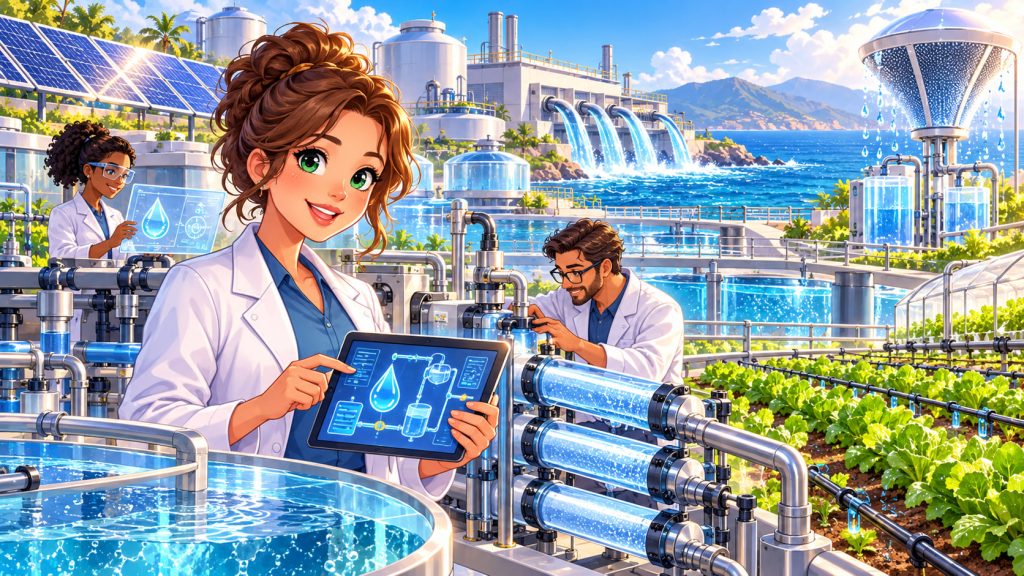
Freshwater is one of the most valuable resources on Earth, yet billions of people live in regions where reliable access to clean water remains a serious challenge.
Growing populations, expanding cities, agricultural demand, pollution, and climate change are placing increasing pressure on rivers, lakes, and underground water reserves.
However, the problem is not simply that the planet is running out of water. Water is constantly circulating through Earth’s natural systems, but freshwater is unevenly distributed, and much of it is difficult or expensive to access.
Modern technology offers powerful opportunities to produce clean water, recycle wastewater, reduce losses, and use existing supplies more efficiently.
From enormous desalination plants to intelligent irrigation systems and machines that extract moisture from the air, several innovations are already transforming how humanity manages its most essential resource.
Desalination: Turning Seawater Into Drinking Water
Oceans contain approximately 97% of Earth’s water, but their high salt concentration makes seawater unsuitable for direct human consumption.
Desalination technology removes dissolved salts and other impurities, producing freshwater suitable for treatment and distribution.
The most widely used modern method is reverse osmosis.
This process forces seawater through specialized membranes that allow water molecules to pass while rejecting most dissolved salts.
Countries such as Israel, Saudi Arabia, and the United Arab Emirates rely heavily on desalination to supplement their freshwater supplies.
Israel’s large seawater desalination facilities demonstrate how membrane technology can provide drinking water at a national scale.
However, desalination requires substantial energy and produces concentrated salty wastewater called brine.
Poorly managed brine discharge can harm marine ecosystems.
Renewable energy, improved membranes, and responsible brine management are making desalination more sustainable and practical.
Wastewater Recycling: Turning Used Water Into a Valuable Resource
One of the most promising solutions involves treating wastewater so thoroughly that it can be safely reused.
Modern purification facilities combine filtration, membranes, and disinfection to remove microorganisms and chemical contaminants.
This approach supports potable water reuse, in which highly treated wastewater becomes part of the drinking water supply.
Singapore provides a major real-world example through its NEWater program.
Its advanced treatment process uses membrane filtration, reverse osmosis, and ultraviolet disinfection to produce exceptionally clean reclaimed water.
In California, the Orange County Groundwater Replenishment System purifies wastewater and uses the treated water to replenish groundwater supplies.
These technologies demonstrate that wastewater does not have to be discarded after one use.
With rigorous treatment, monitoring, and regulation, used water can become a dependable resource again.
Smart Water Networks: Stopping Invisible Water Losses
Water shortages are not always caused by insufficient natural supplies.
Many cities lose substantial quantities of treated water through leaking pipes, damaged infrastructure, and inefficient distribution systems.
Engineers refer to water lost or unaccounted for before reaching paying customers as non-revenue water.
Modern smart networks use sensors, digital meters, and artificial intelligence to identify unusual water consumption patterns.
Pressure sensors and acoustic monitoring equipment can detect signs of underground leakage.
Machine-learning software helps utility operators prioritize repairs and predict which pipes are most likely to fail.
Digital monitoring also allows cities to identify problems before they develop into major disruptions.
Preventing water losses can be considerably cheaper than constructing additional treatment plants or reservoirs.
Precision Agriculture: Growing Food With Less Water
Agriculture accounts for approximately 70% of global freshwater withdrawals.
This makes farming one of the most important areas for water-saving technology.
Traditional irrigation methods can lose considerable water through evaporation, runoff, and inefficient application.
Modern drip irrigation delivers water directly to plant roots through carefully positioned tubes and emitters.
This can significantly reduce water use compared with poorly managed surface irrigation.
Advanced farms also combine soil moisture sensors, weather forecasts, and satellite observations.
These systems estimate when plants actually need water and how much should be applied.
Some agricultural platforms calculate evapotranspiration, the combined movement of water from soil evaporation and plant transpiration.
This helps farmers schedule irrigation more accurately.
However, overall water savings depend on crop choices, local conditions, and whether efficiency improvements lead to expanded cultivation.
Extracting Drinking Water From the Air
The atmosphere contains enormous quantities of water vapor.
New technologies can collect a portion of this moisture and convert it into liquid water.
These systems are collectively known as atmospheric water harvesting.
Some devices cool humid air until water vapor condenses into droplets.
Others use moisture-absorbing materials to capture water vapor and release it when heated.
Researchers are developing advanced materials, including porous structures known as metal-organic frameworks, that can absorb moisture even under relatively dry conditions.
Atmospheric water systems may be useful for remote communities, emergency supplies, and locations without reliable water infrastructure.
Their performance, however, depends heavily on humidity, temperature, and energy availability.
They are generally less practical for supplying entire large cities than conventional water infrastructure.
Solar-Powered Water Purification
Solar energy offers another important opportunity for improving freshwater access.
Solar-powered pumps can transport groundwater or surface water without relying on diesel generators.
Solar electricity can also operate membrane-based purification and desalination systems.
Another promising technology is membrane distillation.
This process uses a temperature difference across a water-repelling membrane to separate water vapor from salty or contaminated water.
Because it can operate with relatively low-temperature heat, researchers are investigating ways to combine it with solar thermal energy and industrial waste heat.
Solar-driven purification systems are particularly attractive for isolated areas where electricity infrastructure is limited.
Their effectiveness depends on system design, maintenance, water quality, and available sunlight.
Underground Water Storage: Saving Water for Dry Periods
Producing more freshwater is only part of the solution.
Communities must also store water efficiently for periods of drought.
Managed aquifer recharge involves deliberately adding water to underground geological formations that naturally store groundwater.
Water may enter through infiltration basins, specially designed wells, or restored natural recharge areas.
Suitable sources can include stormwater and properly treated recycled water.
Underground storage reduces some of the evaporation losses associated with exposed surface reservoirs.
It can also help replenish groundwater reserves depleted by excessive pumping.
Careful monitoring is essential because unsuitable recharge water can contaminate underground supplies.
Artificial Intelligence and the Future of Water Management
Artificial intelligence is becoming increasingly important in water infrastructure.
Computer models can analyze rainfall, river flows, reservoir levels, and consumption patterns to support operational decisions.
Advanced forecasting systems help water managers anticipate drought conditions and adjust storage strategies.
AI can also optimize energy use in treatment facilities and identify abnormalities in water-quality measurements.
Some utilities are developing digital twins, virtual representations of physical water networks that can simulate their behavior.
These models allow engineers to test possible operational changes before implementing them.
The greatest opportunity may come from combining intelligent management with existing infrastructure rather than depending on a single revolutionary invention.
Expert Perspective: Technology Must Work Alongside Conservation
Water scientist Peter Gleick, co-founder of the Pacific Institute, has long emphasized the importance of efficient water use, sustainable management, and protecting freshwater resources.
His work highlights a fundamental principle of water security: expanding supplies is only one part of addressing scarcity.
Reducing waste, improving infrastructure, protecting natural water systems, and managing demand are equally important.
For example, a city that combines wastewater recycling with leak detection and efficient appliances may reduce its need for expensive new water supplies.
The most effective freshwater strategies combine technological innovation, conservation, environmental protection, and responsible public policy.
Can Technology Make Water Scarcity a Thing of the Past?
Modern technology can substantially reduce freshwater shortages, but no single invention can solve every regional water problem.
Coastal cities may benefit greatly from desalination.
Agricultural regions may gain more from precision irrigation and groundwater management.
Dense urban areas can improve resilience through water recycling and smart distribution networks.
Remote communities may benefit from decentralized solar-powered treatment systems.
The right solution depends on geography, water quality, energy availability, infrastructure, and economic resources.
Ultimately, the future of freshwater security will depend on making reliable technologies affordable, maintaining them properly, and using water responsibly.
Interesting Facts
- Approximately 97% of Earth’s water is found in the oceans.
- Modern reverse osmosis membranes can remove the vast majority of dissolved salts from seawater.
- Singapore produces highly purified recycled water for industrial applications and to supplement drinking water resources.
- Some advanced materials can capture water vapor directly from the atmosphere.
- Underground water storage can avoid some evaporation losses experienced by open reservoirs.
- Intelligent leak detection can identify hidden pipeline damage without excavating entire streets.
- Solar-powered water systems can operate in remote locations without conventional electricity connections.
- Agriculture represents the largest share of global freshwater withdrawals.
- Combining water recycling, conservation, and desalination can make cities less dependent on seasonal rainfall.
Glossary
- Desalination — The process of removing dissolved salts from seawater or brackish water to produce freshwater.
- Reverse Osmosis — A membrane-based purification process that uses pressure to separate water from dissolved salts and many contaminants.
- Brine — Highly concentrated salty water produced during desalination.
- Potable Water Reuse — The treatment and use of reclaimed wastewater as part of a drinking water supply.
- Non-Revenue Water — Water supplied to a distribution system that does not generate revenue because of leaks, unauthorized consumption, or measurement errors.
- Drip Irrigation — An irrigation method that delivers controlled amounts of water directly to plant roots.
- Evapotranspiration — The combined loss of water through evaporation from surfaces and transpiration from plants.
- Atmospheric Water Harvesting — The collection of water vapor from air and its conversion into usable liquid water.
- Metal-Organic Frameworks — Porous engineered materials that can capture and release molecules, including water vapor.
- Membrane Distillation — A thermal separation process that transfers water vapor through a water-repelling membrane.
- Managed Aquifer Recharge — The intentional replenishment of underground water-bearing formations.
- Digital Twins — Virtual models of physical systems used to simulate, monitor, and optimize their performance.